‘Lean In and Lead’: Agribusiness Pioneer Ray Goldberg Dies at 99
Ray A. Goldberg, the Harvard Business School professor widely credited with popularizing the concept of agribusiness and reframing agriculture as an integrated global food system, died at 99.
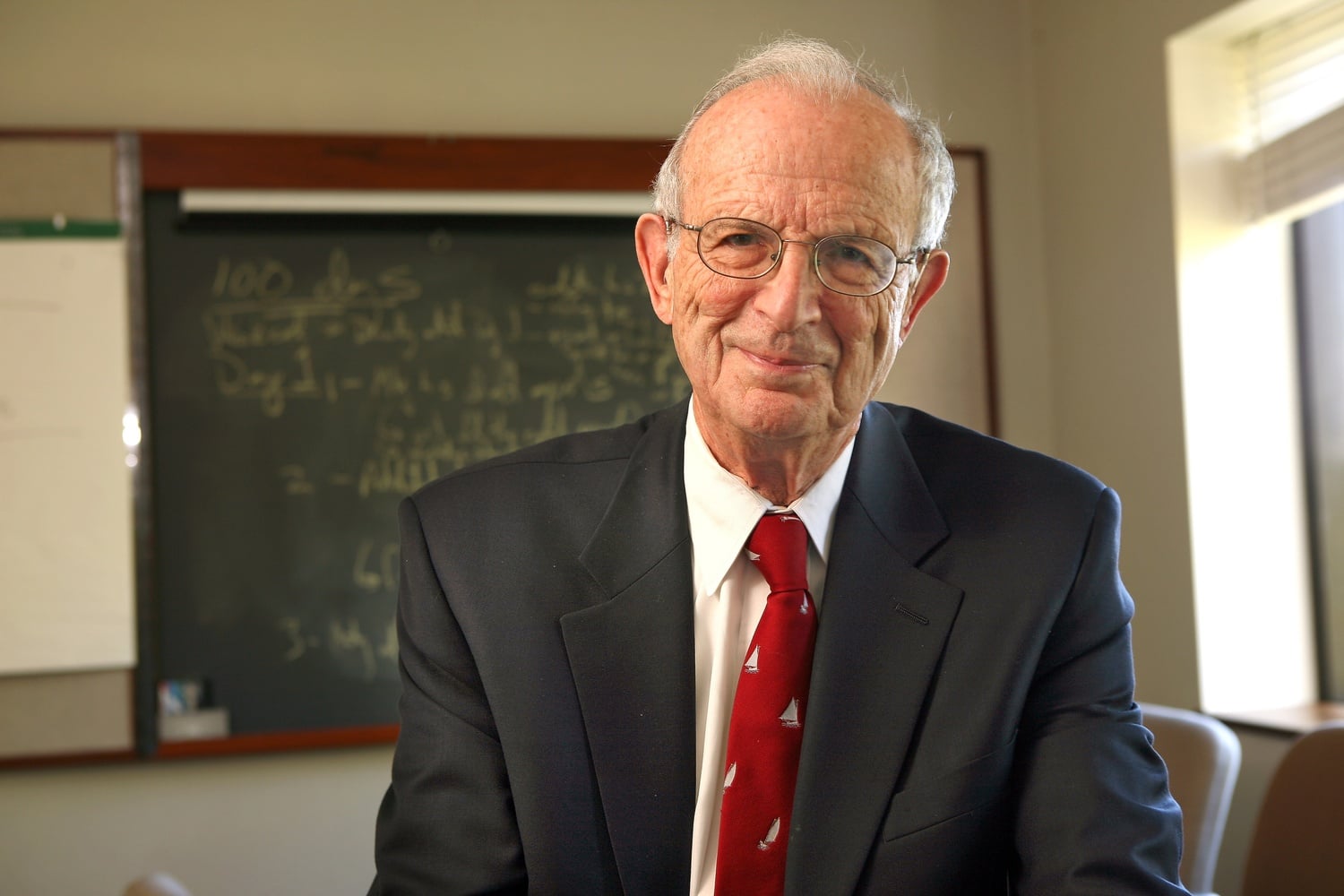
At a conference on the global food system nearly a decade ago, Ray A. Goldberg handed the microphone to an unusual speaker: a 14-year-old girl.
The teenager — the daughter of one of Goldberg’s mentees — addressed an audience of more than 100 executives, academics, and policymakers about how young people viewed the food system. Goldberg listened closely.
“He gave her the whole slot in front of 100 top people,” said Yoav Levsky, the girl’s father and a longtime collaborator of Goldberg’s. “He was genuinely listening and taking a lot of the things that she said and was using that many years afterwards to shape some of his messaging.”
For Levsky, the moment captured Goldberg’s openness to new ideas, even late in life.
“You’re thinking about a person who was already over 90 years old, who had served on many boards and run many case studies and lectures,” he said. “And still he can take and crystalize the message from a young person to shape his own opinion on the global food system.”
Goldberg, a longtime Harvard Business School professor, is widely credited with coining the term “agribusiness.” During a career that spanned more than seven decades, he helped reframe agriculture as an integrated global system.
“The single biggest contribution he made was changing how people thought about agriculture from a series of independent types of operators into an integrated system,” said Marc Goldberg ’79, his son.
At Harvard Business School, Goldberg introduced the school’s first course on agribusiness and later served as the George M. Moffett Professor of Agriculture and Business. Through his scholarship, case studies, and mentorship, he helped establish Harvard as a global center for agribusiness education.
His influence reached far beyond Cambridge. Today, more than 200 agribusiness programs around the world draw on the framework Goldberg helped pioneer.
Goldberg was 99 when he died last month. His wife, Thelma Englander, died in 2015. He is survived by his partner Joan Gordon, three children, six grandchildren, and nine great-grandchildren.
Get The Crimson in your inbox.
Reimagining Agriculture
Goldberg’s interest in agriculture began long before he entered academia. He grew up in Fargo, North Dakota, during the Great Depression in a community shaped by farming and the grain trade. His father operated a grain feeding store that later expanded into a network of grain elevators and a cattle farm, exposing Goldberg to nearly every stage of the agricultural economy.
“My father was exposed to all facets of the agricultural system from basically birth onwards,” Marc Goldberg said. “You were either a farmer, or you were a grain elevator operator, or you were a processor or a distributor, or a retailer.”
But the connection between those roles were rarely articulated.
“In those days it wasn’t thought of as a system,” he said. “Everything was thought of independently.”
That fragmented understanding of agriculture would become the central intellectual problem Goldberg sought to solve.
After graduating from Harvard College in 1948, Goldberg remained at the University to earn a master’s in business administration from HBS in 1950. He later completed a Ph.D. in agricultural economics at the University of Minnesota in 1952, where his doctoral research on the soybean industry helped shape his thinking about how agricultural industries functioned from production to consumption.
Working with his HBS colleague John H. Davis, Goldberg helped develop the concept that would define his career: agribusiness. Rather than treating farming as a standalone occupation, Goldberg argued that agriculture was part of a broader value chain linking actors from farmers to consumers.
“He was really the first person to think of agriculture not as agriculture, but as a global food system,” Marc Goldberg said.
At the time, the idea was groundbreaking.
“To think of farming as a business — and to think of how that farming business links to all the other businesses that bring the food to the table — so by coining that term agribusiness, that was revolutionary,” said Shari Rogge-Fidler, the chief executive officer of Farm Foundation and a longtime mentee of Goldberg.
From Classroom to Global Industry
Goldberg spent most of his professional life at HBS, where he became one of the institution’s longest-serving professors and one of its most renowned case writers.
“He’s certainly the most prolific case writer at Harvard Business School, ever,” Marc Goldberg said.
Throughout his career, Goldberg authored or edited 23 books and more than 110 scholarly articles examining the strategic and economic challenges facing the global food system. He also wrote or supervised hundreds of Harvard Business School case studies that became core teaching tools for students studying agribusinesses and food policy.
Goldberg’s influence extended well beyond academia. Over the course of his career, he served on more than 40 corporate and nonprofit boards across the agricultural sectors and advised financial institutions involving John Hancock.
Even after retiring from the Business School in 1997, Goldberg continued teaching at the Harvard Kennedy School until 2015.
Former students said his mentorship was as important as his scholarship.
“He was always challenging us to think more broadly,” Rogge-Fidler said. “From perhaps the narrow lens that each of us brought into the classroom from our own past experiences, and certainly that global perspective, really opening that up.”
Several students said they continued seeking Goldberg’s advice throughout their careers.
“I came to him at pivot moments in my life where I was trying to decide what to do next,” Rogge-Fidler said. “He kept calling me back to my roots and encouraging me when I was considering coming back to the sector.”
Levsky, another mentee, said Goldberg’s ideas shaped his own work in the food system.
“I can really count several actual projects that, based on Ray’s inspiration and guidance and continuous support, have really helped to improve and to fix broken parts of the food system,” he said.
His message, Rogge-Fidler said, was always consistent.
“It’s always about lean in and lead,” she said. “The global system needs leaders. The farming sector needs leaders.”
Even late in life, Goldberg maintained an intense curiosity about the world. Marc Goldberg said his father read four daily newspapers and nearly 20 periodicals, many focused on agriculture and science.
“He loved learning,” he said. “There was always something new, some new challenge, some new development that he thought would profoundly impact the next generation.”
—Staff writer Siena G. Devine Guzmán can be reached at [email protected]. Follow her on X @sienadevinee.
Want to keep up with breaking news? Subscribe to our email newsletter
Have a tip for The Crimson? Share it confidentially