Penny Pritzker Says Harvard ‘Recommitting’ to Free Inquiry as Governing Boards Convene
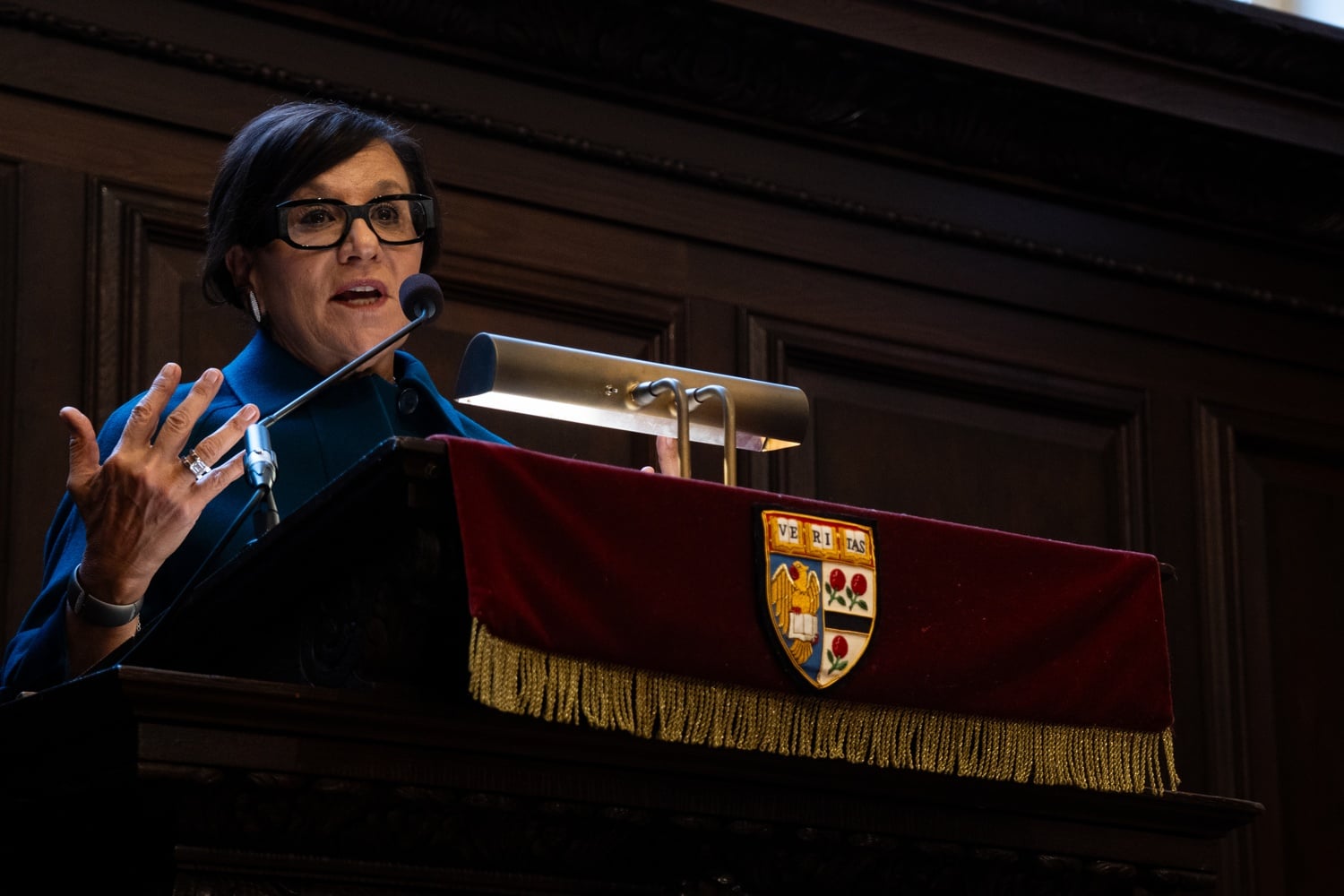
Harvard Corporation Senior Fellow Penny S. Pritzker ’81 said Tuesday that the University is “recommitting” to open inquiry and constructive dialogue under “responsible leadership,” suggesting those principles had, at least recently, come under strain.
In a morning address at Memorial Church, Pritzker aligned herself with Harvard President Alan M. Garber ’76, who has framed his tenure as an effort to restore civil discourse at Harvard. She called Garber a “remarkable” leader and credited his leadership with steering the University toward a renewed focus on academic freedom.
“Under the leadership of our remarkable president, Alan Garber, this university is expanding opportunity, advancing research that improves lives, recommitting to free inquiry and civil discourse, and responsible leadership, and preparing all of us, especially our students, not just for success, but for purpose,” Pritzker said.
Her remarks come after a period of intense scrutiny over Harvard’s response to campus activism following Hamas’ Oct. 7, 2023, attacks on Israel, which drew criticism of the University’s handling of speech, protest, and antisemitism.
Pritzker spoke as Harvard’s two highest governing boards — the Corporation, which she chairs, and the Board of Overseers — convened for at least two days of meetings alongside senior administrators.
The boards met Sunday with Faculty of Arts and Sciences Dean Hopi E. Hoekstra and Harvard Business School Dean Srikant M. Datar, and on Monday with Harvard College Dean David J. Deming.
Deming remained at Loeb House into the late afternoon — more than an hour after it was announced that Harvard College’s contentious grading reform plan would be delayed until fall 2027.
The regularly scheduled meetings occurred as Harvard stares down the Trump administration on several new fronts, including a Department of Justice lawsuit alleging the University violated federal law in its response to campus antisemitism.
Pritzker declined on three separate occasions to comment on the status of settlement negotiations between Harvard and the White House when approached by Crimson reporters.
Garber, eight other members of the Corporation, and nearly a dozen Overseers also declined to address the settlement negotiations.
Get The Crimson in your inbox.
Harvard Corporation member Richard P. Lifton told a Crimson reporter on Sunday as he climbed into a limousine that the body had not discussed settlement negotiations.
“I have no idea,” he said. “We haven’t talked about it.”
Pritzker equally opted to stay above the campus fray in Tuesday’s remarks — a speech that ranged from the personal to the political and called on her audience to “repair what is broken” in the world through service and moral leadership.
Though Pritzker did not make reference to the Trump administration’s prolonged attack on the University and its key functions, she described Harvard as one of many institutions being “tested like never before.”
“There’s no question that we're living in a difficult and unsettled moment here at this university, across our nation, and around the world,” Pritzker said.
“Veritas, or truth itself, is being challenged,” she added. “The path forward is not always clear.”
Shortly after the conclusion of her remarks at Memorial Church, the University announced two new members — Sylvia M. Burwell ’87 and Michael S. Chae ’90 — would join the corporation.
Reviving a culture of constructive debate has been a north star for Garber since he assumed the presidency under heavy scrutiny in January 2024. Shortly after taking office, Garber launched a slew of initiatives targeting campus discourse and Harvard declared an institutional voice policy that prevents the University and its top officials from making public, political statements.
Garber has publicly attributed a culture of illiberalism to faculty activism, faulting the University for allowing professors to express their personal views in the classroom. In a December 2025 podcast appearance, Garber said Harvard had since reversed course and committed to restoring neutrality.
Even as institutions of higher education stare down a hostile federal government and a disillusioned public, Pritzker framed them as more important than ever.
“Universities like Harvard, at times like this, matter most,” Pritzker said. “They remind us that ideas have power, that evidence matters, that community is built, not assumed, and that leadership begins with a responsibility to do all we can to help others.”
Pritzker’s comments arrive as the Trump administration ratchets up its pressure campaign against Harvard. Two weeks ago, the Justice Department filed its lawsuit accusing the University of failing to protect Jewish and Israeli students from harassment, largely rehashing litigation from last summer when it attempted to revoke a $2.7 billion funding cut.
Just days later, the Department of Education launched dual probes into Harvard over antisemitism and alleged noncompliance with an investigation into its admissions practices.
Pritzker said that her time in Appleton Chapel brought her back to her time as an undergraduate attending Kol Nidre and Yom Kippur services — and reflected on Harvard’s lasting role in her life.
“For me, Harvard has not just been a place of learning, of challenge, and of course of deep growth, but it's been a place that's helped me build community and a place that has nurtured my soul,” she said.
Correction: April 2, 2026
A previous version of this article incorrectly stated that the governing boards met with Dean of Undergraduate Education Amanda Claybaugh on Monday. In fact, Claybaugh did not attend the meeting.
—Staff writer Hugo C. Chiasson can be reached at [email protected] or on Signal at hcc.35. Follow him on X @HugoChiassonn.
—Staff writer Elise A. Spenner can be reached at [email protected] or on Signal at elisespenner.82. Follow her on X @EliseSpenner.
Want to keep up with breaking news? Subscribe to our email newsletter
Have a tip for The Crimson? Share it confidentially