Garber Offers Measured Defense of Gay’s 2023 Congressional Testimony on Antisemitism
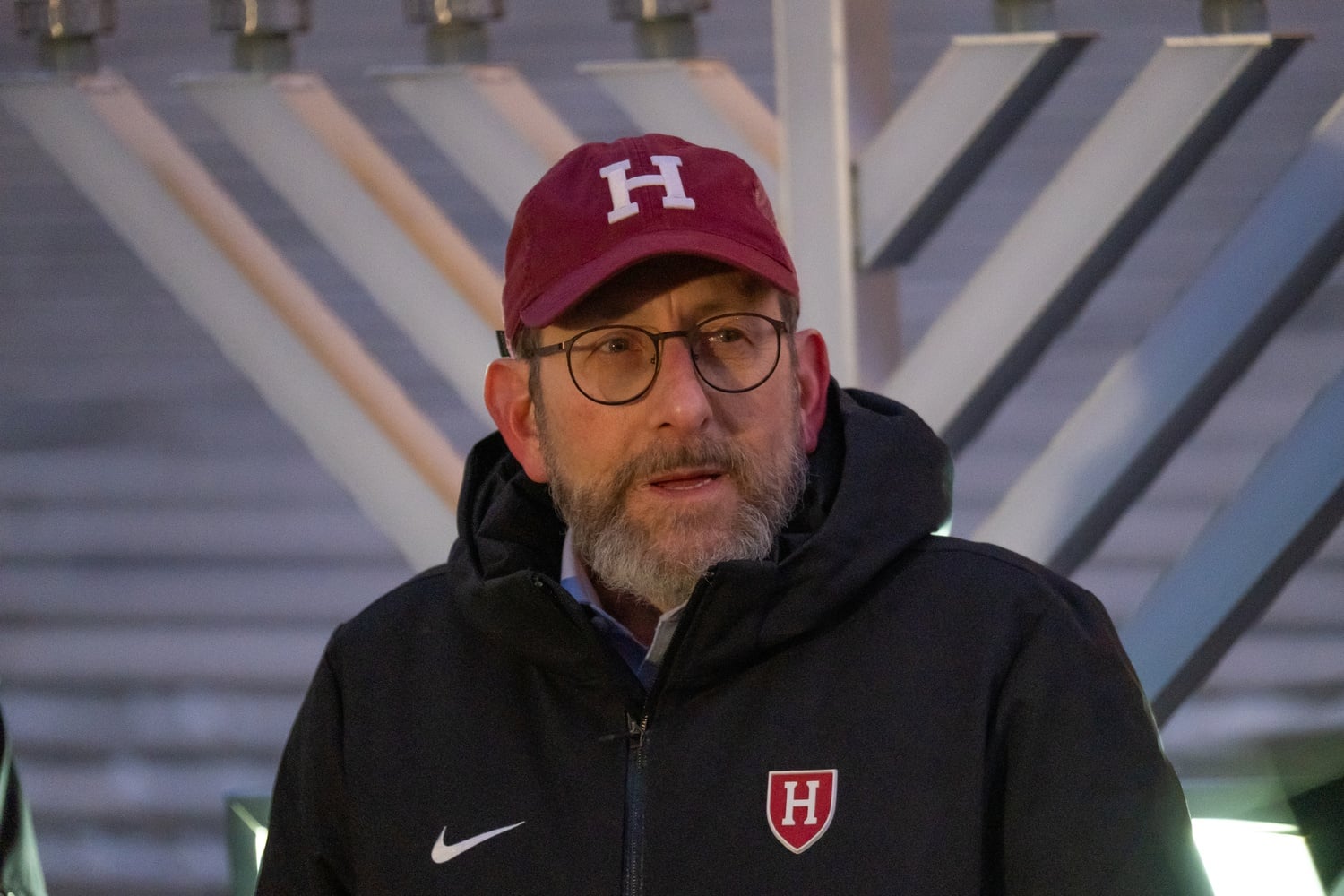
Harvard President Alan M. Garber ’76 offered a measured defense of former University President Claudine Gay’s widely criticized House testimony in a Monday interview, suggesting her response reflected a technically correct — if politically maladroit — reading of school policy.
In a public interview in Manhattan, Garber pointed to the now-infamous December 2023 colloquy between Gay and Rep. Elise M. Stefanik ’06 (R-NY) in which Gay said that calling for the genocide of Jews could violate University policy “depending on the context.”
The remark quickly went viral, drawing sharp backlash from lawmakers, donors, and Harvard affiliates alike, who bashed her for failing to issue an outright condemnation of antisemitic speech.
Reflecting on the moment, Garber noted that he had been seated behind Gay during the hearing, watching the exchange unfold in real time. He suggested that, in a narrow sense, the response tracked the question being asked.
“The literal right answer was about whether it violated the codes. It depends on what your policies are,” Garber said. “The issue is that people are looking for a condemnation of the thought behind it.”
Though Gay backtracked, apologized, and clarified in the weeks that followed, the damage was done. She resigned less than a month after the hearing.
More than two years later, Harvard is still reliving Gay’s testimony. In an otherwise forward-looking interview, Wall Street Journal’s editor-in-chief Emma Tucker asked Garber point blank how he would respond if posed Stefanik’s question.
He declined to answer directly. Instead, he made an effort to insert the context he said was missing from Gay’s testimony.
“In the hearing, there was a great deal of discussion about speech and speech rights,” he said.
“In universities, we tend to follow First Amendment law, and that is not a violation of First Amendment law, no matter how reprehensible it may be,” Garber added, referencing “from the river to the sea” chants. “So I think that may be what the presidents were actually responding to, but you couldn’t tell that from just looking at that little clip.”
Get The Crimson in your inbox.
Garber was quick to note, though, that Gay’s response fell flat with an audience that he said hoped she would condemn the thinking behind demonstrators’ rhetoric.
“Many people, having benefit of hindsight, would have said something that might not have been literally true, but was emotionally true and that is that it is completely unacceptable to say anything that seems to call for genocide,” he said.
Gay’s remarks, and the aftermath, pointed to a growing gap between the technical but often convoluted nuances of the University’s free speech policies and public expectations of moral clarity.
That same tension has been central to Garber’s tenure. Since taking office in January 2024, he has been tasked with cleaning up the fallout from Gay’s testimony and Harvard’s handling of pro-Palestine protests following Hamas’ October 7, 2023, attack on Israel.
Amid persistent concerns about hostility on campus, Garber launched twin task forces: one on combating antisemitism and anti-Israeli bias, and another on anti-Muslim, Arab, and Palestinian bias. He also declared an institutional voice policy limiting when the University and top administrators take public stances on controversial issues.
The University has faced mounting external pressure as well. Several major donors, including Leonard V. Blavatnik and the Wexner Foundation, ended their financial relationship with Harvard amid the controversy, prompting an effort by Garber to coax back support.
Gay retreated from public appearances following her resignation, only re-emerging briefly in September to criticize Garber of “compliance” with the Trump administration in his ongoing back-and-forth with the White House.
She is now slated to teach two courses in the fall term, including a tutorial in the Government department on university governance.
The accusation that Harvard failed to adequately respond to campus antisemitism has fueled a prolonged clash with the Trump administration. Federal officials have unsuccessfully attempted to freeze billions in funding and restrict the University’s ability to enroll international students.
And though the University initially won relief from the courts, the Department of Justice launched a new suit in March aimed at alleged violations of federal civil rights law for Harvard’s purported mishandling of pervasive antisemitism within its gates.
Garber denounced the government’s claims as “meritless” at a faculty meeting last week, claiming the DOJ overlooked steps taken by the University to curb antisemitism on campus.
—Staff writer Hugo C. Chiasson can be reached at [email protected] or on Signal at hcc.35. Follow him on X @HugoChiassonn.
—Staff writer Elise A. Spenner can be reached at [email protected] or on Signal at elisespenner.82. Follow her on X @EliseSpenner.
Want to keep up with breaking news? Subscribe to our email newsletter
Have a tip for The Crimson? Share it confidentially