HMS Dean Defends Removal of Diversity Language From Mission Statement
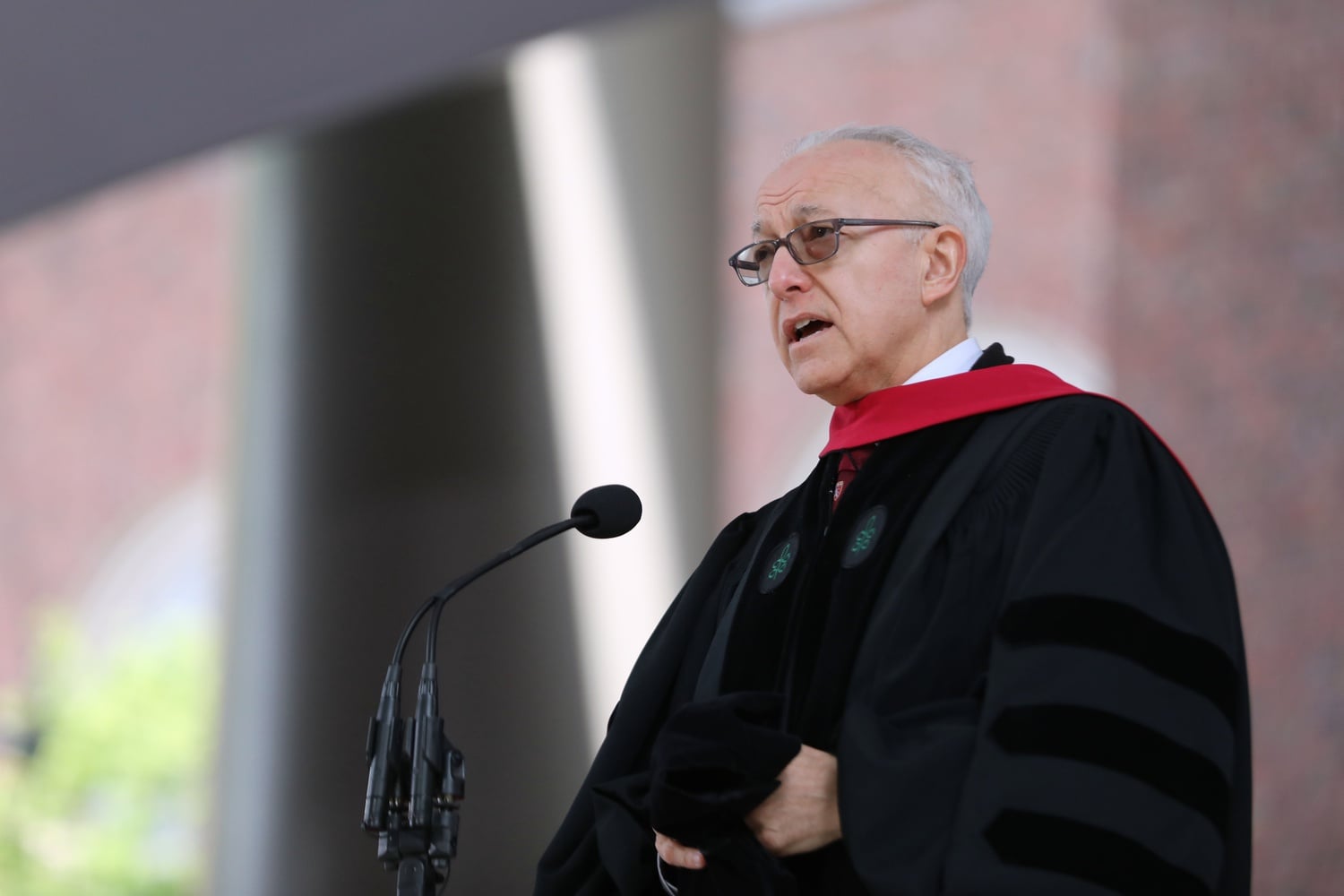
Harvard Medical School Dean George Q. Daley ’82 defended the school’s decision to remove an explicit reference to diversity and inclusion from its mission statement, saying in a Tuesday interview that the revision produced a “leaner” document without retreating from the school’s values.
On April 9, HMS unveiled a revised mission statement and set of guiding principles. The new statement drops the pledge to “nurture a diverse, inclusive community” and focuses on the school’s work to “improve health and well-being.”
Daley said the earlier mission statement had become “long and complicated” and that the school’s commitment to diversity and inclusion had been relocated to a separate Medical School values statement rather than eliminated.
“We’ve made a leaner mission statement that speaks very directly to what we do, which is to really advance excellence across our multifaceted mission of education, research and clinical care, and we’ve fully endorsed our commitment to a diverse and inclusive community,” Daley said.
Daley said he had first asked for a review of the mission statement and community values when he became dean in 2017. He said the revised language was vetted with the faculty council, preclinical chairs, and a survey that drew “many, many dozens of comments.”
“We have really reaffirmed our commitments to our core values,” Daley said.
The changes follow the April 2025 launch of an HMS working group on open inquiry, chaired by former HMS Dean Jeffrey S. Flier, which has not publicly released its findings. They also come roughly a year after HMS renamed its Office for Diversity Inclusion and Community Partnership as the Office for Culture and Community Engagement and removed a longstanding diversity statement that had pledged to “challenge discrimination” and “actively promote social justice.”
Daley also confirmed that HMS had laid off employees over the past year — the first layoffs of his nearly nine-year deanship — as the school navigates what he called a “recurring structural deficit.” He said he did not have a figure for the number of employees laid off.
Get The Crimson in your inbox.
“Layoffs happen, and it’s terribly unfortunate,” Daley said, citing “significant shortfalls in our revenue.” He said HMS also relied on “position control” — declining to fill roles vacated by departures or retirements — to limit the scale of layoffs.
HMS cut its research enterprise by roughly 20 percent over the past year, a target Daley first outlined in a state-of-the-school address last September. Daley said Tuesday that the school had not finalized fiscal year 2026 budget but had been “making very judicious use” of its reserves — which HMS officials said last April stood at about $39 million — to maintain a balanced budget on unrestricted funds.
Daley said the financial strain will intensify when the Trump administration’s increased endowment tax takes effect in 2027, which he said would leave HMS with “tens of millions of dollars less” to distribute.
To offset federal losses, Daley said, HMS is pursuing deeper partnerships with industry.
“We are looking deeply at academic industrial partnerships,” Daley said, adding that the University has convened “a couple of task forces” examining how Harvard engages with industry partners.
He described a reversal in how those partnerships are typically initiated. Universities have historically approached biopharmaceutical companies and asked what research they would like to support, Daley said. HMS is instead asking those companies to identify the scientific problems holding back new drug development, then pairing academic and industry scientists to tackle them jointly.
Daley also pushed back against a new NIH effort to redistribute grant funding by geographic region — a change that could disadvantage Massachusetts, home to a dense cluster of research institutions that has long drawn an outsized share of federal biomedical dollars.
“We think that the peer review process, imperfect as it is, is still the best process for identifying meritorious grants,” Daley said. “I’m hopeful that the NIH will continue their core commitment to expert peer review as the basis for providing the grant funding so that the most meritorious science continues to be supported.”
—Staff writer Riya S. Shah can be reached at [email protected] and on Signal at riyas.23. Follow her on X @RiyaShah233.
—Staff writer Juliana L. Yao can be reached at [email protected] and on Signal at jly.87. Follow her on X @JulianaYao298.
Want to keep up with breaking news? Subscribe to our email newsletter
Have a tip for The Crimson? Share it confidentially