
Democratic Socialists and The City on a Hill
ernie Sanders is on TV, and Zohran Mamdani stands in the corner.
It’s Feb. 11, 2020, and a few dozen members of the New York City Democratic Socialists of America are packed into the basement of an East Village bar. The event is ostensibly for Mamdani, then campaigning for state assembly. In less than six years, he’ll be the mayor of the entire city. But for now, he’s just a DSA member, and he’s lost control of the room. The main event on CNN, where the ageless anchor Wolf Blitzer is about to announce the results of the New Hampshire Democratic Primary.
45 minutes to midnight, Blitzer makes the call: “CNN projects that Bernie Sanders will win the New Hampshire Democratic Presidential Primary.” A cheer rises up from the crowd. Many have spent weeks campaigning for Sanders, a senator from Vermont, a self-proclaimed democratic socialist, and, it seems, a leading contender for the Democratic nomination.
Among those cheering is Estefania Galvis. At the time, she had been a DSA member for little more than a year. Six years down the line, she would move from New York to Boston, and eventually co-chair the sixth largest chapter of the DSA in the nation.
The socialist movement has progressed with her. Since Sanders’s first presidential campaign in 2015, DSA has seen a swift rise in membership. Nationally, the organization has grown from about 4,000 members to more than 100,000, making it the largest socialist organization since the original socialist party prior to World War I. Meanwhile, Boston DSA’s count has shot up to 2,600, an all-time high and nearly double its size from a year ago. And in Cambridge, two of nine City Council seats are held by DSA members Ayah Al-Zubi ’23 and Jivan Sobrinho-Wheeler. Among the more than 20 Boston DSA members we interviewed for this story, many see growing interest in socialist ideas as an opportunity — both locally and nationally.
In late October 2025, Galvis and fellow Boston DSA co-chair Bonnie Jin visited New York City to canvass for Mamdani’s soon-to-be victorious mayoral campaign. Reflecting on their weekend as they returned to Boston, they referenced a quote often attributed to Vladimir Lenin: “There are decades where nothing happens; and there are weeks where decades happen.”
That week, and the ones since, felt like the latter.
‘The Big Tent’
n the last weekend of March, I walk up Third Street toward The Foundry for a Cambridge DSA Neighborhood Group meeting. I’m running a couple minutes late, and in my haste, overtake an old woman shuffling down the sidewalk. Already a few steps ahead, I almost miss it when she awkwardly says, “Hi.” I turn over my shoulder before turning into The Foundry, where it takes several doors for me to locate the meeting room.
Inside, there’s perhaps 20 people sitting at a horseshoe of tables surrounding a large TV, where more members watch on Zoom. Standing near the front, the neighborhood group co-chairs Brett Kahmann and Yann Dardonville distribute agendas. The room is larger than required for the assembled group and extra tables have been pushed to the walls. The reclaimed-warehouse-style vibe is slightly undercut by a mouse’s recurring patronage along the back wall and the pounding bass of house music from somewhere upstairs.
I settle into a seat at the far corner of the horseshoe between two members I don’t know. The group is just finishing an icebreaker: “What are you looking forward to in warmer weather?” Before answering, each member introduces themselves in DSA-style — first name, last initial — a tradition meant to protect privacy. As members wrap up their answers, I notice the old woman from the street slowly enter the room. She takes a chair two down from me just as Kahmann asks: “Can everyone new to the neighborhood group please raise their hands?” Several people, nearly half the room, do.
Becoming a DSA member is relatively easy. The national dues are recommended at $50 a year or $25 per month but can be as low as $2 annually. Chapter dues are encouraged, but optional. The low barrier to entry has contributed to a city-wide phenomenon: new attendees are cropping up across Boston DSA’s 10 active neighborhood groups, including Cambridge, the oldest and largest. Occasionally, neighborhood groups hold votes on support for local campaigns, but Jin describes their primary function as “onboarding, socializing and building the culture of democratic socialism needed to carry us through tough fights.”
At the meeting, I listen as Kahmann announces the first agenda item: a presentation from one of the Housing Working Group co-chairs. Though neighborhood groups and working groups have no formal distinction, working groups are formed on issues — like labor, immigration, and eco-socialism — rather than geographies. Working groups organize in a variety of ways — some are more educational, others involve forms of direct action, and still others focus on petition or canvassing campaigns. Similarly, each has their own leadership structures and holds elections at different times.
The Housing Working Group, as the presenter goes on to explain, is campaigning to place a rent control measure on the fall ballot. If approved, the proposal would cap annual rent increases at five percent. The issue has divided state Democrats, but the presenter assumes the group’s support. No one contradicts them.
The old woman raises her hand. Rather than asking about rent control or social housing, the two topics covered in the presentation, she begins talking about her own housing situation, which apparently involves a faulty elevator. After a minute, she switches tact, asking why increasing market-rate housing supply could not reduce costs — a budding perspective often referred to as “abundance.” The neighbor to my left mutters, “Oh jeez,” presses her fingers to her temple, and shakes her head slightly.
To redirect the conversation, Kahmann and Dardonville send around a handout. The Housing Working Group has prepared some language on housing reform to circulate among DSA members, and they’re soliciting feedback from attendees. Groups of four or five coalesce, breaking out pens to annotate and make notes. Some are deep in thought, and others discuss avidly among themselves.
My group, though, is an exception. The person to my left, who seems to have already read a digital copy, briefly thumbs through the pages before setting them down in front of me, where they remain, untouched, for the remainder of the discussion. The person to my right removes their mask and articulates their struggle to keep a straight face amid the old woman’s interjections. “I think I can reveal my face. I just don’t have a silent mode,” they say before trailing off and looking vaguely in the old woman’s direction. I follow their eyes, but the woman’s chair is empty — her departure has evaded my notice. “The Ezra Klein of it all,” they continue. “One of our electeds is really into it.” The others nod.
The Ezra Klein of it all notwithstanding, I catch on quickly. They’re talking about Cambridge City Council, where the DSA-endorsed Sobrinho-Wheeler and Al-Zubi have differing programs for affordable housing. Sobrinho-Wheeler, like the old woman, has advocated in favor of abundance, while Al-Zubi has said it is an over-simplified solution. Both perspectives are represented in my group — the man sitting next to the old woman’s empty chair says he’s been “pretty swayed” by arguments for abundance — but a vocal majority is anti-abundance.
Alas, Cambridge’s housing dilemma is not to be solved during the 20-minute discussion period. However, the disagreement exemplifies a core DSA principle: they are, as several people eagerly inform me, a “big tent organization.” Members don’t have to — and often don’t — agree on a defined set of policies. It’s central to how they imagine a functional democracy, and it enables people who may broadly disagree to organize around shared issues.
It can also lead to conflict. As Kit Haines, a member of Boston DSA’s Socialists in Office Committee, puts it, “We’re a big tent organization, which is wonderful, but people in Boston DSA do not agree about anything other than that socialism is good.”
During the meeting, disagreements remain brief and contained. The critiques of the Housing Group’s document are mostly semantic: one member calls it “inaccessible,” another “out of touch” — to which my neighbor mumbles, “What does he mean, out of touch?” In the end, the most disrespectful action is taken toward the clock: the meeting is always off schedule by at least 20 minutes, and the final few items are skipped or glossed over.
As the meeting ends, I ask one attendee whether this is typical.
He considers. “Pretty much,” he says.
New Socialists, New Socialism
any of the ideals and tensions present in modern DSA trace back to the organization’s founding. Paul Garver was a socialist leader in the early 1970s, when he served on the National Political Committee for one of DSA’s two predecessor organizations, the New American Movement. Even in his mid-30s, Garver recalls being considered old within the socialist movement — more so when, at 42, NAM merged with the Democratic Socialist Organizing Committee to form DSA in 1983. Garver went on to serve on DSA’s inaugural National Political Committees, helping build its organizing efforts.
At its founding, DSA had roughly 6,000 members, about 1,500 from NAM and between 4,000 and 5,000 from DSOC. Over the next three decades, the organization fluctuated in both influence and membership. Garver, who spent 15 of those years working overseas, returned to the United States and DSA in 2007. The organization was “pretty shrunk,” he remembers. “It had probably three or 4,000 nominal members, but we looked around and saw the average age — it was about 70.”
During the Obama administration, DSA was one of several similarly-sized socialist organizations struggling to assert itself. Members, including Garver, recognized the need for a younger generation to expand and sustain the organization. That shift came through a combination of timing and strategy. A series of movements and campaigns — including the 2011 Occupy Wall Street protests, Sanders’s 2016 and 2020 presidential runs, and Rep. Alexandra Ocasio-Cortez’s (D-N.Y.) 2018 election to the House of Representatives — brought a new wave of younger members into the organization. These national figures and movements catalyzed the participation of most of the Boston DSA members I spoke to.
Russell Weiss-Irwin, a DSA member since 2014, describes how the organization positioned itself during that period. Sanders was not a DSA member, and Occupy was not a DSA movement, but by association, DSA became a home for those called to continued action. “DSA was just really well-positioned, because of the work that we had done in the five years up until then, to catch those people,” Weiss-Irwin says.
Why DSA, and not any of the other socialist organizations? It may have simply come down to language. When Sanders declared himself a democratic socialist at rallies, listeners looked up the term, and because of the shared verbiage, the DSA website came up first. The phenomenon was compounded by $25 yearly dues and minimal requirements for membership. “All you had to do was click a button,” Weiss-Irwin says.
Suddenly, DSA was the socialist organization.
Behind the scenes, though, matters were more complicated. The generational divide between DSA’s new guard, seen as inexperienced, and old guard, seen as ineffective, caused friction. “It’s what we’ve always dreamed of happening, thousands of people joining our organization overnight,” Weiss-Irwin says. “But then, it’s like, ‘be careful what you wish for,’ because all these people joined our organization, but all of a sudden, because it’s totally democratic, it’s not our organization anymore.”
Despite many younger members’ attempts to build productively off the wisdom of the past, Weiss-Irwin says some experienced members of DSA “left or went crazy, became extremely resentful of the newer people, or became borderline paranoid.” Conversely, while parts of the old guard embraced roles as mentors, “some of the new people were huge jerks.”
DSA became attractive to young, well-educated liberals disaffected with mainstream politics, a demographic particularly prevalent in the college hub of Greater Boston. David Grosser, a former Boston DSA membership coordinator who joined the organization in 2018, has the unique experience of being an older, lifetime socialist who joined DSA during this era of expansion. He embodies both sides of the tension: of an older ilk, but in with the new crowd.
“The fact that there are so many graduate students and ex-graduate students in Boston, I don’t think is an asset for us,” he says, acknowledging that his view is not widely shared. The idealism — or, as Grosser says, “obsession with correct ideas” — of young DSA converts unambiguously grew the movement. Simultaneously, it alienated older members, for whom socialism was synonymous with unions in blue-color industries.
“Socialist ideas are more popular than they have been in a hundred years, and yet our actual impact with the working class, as it exists, is like a fingertip,” Grosser says.
DSA “heavily disputes” Grosser’s characterization. In an official statement, the organization wrote: “It’s hard to measure relative impact in that way — we haven’t ended American capitalism, but we, our campaigns, and our electeds have certainly made positive material change for working class people.”
Boston DSA’s infrastructure struggled to keep pace with its rapid growth between 2016 and 2019. According to Grosser, one response was the expansion of the working group model. Members interested in a particular issue quickly formed their own groups, creating decentralized spaces for organizing that Grosser considered “autonomous little collectives.”
Compared to the complications that arose from the initial membership surge, members feel Boston DSA has handled recent growth more adeptly. Organizational structures have caught up with enrollment, and those who witnessed the initial chaos are eager not to repeat it. “Every political organization ought to mature, ought to continue to grow and build out its infrastructure,” Ben Lappen, another former Boston DSA membership coordinator and member since 2017, says. “Our organization is not only politically different, but on an entirely different weight class than it used to be.”
That “weight class” has manifested itself most directly in the evolution of a DSA endorsement. When Sobrinho-Wheeler joined DSA in 2018, a Boston DSA endorsement’s most visible benefit was a note on the candidate’s website. The endorsement was used liberally — the organization endorsed Obama in his first presidential campaign — but carried little significance. Recently, the inverse has become true: DSA is picky about its endorsed candidates, but does much more work for them. As Jin says, “the definition of what is DSA-endorsed, who we’re looking for, what this movement is about, has just changed so much.”
Now, Boston DSA’s endorsement isn’t a speech or stamp — it’s a commitment from the Electoral Working Group to design a door-to-door campaign rostered by members. This ground support can make or break a candidate’s campaign. When Al-Zubi, part of DSA’s new guard, first ran for City Council in 2023, freshly graduated from Harvard, she was endorsed by DSA late in an ultimately unsuccessful campaign. Nonetheless, after the endorsement “there was a shift that I felt, to some extent, on the level of commitment I saw with people engaging in our campaign,” Al-Zubi shares. In 2025, with more time for DSA and Al-Zubi to prepare, she finished third out of nine electeds in Cambridge’s ranked-choice ballot. “There’s this force that DSA holds. That commitment translates into organizing on the ground together.”
With so much time invested in campaigns, there’s a rigorous process for candidates to procure an endorsement. Candidates must apply to the Electoral Working Group, who only take their application to a chapter-wide vote if a majority of the working group believes they merit further consideration. After a public forum where members have a chance to engage with the candidate directly, 60 percent of the chapter must then vote in favor of the endorsement. Chris Duncan, one of the Electoral Working Group’s co-chairs, adds that the process often begins earlier: “In an ideal situation, we’re not simply just waiting for candidates to come to us; we’re growing our own folks, developing our own candidates.”
The Neighborhood Approach
n a Saturday morning in early March, I sit in the basement of Andala Coffee House in Central Square, surrounded by socialists sharing hummus and pita. It’s the Cambridge Neighborhood Group’s monthly “Coffee with Comrades” event, and it’s lively. About 20 Cambridge-area socialists and myself are squeezed on a few couches and chairs arranged in a loose figure-eight, sipping elaborately-ordered coffees and talking over one another.
Trying to keep up with these “comrades” — the term DSA members use for one another — feels like trying to tune a radio to multiple frequencies at once. To my left, a member recounts their pinky surgery. To my right, someone swears under her breath while two others discuss the Ecosocialism Working Group’s campaign to add more bathrooms in public transit stations. At several points, I hear wildly decontextualized, possibly facetious, statements from voices across the basement: “I might even be an anarchist!”
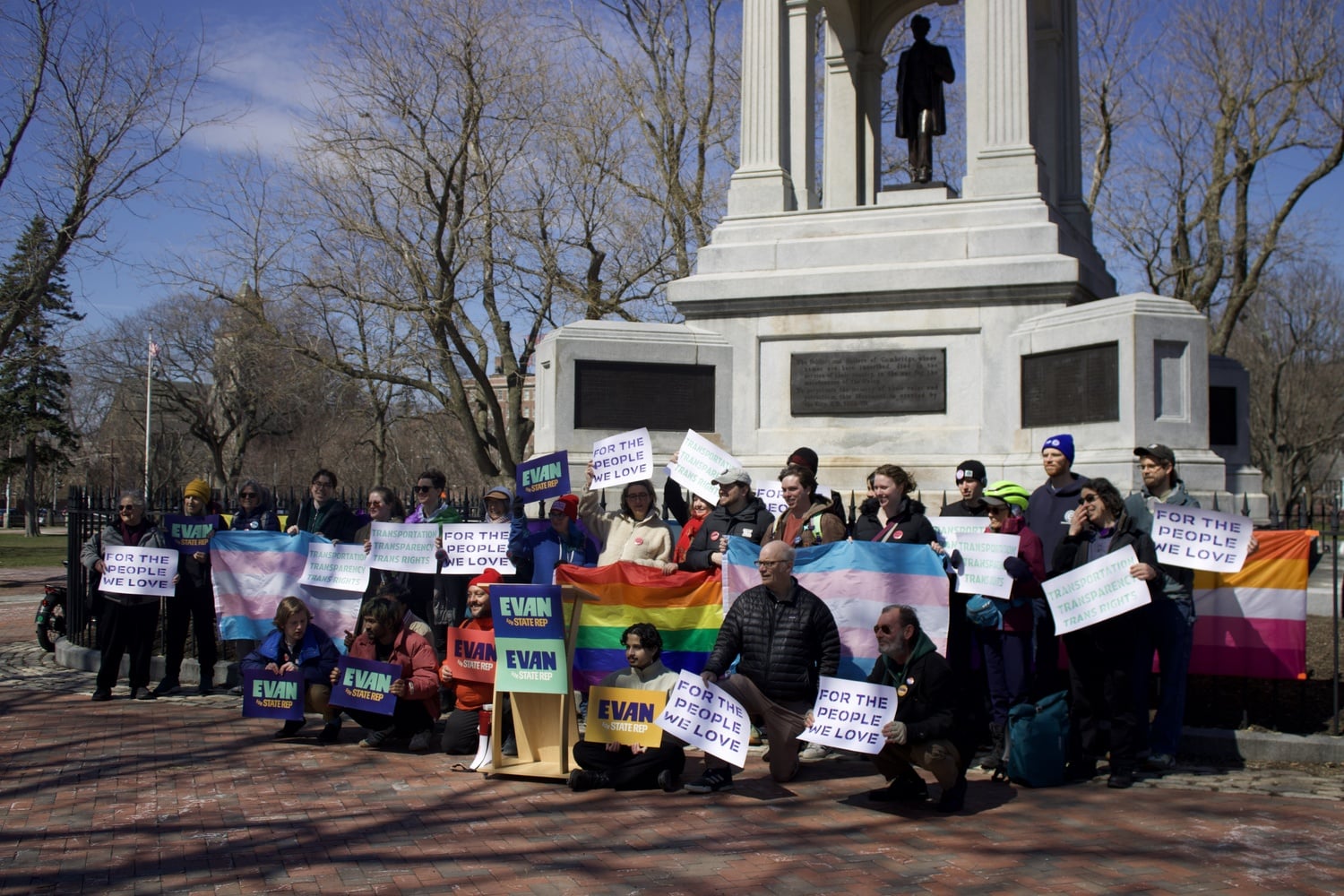
I’m waiting for someone, and 15 minutes before the event ends, they arrive. Evan MacKay ’19 — who identifies as non-binary and uses they/them pronouns — is a 29-year-old DSA member, a JD-Ph.D. candidate in Sociology and Social Policy at Harvard, a tutor at Currier House, and a former president of the Harvard Graduate Students Union-United Auto Workers Union. They are also Boston DSA’s only endorsed candidate in the 2026 election cycle — one of the “homegrown candidates” that Duncan referred to. After coming within 41 votes of victory in 2024, MacKay is again vying to take over State Representative Marjorie Decker’s House seat, which oversees most of Cambridge — including the majority of Harvard’s campus.
I accompany MacKay and a group of volunteers on one of their weekly canvassing campaigns. Canvassing — going door to door to speak directly with voters — is another tenet of DSA’s electoral strategy, and MacKay is a strong proponent. “Canvassing is core to how we think about politics,” they say. “We’re going directly to people because we believe that people should be at the center of this, and we believe in the agency of all people to be able to collectively improve our communities.”
That Boston DSA is running another candidate in Cambridge reflects an ongoing bit — the chapter should really be called Camberville DSA. At Andala, Cambridge Neighborhood Group members joke about “Cambridge DSA superiority.” The tone is light, but the underlying point is real. No DSA members currently represent Boston in either the City Council or the State House.
Some members attribute the difference to Cambridge’s high concentration of college-educated renters and its population density, which are well-suited to DSA’s canvassing campaign. Weiss-Irwin, who lives in Boston, says the focus on Cambridge has “irked” him at times, but he does not see it as a “huge problem.”
Others feel more strongly. Jin calls the idea that DSA should concentrate electoral campaigns in areas of existing strength “a self-fulfilling perception.”
“The reality is that where we run campaigns and where we do our work affects the kinds of members that are brought into our organization,” she says. Without organizing in working-class neighborhoods, she adds, DSA’s reach into those communities is unlikely to expand.
For the time being, though, MacKay is the candidate and their campaign is in Cambridge. MacKay’s campaign will culminate in the Democratic primary on Sept. 1, and before then, canvassers tell me the goal is to knock every door in Cambridge three times. A member of the Electoral Working Group leadership team goes a step further: he wants every Cambridge voter to have between six and nine interactions with the MacKay campaign, whether through canvassing, campaign literature, or some other form of contact.
MacKay and I walk 10 minutes from Andala to Franklin Street Park, where the canvassers are scheduled to meet. About 15 people, including MacKay and a few faces I recognize from Coffee with Comrades, are present by the time everyone’s arrived. Before sending people off, two veteran canvassers explain the goals of the day’s work. In theory, members are collecting signatures — MacKay needs 150 of them in order to appear on the ballot for the primary. However, even in March, the group is already over that threshold. The canvas is as much about visibility as it is about signatures.
I follow MacKay for about an hour in Cambridge’s Riverside neighborhood, observing their conversations with residents and asking about the campaign in between. The first few doors we visit go unopened, despite a characteristically assertive knock. One, two, three, four times the knuckles rap, all in slightly different areas of the door, a beat, then two more knocks dead in the middle. Before I can ask, they explain their theory: knocking on different parts of the door creates different timbres that might resonate throughout the house. They’re not sure it makes a difference.
MacKay’s first hit is the seventh residence, where two cats stare at us beadily through a large bay window. MacKay seems to know the person who answers the door, and the two strike up a conversation about a forthcoming wedding. It’s a contrast to the more scripted examples volunteers rehearsed earlier. MacKay listens closely, maintaining eye contact while gradually stepping back from the doorway as the conversation unfolds. After five minutes, the conversation ends with the resident referencing MacKay’s previous loss: “41 votes is not a lot, and we can definitely overturn that.”
As we walk away, MacKay explains how the campaign team tracks voter interactions. Canvassers use a platform called MiniVAN, which is under contract with the Democratic Party, to run campaigns. Through the app, MacKay can see the names of inhabitants in all of Riverside, though they stick to the 60 addresses within their “turf.” After each conversation, MacKay checks to see if they are the residents listed at the address in Mini-Van. In the case of several houses I see that afternoon, the person at the door doesn’t match the listed resident. In a transient, renter-heavy neighborhood, updating this data helps future canvassers know who they’re dealing with, and whether to come back. Afterwards, MacKay places the voter on a scale from one to five: one is a surefire vote for them, and five a surefire vote for Decker.
Outside of the nuptial discussion, MacKay is issue-first. Transparency is a major theme of this campaign, as it was in 2024. MacKay mentions to residents that Massachusetts State House has consistently been ranked by some groups as one of the least effective in the nation, and repeatedly cites a critical article from Act on Mass, a State House watchdog, that attacks the State House’s lack of transparency.
Immigration and Customs Enforcement is another major talking point. Hardly a doorstep conversation passes where MacKay doesn’t bring up the Massachusetts Department of Correction’s 287g agreement with the federal government, which gives ICE officers access to incarcerated people’s records. MacKay hammers home the point: Massachusetts is the only blue state with such an agreement.
Even when residents look ready to end the conversation — fingers inching the angle of the door slightly further shut, eyes darting back behind them into the house — MacKay is never quite ready to go. Several times, MacKay personally writes out the link to a video explaining the State House’s lack of transparency on top of the leaflets they give out. MacKay repeatedly emphasized these issues in conversations with residents, and they don’t give residents a moment to decide otherwise.
If elected, MacKay would become Boston DSA’s fourth endorsed officeholder, joining Al-Zubi, Sobrinho-Wheeler and Somerville City Councilor JT Scott. They would also be the only DSA-endorsed member of the Massachusetts House. In doing so, they would replace Decker, whom some members described as part of the party establishment.
In response to a request for comment, Decker’s campaign shared a list of her “extensive, progressive” voting record, which they described as “sustained, effective leadership that has delivered concrete improvements in health care, economic security, civil rights, public health, and dignity for working people and vulnerable communities.”
The Electoral Working Group co-chairs believe that Decker will run a stronger campaign than in 2024, but they’re bullish on MacKay’s prospects. Jennings, while acknowledging that such estimates are more art than science, estimates that MacKay will need roughly 4,000 votes to win the district. He thinks it’s attainable. Chris Duncan, the Working Group’s other co-chair, adds that “Evan has spent every day since September 4, 2024, investing in their relationships with community members. Over the next couple of months, it’ll really show the buy-in that not just the chapter, but the district and the whole community, has with this campaign.”
MacKay is similarly hopeful. Speaking to me inside the Smith Campus Center at the end of February, they repeat one word constantly: neighbor. Their organizing philosophy is built around the neighbor —“building relationships with our neighbors”, “what our neighbors care about”, “our neighbor is struggling”, “improve lives for our neighbors”, “organizing alongside their neighbors.”
For MacKay, the emphasis reflects a broader view of politics.
“An election is people filling in bubbles on a sheet of paper, and, cool, we want more bubbles than the opponent, but this is about much more,” MacKay says. “What really excites me is people becoming activated into this campaign and going out and meeting their neighbors in Cambridge. That is beautiful.”

The Socialist Spectrum
dvanced Placement U.S. History, a course taken by nearly half a million high school students each year, including myself, makes little mention of socialism. The College Board’s 560-page class curriculum uses the word “socialism” four times and “socialist” three times, with both words highly concentrated in the “Optional Sources” section of one sub-unit of the late 19th century.
“It’s a subject that you have to really endeavor to learn, because it’s not going to be taught to you,” Lappen, a former Boston DSA membership coordinator, says.
Historically, socialism has been stigmatized due to its association with communism. Although related, the two are distinct systems: communism calls for complete communal ownership of land and resources, while socialism generally refers to public control over major industries, alongside private property. Still, the distinction has often blurred in political rhetoric. As recently as 2010, former Speaker of the House of Representatives Newt Gingrich called socialist infiltration in national politics “even more disturbing than the threats from foreign terrorists.”
As socialist ideas have become more visible in mainstream politics, some members say public perception has shifted. Al-Zubi acknowledges that after years of socialism being “scary,” “people are now opening their eyes and hearts to the approach that democratic socialists have.”
At the same time, definitions have become murkier. What socialism entails — and how it should be practiced politically — remains contested. One obvious manifestation: DSA’s caucuses. These internal subgroups are the individual acts within the big tent, functioning as ideological and social poles within the organization. Each has its own issue priorities, theoretical influences, and vision for a socialist future. As in other organizations, caucuses coordinate support for each other’s resolutions, lobbying one another to build out a coalition within the organization. Although no public information about caucused members is available, Joe Whitcomb, a seven-year DSA veteran and the head organization’s communications committee, guesses that around five percent of DSA members nationally and locally are caucused. He adds that being caucus-affiliated is strongly correlated with member activity.
Though caucuses have individual policy priorities, there are three broad categories for how they articulate a socialist vision. Whitcomb, joking that “they’re gonna kill me for giving away state secrets,” takes my notebook and arranges the most prominent caucuses on a left-right axis, articulating the differences as he goes. There is a DSA ‘right’, which is interested in bringing socialism to prominence primarily by running electoral campaigns within the Democratic Party. There is the DSA ‘left’, which prioritizes “principled” socialism — focusing on direct action, like protests and strikes, with electoral politics playing a lesser role. Then, there is the DSA ‘center’, which is invested predominantly in labor organizing, a modern version of the classic socialism from classes like AP U.S. History.
Even these categories are imperfect. Many members reject the use of a conventional left-right spectrum to describe internal differences, even as they use the terminology informally. I seek out a less binary framework, but find that members, fittingly, disagree on labels. Whitcomb draws out the spectrum as one between “mass politics” and what he calls “social identitarianism,” contrasting efforts to engage broad segments of the electorate with approaches focused on building explicitly socialist institutions. Whitcomb’s electorally-focused caucus, Groundwork, lands toward the right of his chart.
Lappen, by contrast, is aligned with the Libertarian Socialist Caucus on the left of Whitcomb’s doodled spectrum. The caucus’s website claims they collect “council communists, anarchists, cooperativists,” and other more revolutionary socialist subsets. I do a cursory check to see if Lappen would call himself a social identitarian. Instead, he texts me three short paragraphs, two website pages, and an article, and we have a thirty-minute phone call in which he articulates the shortcomings of this framing — and why “popular front” for the right and “united front” for the left presents a better alternative.
Caucuses are more prominent nationally than in Boston DSA— Whitcomb estimates that less than ten percent of Boston DSA members are caucused, with several active but none dominant. Nonetheless, the questions caucuses try to answer, grouping around those three tendencies, remain. How much should DSA align with the Democratic party? How strictly should it stick to its principles? How much should an individual embody the DSA platform? These are the questions which have caused some of Boston DSA’s most public arguments.
The most prominent example of this disagreement is State Representative Mike Connolly’s departure from DSA in 2023. Connolly successfully ran for state representative with DSA’s endorsement in 2016. He continued to garner support during his subsequent terms in office, serving as the Massachusetts co-chair of Sanders’s 2020 presidential campaign and a Sanders delegate at the Democratic National Convention. Grosser called Connolly the local organization’s “earliest electoral triumph.”
By July 2023, the relationship had soured. Several Boston DSA members filed an official motion to expel Connolly. According to the motion, Connolly’s offenses included a “failure to engage with the chapter’s electoral endorsement process since 2016” and opposing DSA’s national political program on housing and internationalism. The motion also cited Connolly’s support for candidates “fundamentally opposed to socialist reforms”, including Democrat Ron Mariano for State House Speaker and Democrat Christine Barber for State House. Connolly disputed some of the claims and initially opposed the motion but ultimately resigned from DSA before a vote could take place. In a tweet announcing his departure, Connolly wrote that the alleged transgressions were essentially “a willingness to work with and support elected leaders and activists who are delivering results for working class and marginalized communities. I am guilty as charged, and proudly so.”
Among Boston DSA members, reactions to Connolly’s departure remain mixed. Some declined to comment, while others suggested the conflict may not have led to expulsion if it had gone to a vote. Weiss-Irwin is adamant: “I will go to my grave certain that, if it had come to a vote, we would not have expelled Mike Connolly, and I don’t even think it would have been close.”
In response to a request for comment, Connolly writes that “For some, especially in that 2023 era, there has been an expectation that an endorsed candidate is obligated to do every single thing that the organization demands of them.” This notion, Connolly says, is “fundamentally at odds with the very meaning of democratic socialism” — were he to have aligned himself exclusively with DSA positions, Connolly says he’d be ignoring the interests of his constituents as a whole.
Similar dynamics have played out before, and since. In 2018, DSA decided not to endorse the organizer Nika Elugardo’s ultimately successful campaign for Massachusetts State House in Jamaica Plain. Elugardo was not a self-identified socialist, but Weiss Irwin characterized her politics as “very strongly left.” Rather than a thoughtful debate about the arguments for and against endorsement, though, “the debate about endorsing Nika Elugardo was almost unfathomably acrimonious,” Weiss-Irwin shares. Names were called, tweets were sent, then deleted. It was a close vote — Elugardo received a majority of votes, but less than the 60 percent required for chapter endorsement, where supporters were saddened she wasn’t endorsed and detractors mortified that it had been so close.
Still, Elugardo recalls DSA members showing up for her campaign — volunteering, canvassing, and mentoring her in preparation for State House. Elugardo writes in response to a request for comment that no aspect of the endorsement process “struck me as out of the ordinary for organizations run by a large number of passionate and diverse volunteers.”
Earlier this year, a similar situation played out, but without most of the vitriol: State Representative Erika Uyterhoeven, a DSA member who was endorsed for her successful 2020 and 2022 campaigns, but not endorsed in 2024, sought DSA’s endorsement for her State Senate race. In the better part of three terms in office, Uyterhoeven has been a vocal critic of ICE’s operations within Massachusetts and a proponent of rent control, two major DSA initiatives. The Electoral Working Group approved Uyterhoeven’s application for endorsement, but like Elugardo, she did not reach the 60 percent endorsement threshold. Uyterhoeven wrote in a statement that she was “proud to be a democratic socialist and DSA member” and “immensely humbled to have received an overwhelming majority of support for my endorsement.”
Like Elugardo’s vote, Uyterhoeven’s was “extremely contentious,” Whitcomb shares. He explains Uyterhoeven’s track record in office featured “some bumps in the road” that “a lot of people were worried about.”
One such worrier was Galvis: she published an op-ed in Working Mass, a DSA-run publication, articulating her reasons for voting ‘No’ on Uyterhoeven’s campaign. “In the moment when big, shiny, exciting opportunities arise, it is important to take a breath and consider the way that potential “low-hanging fruit” will shape the implementation of our larger, long-term strategy,” she wrote.
Weiss-Irwin, on the other hand, called the result of the endorsement vote “a big missed opportunity.” He’s not alone. At DSA socials, I overhear multiple conversations between Uyterhoeven proponents lamenting the decision not to endorse. However, Weiss-Irwin acknowledges “No” voters’ basis, saying the vote was “grounded in things Erika has actually done.”
Across different visions for DSA and caucus affiliations, Lappen, Weiss-Irwin, Whitcomb and others acknowledge that DSA’s internal processes are complex, with room for debate. “You’re going to have differences that bubble up, and some of those differences are just legitimate disagreements,” Lappen says. “It’s why we are multi-tendency, and pluralistic, and big tent, is that we actually commit to democracy, right?”
Unlike other members, Whitcomb doesn’t try to conceal the reality of passionate disagreement within Boston DSA. Without championing it, he understands the reasons for the occasional vitriol. “It feels like every fight is life or death, and that’s why I think people get very sensitive about factionalism, but it’s kind of beautiful,” Whitcomb says. “It matters so much that we are doing this collectively, democratically, as an organization.”
Electing A Movement
rosser, another former DSA membership coordinator, meets me outside Cafe Zing in Porter Square wearing a black DSA sweatshirt despite the heat. A Marx paperback rests on his lap. Our conversation ranges widely, from his organizing history to DSA’s internal structure to his broader critiques of the movement.
At one point, unprompted, Grosser turns to the way socialism is portrayed in the media. “The idea that some hero takes a stand and inspires all the dim proles, that’s a point of view that Marx fought against, but that’s the view you get from the media in this country: heroes! Mass movements have to have a hero, and the hero is so much more important than the mass anyway.”
He pauses, then adds: “Somehow, you find a bunch of benighted proles, and you give the right speech.”
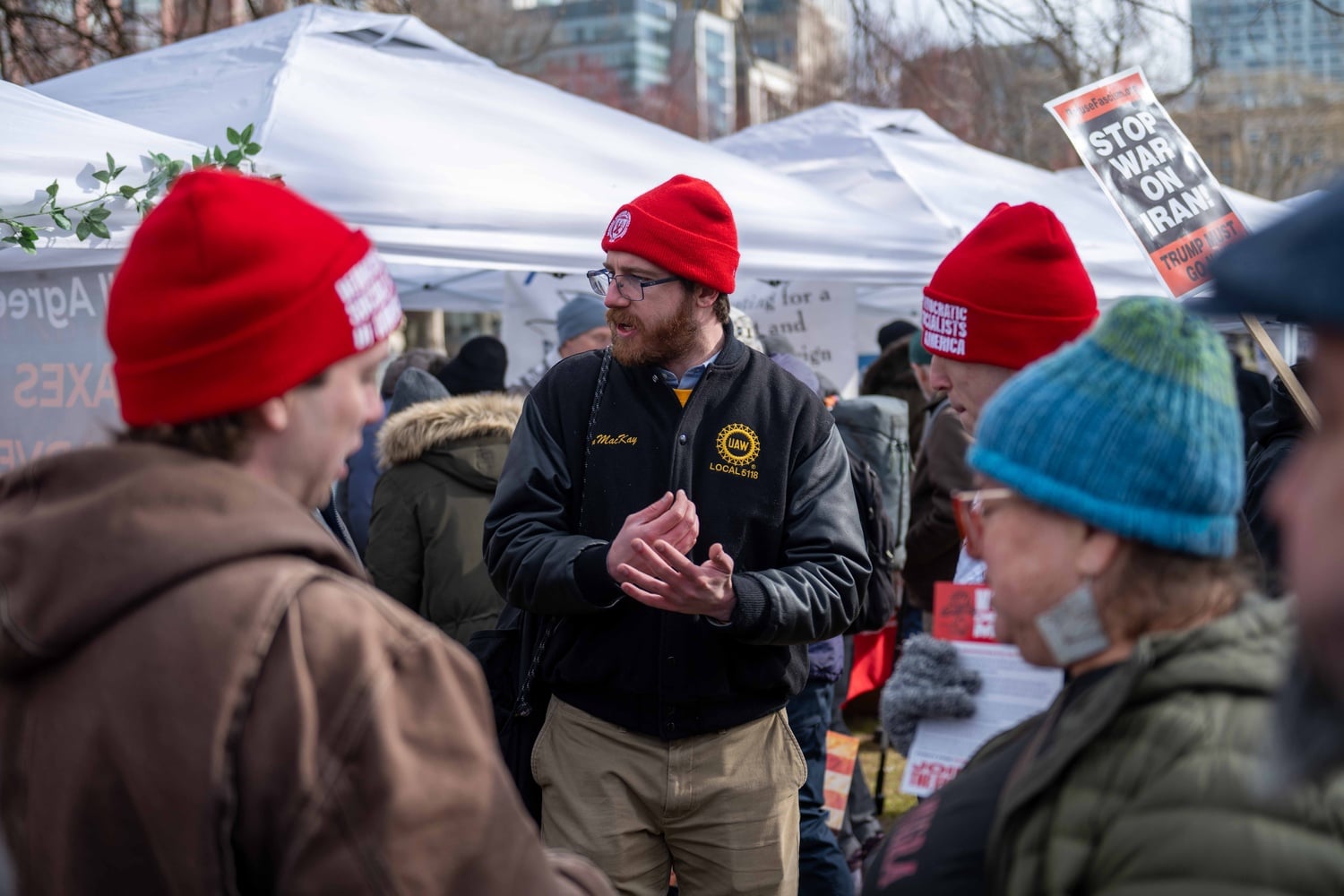
These words come back to me three weeks later at the Boston No Kings protest. Organizers say that 180,000 people attended the protest. American flags of all colors (rainbow, black, white and more) and orientations (upside down, inverted, or plain) occupy the space just above people’s heads, where hats and hoods look like little buds several feet above the grass.
I cross diagonally at the intersection of Charles and Beacon Streets, where the back of the stage rises up to my left. Judging by the muted call and response between speaker and audience, the program has just begun. I look for MacKay, who’s singing with the choir group Boston Voices of Community and Labor early in the program. After searching for several minutes, I find them standing near the barricade that separates the spectating area from backstage. They’re wearing a dandelion yellow “BVOCAL!” t-shirt, standing just apart from several dozen other yellow-shirted folks waiting to enter the stage. We chat briefly, and MacKay catches me up on a busy day: that morning, they’d conducted street canvasses in Porter Square, Cambridge Common, and Harvard Square, in a dual effort to speak with voters and bring them out to No Kings. They point me in the direction of the DSA tent, way off on the other edge of the Common, and we plan to meet up after the choir performance.
I pass through a metal detector to reach the standing area directly in front of the stage, finding some space next to two middle-aged guys towards the back. The choir has just come on stage, and the platform can hardly hold them all. It takes me some time to identify MacKay in the back row, their red hair peeking out above the bodies.
The choir leader directs a group in a song that I — and, judging by the looks of people around me, the crowd — have never heard. “Hostile government takeover // Takeover, take-take over,” the singers chant. “Due process rights are under attack // What do we do // Stand up fight back.” The song continues in this manner for several minutes, to minimal engagement. The guys next to me titter, cracking a few jokes while the crowd starts to slowly hollow — swathes of brown dirt become more visible as people drift toward the exits.
“Hostile Government Takeover” is followed by an energetic rendition of Twisted Sister’s “We’re Not Gonna Take It” — wherein singers rhyme the title with “this bank is funding hatred.” The performance ends, the choir leaves the stage. Anticipating my later rendezvous with MacKay, I move toward the exit. Before I can get there, the emcee announces the next speaker: Massachusetts Governor Maura Healey. I pause.
The applause has suddenly become much, much louder. “250 years, we haven’t had kings in Massachusetts, and we’re not going backwards,” Healey begins. The crowd roars its assent.
Healey speaks for six minutes, articulating a passionate policy-oriented rebuke of President Donald Trump. She mentions legislative victories on abortion and healthcare. She champions the recently-passed PROTECT Act, which limits local law enforcement’s cooperation with ICE. She calls on voters to continue to resist at the ballot box and in the community. “Fight for this democracy, fight for our great country. I’ll be out there with you,” she concludes.
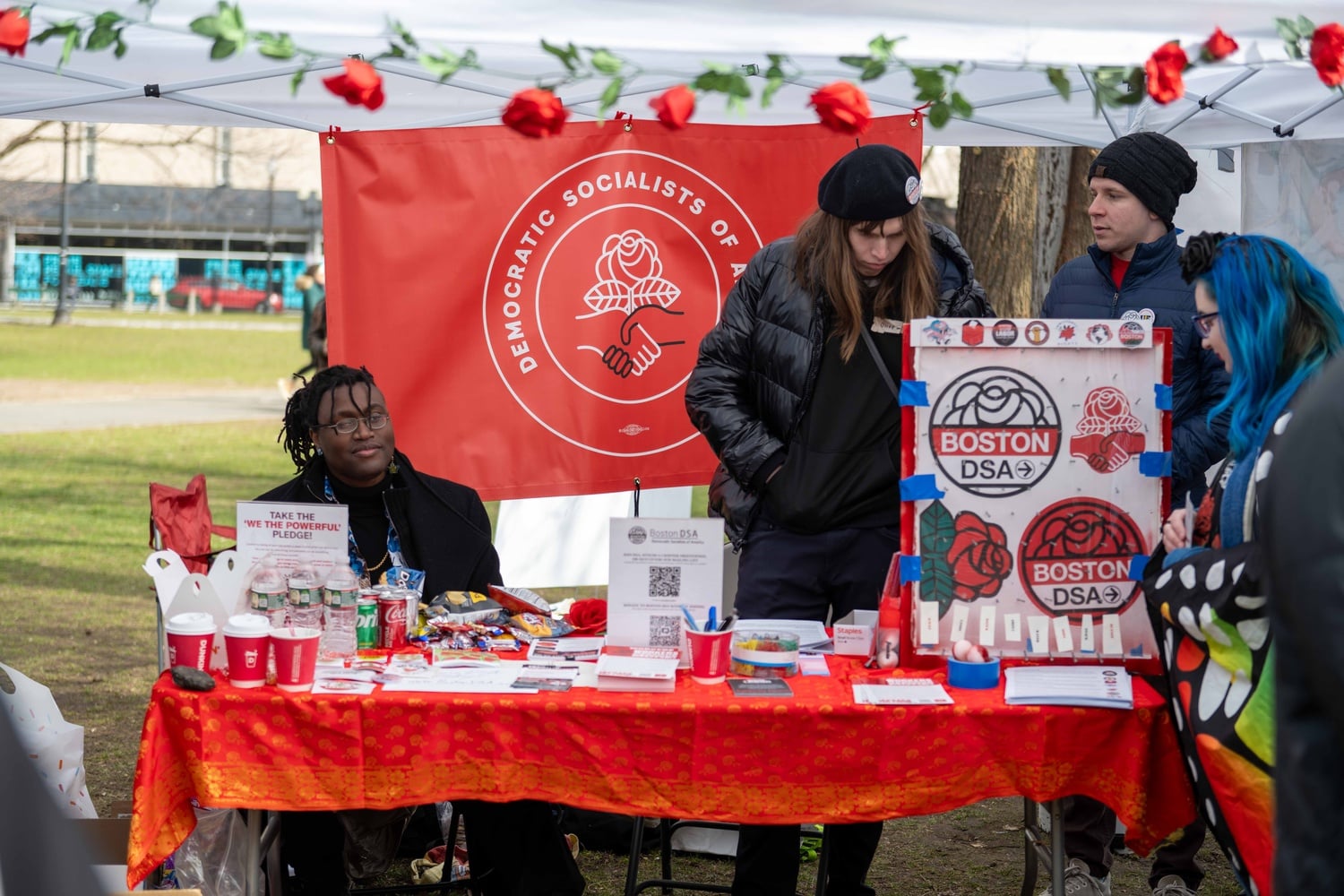
After Healey’s speech, it takes me a while to find the DSA tent, which is clustered among dozens on the opposite side of the Common. I walk past the American Civil Liberties Union, the Revolutionary Communists of America, and others before finding the DSA tent. A large poster of a red rose, DSA’s logo, signals I’m in the right place.
The crowd outside the DSA tent is consistently larger than those congregating outside the others. I speak to a few passers-by, and their interest is action-oriented. One person is drawn to the Ecosocialism Working Group because their tech job has made them realize the environmental impact of artificial intelligence. Another is a “big fan” of Uyterhoeven — a subject the DSA member speaking to them deftly dodges — but wants to get involved in working groups as well.
I attempt to reconnect with MacKay, but they are assailed by members and acquaintances vying for their time — seemingly everyone wants them to meet someone else. At the end of each of these five-minute mini-audiences, MacKay says “solidarity” rather than goodbye. The lingo reminds me of a campaign event during which MacKay directed listeners to chant “shame” when they heard something they don’t like.
“I’m very happy that these events happened, and I’m very happy that DSA is here,” they tell me when we find a couple minutes to talk. “I think that this is a moment of crisis for the political establishment, and DSA is leading in that gap.”
But DSA is only a small part of today’s resistance. I recall the signs — attacking U.S. President Donald Trump, or U.S. Vice President JD Vance, or U.S. Defense Secretary Pete Hegseth, or expressing broad discontent. I recall the cheers — loudest for Healey, a Democrat who’s been involved in politics for 20 years. I recall the setup — DSA just one of many tents offering action to a small fraction of the masses listening to the main stage.
The Weeks that Feel Like Decades
t the end of nearly every interview, I ask some version of the same question: On the arc of democratic socialism in America — stretching back to its origins — where are we now, and where are we going?
The responses vary widely.
Most members agree that DSA is growing. Beyond that, there is less consensus. Is this momentum sustainable? What would success look like —and where would it occur? How long would it take? And does DSA’s rise signal a turning point in American politics, or something more ambiguous?
The answers to these questions will define DSA — and to some extent, the country — in the coming decades. Members look to Sanders and Mamdani to carve out a permanent space for socialism in public office. In Cambridge, MacKay and others try to set themselves apart from Massachusetts’ already-progressive politics. Those within the still small organization are generally hopeful, but conscious of the precarity of opposing the political establishment, capitalism, and all that comes with it.
“The ball’s in our court. It’s ours to lose,” Grosser says. “I’m scared as shit.”
—Magazine writer Wyatt J. Meyer can be reached at [email protected].
Want to keep up with breaking news? Subscribe to our email newsletter
Have a tip for The Crimson? Share it confidentially