Inside Out
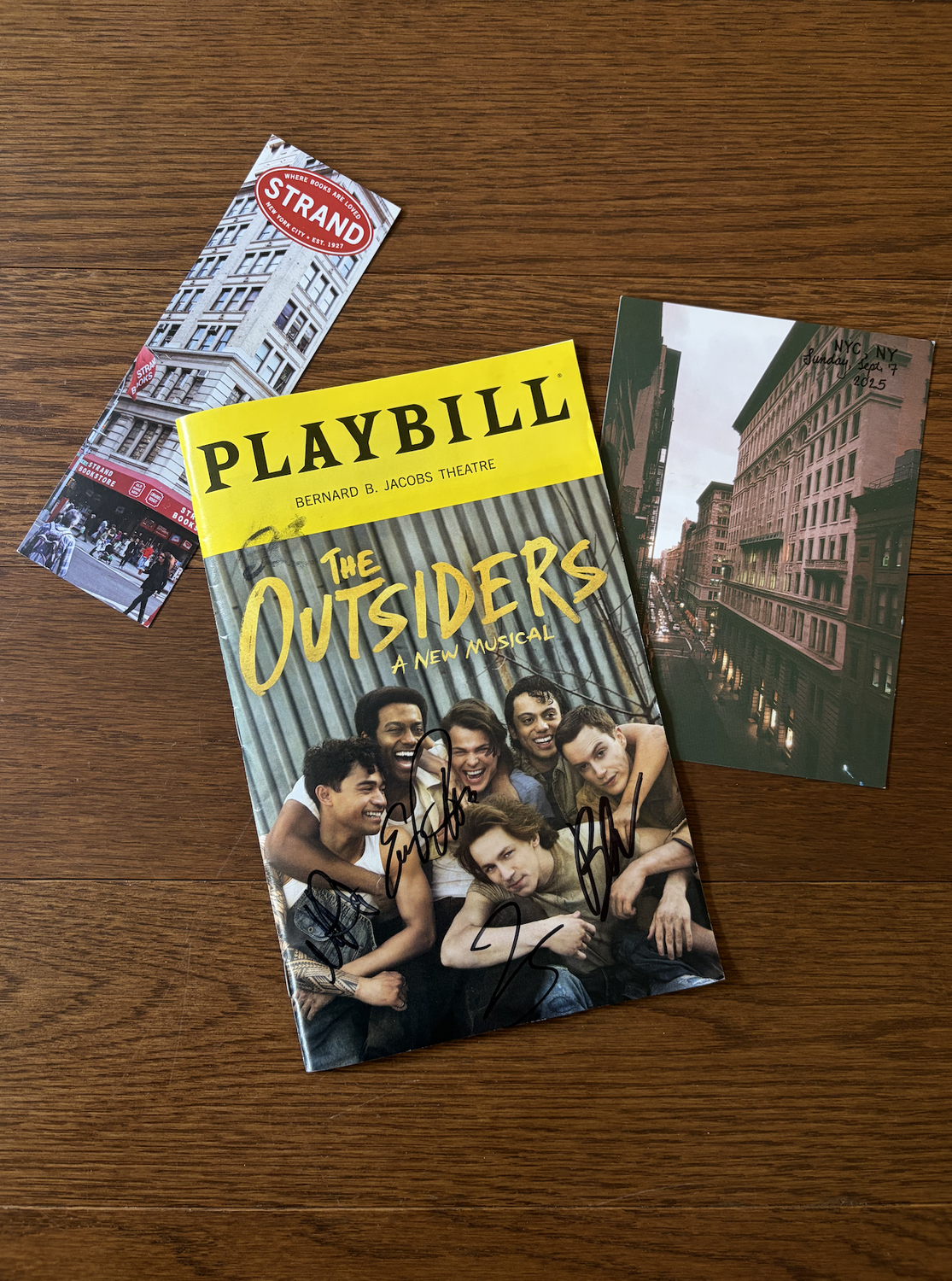
My clothes had just recovered from being drenched in water from the heavens when the protagonists of Tony Award-winning musical “The Outsiders” ran into a burning cathedral and all the water in my body started leaking out of my eyes.
t was raining when we hobbled into New York that morning.
Turns out “we’ll sleep on the way” is a lot easier said from a beanbag in your dorm while booking a 1 a.m. Greyhound than done when said bus is grand jeté-ing over every pot-hole on the interstate at an ambient temperature of 40 degrees.
Spirits undampened, we set out in search of entertaining indoor activities that were quintessentially NYC and also open at 5:30 a.m. This led us first to a diner with mediocre toast and a wall lined with signed photos of what surely were celebrities, then to a coffee and bagel place where my sleep-deprived flirtation with the cashier was fatally interrupted by my roommate ordering a $5 rainbow bagel with bright blue cookie monster cream cheese.
Unfortunately, neither the rain, nor the coffee, nor even the rainbow bagel can explain why I spent 10 minutes in a theater bathroom humping a hand dryer that afternoon. Actually, my clothes had just recovered from being drenched in water from the heavens when the protagonists of the Tony Award-winning musical “The Outsiders” ran into a burning cathedral onstage and all the water in my body started leaking out of my eyes.
***
“I had decided long before you,” my dad told me when I was maybe 10 years old, “that if I had a son I would raise him like a girl. And a daughter I would raise like a boy.”
Good, I remember thinking. We were best friends even then, single parent and single child, and he was the buffer between me and all the crazy women in our lives. My mom was divorced from my dad (and sometimes reality), my aunt spent her days scheming to take over the family fortune, my other aunt worked longer hours at home than at the hospital, and my pregnant third-grade teacher once threw a student’s pencil case out the window. In the second grade, my (soon to be former) friend Sophie had a “birthday party” during which she entrapped her friends into sitting around basins of water while women painted our nails in Prepubescent Pink and Rotting Peach.
I wanted nothing to do with femininity.
As hormones claimed their victims, I noted with satisfaction all the ways I naturally wasn’t girly: the makeup that never appealed to me, the drama I never created, and, most of all, my physical inability, no matter the circumstance, to shed tears in public. I was sanguine, mature, hassle-free. In eighth grade, Mr. Thompson told me I was invincible, and for the rest of the week I glowed with pride.
Men had their own problems, I well knew. But I would rather spend my life repressed than sad.
***
“The Outsiders” was first a book, then a movie, and is now is the Tony Award-winning musical we waited two hours to get tickets for. It’s like if “Grease” was written by someone who had actually met a greaser.
It’s also what happens when a 16- year- old girl writes about tough working-class guys: the protagonist, Ponyboy, is flawed and sad and loves sunsets, and doesn’t want to be a car mechanic but also doesn’t want to betray his family.
While we were huddled under the meager awning of Bernard B. Jacobs Theatre, I wasn’t expecting much more than fond nostalgia for seventh grade, when we all thought we had already come of age and wished the boys we knew, if they couldn’t be sensitive and misunderstood, would at least have the decency to have better forearms.
It was right after intermission. We were settled in our seats, wrappers unwrapped. My roommate, who sobs at “Shrek,” swiped at her eyes. The music crescendoed, and I could feel the air tightening, the goosebumps on my arms. The punches, I knew, were about to start rolling.
I’ve read “The Outsiders.” I’ve seen the movie. I know how this story ends, and we hadn’t even gotten to “Stay Gold.”
I could’ve kept it together. I’ve made it out of a great variety of sad things with nary a sniffle: “Brokeback Mountain” and “Hadestown,” “Bridge to Terabithia” and ‘The Kite Runner,” the “Modern Love” section of the New York Times, having to leave Girl Scout camp early because I sliced my thumb open with an X-ACTO knife and needed stitches, even — it’s true — the opening sequence from “Up.”
But then Ponyboy turns towards the left orchestra section. For a moment, I swear he looks right at me, eyes bright under the spotlight. His friends lie at eerie angles around him. They are going to die whether anyone cries about it or not, which I’m sure he knows. We understand each other, he and I — we are men of the world. Impossible to say that his problems are smaller than mine.
Not crying won’t make them fixable, he seems to say back to me, those things you are so proud of not crying over.
And there I was, stubbornly stony-eyed, set inside the hard lines of the mold I had poured myself into. I was 19 and all I knew about myself was that I could keep it together.
What a waste all my insistence suddenly seems. Remain unmoved, and everyone still dies. All you are left with is blood and water, bodies on stage. All you get from refusing to mourn is the ability to pretend you’re unscathed. I am not so sure there is anything admirable in that.
You know what, I think. Fuck it. And there, in the darkness of the theater, between friends and a thousand strangers, for the first time outside of my room: I cry. Ponyboy cries with me.
According to Aristotle, the primary role of art in a rational society is catharsis. By this he meant, as an English professor of mine loved to expound, not a release of emotions but a proper ordering of them. In a society that tells you to grieve some deaths but not others, to worry about filing your taxes on time and not about stepping on ants, art gives us a destination for all the compassion and fear in us that doesn’t have a place to go.
Who, I wonder as my tears run down into the remnants of my reasonable and adult jalapeno-cheddar bagel with scallion cream cheese, am I crying for? Dally, because he forgives his brother, or me, because I won’t call my mom?
As I emerge blinking into the sunlight, it’s true that I don’t feel lighter, like I have let something go (any mucus I released is caked into my jeans in an attempt to spare the velvet seat cushions), but centered, like something has settled. Maybe crying really is good for your skin.
Of course, no amount of philosophizing will change the fact that what made me have what my editor for this piece has irritatingly dubbed “an emotional breakthrough” is a bunch of hunky guys getting misty-eyed in a Broadway musical that would never pass the Bechdel Test.
But a few weeks later, when my dad calls to tell me, as he often does, how much fun he’s having now that I’m gone, I laugh along with him and then book a plane ticket home.
***
What my dad actually meant, of course, was he wanted to raise a girl who knew her own strength and a boy who was strong enough to cry. Having sobbed a piece of my soul into the dark of a New York City theater, I suppose I have, finally, become my father’s son.
—Associate Magazine Editor Megha Khemka can be reached at [email protected]
Want to keep up with breaking news? Subscribe to our email newsletter
Have a tip for The Crimson? Share it confidentially