The Robber Barons Are Back
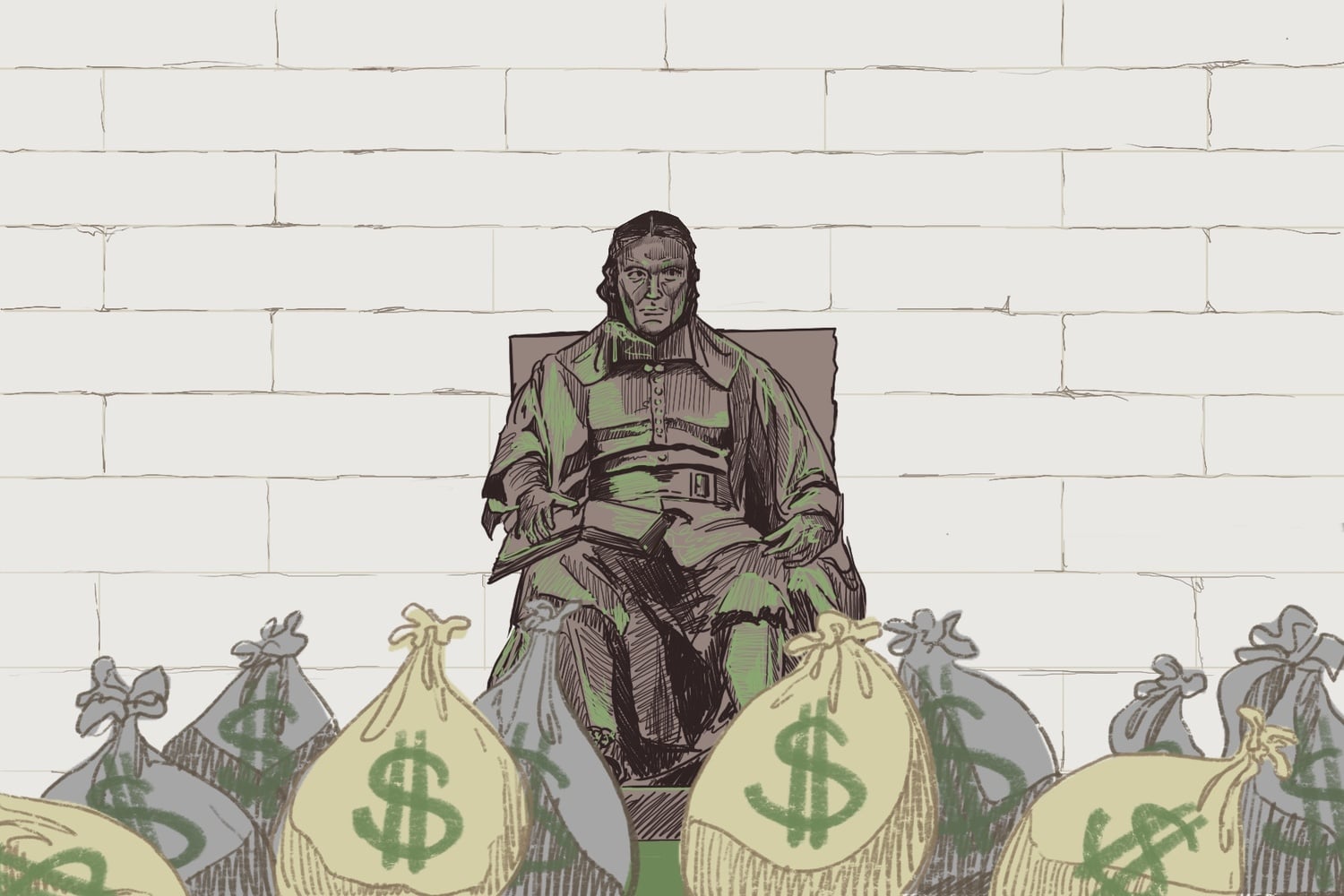
In 2024, the most common reason American students cited for considering dropping out of college was financial challenges. At Harvard, dropouts face a different problem: they’re drowning in cash.
Since 2010, around 235 undergraduates per year have taken a leave of absence from the College. While Harvard reports an overall graduation rate of 98 percent, only 56 percent of students graduate within four years. With the bureaucratic barriers low, the funding seemingly unlimited, and the prospect of a Zuckerbergian success staring down each incoming class, students seem to be jumping at the idea of risking it all to win big.
But how many actually hit the jackpot? An estimated 75 percent of venture-backed startups fail. More concerning, however, is not who falls into entrepreneurship’s tight grasp, but rather who misses it entirely. While young dropouts flock westward in pursuit of a new American dream, the rest of Generation Z lags farther and farther behind, fueling an already growing lack of faith in elite institutions.
The United States is reckoning with an ever-worsening social crisis: a simultaneous devotion to, and disillusionment with, meritocracy. On one hand, college students are graduating into one of the worst job markets in recent history. As of February, nearly 11 percent of new workforce entrants are unemployed, and extreme competition mixed with dwindling supply has diminished the entry-level job market.
On the other hand, the leaders of the AI craze are telling you not to go to college at all: Elon Musk described colleges as places “not for learning” and urged students to drop out. In 2021, Vice President JD Vance delivered a speech titled “The Universities are the Enemy.” Palantir’s Meritocracy Fellowship, an internship program for recent high school graduates, implores its applicants to “skip the indoctrination” of higher education and “get the Palantir degree.”
But if college isn’t important, why do nearly 27 percent of venture capital-backed founders hail from Ivy League schools alone? If universities are the enemy and education is indoctrination, why are more and more employers again beginning to recruit from a select few schools?
The world’s wealthiest are drilling into our minds that it is not education, but raw talent and grit, that separates success from failure, yet the means to actually maintain wealth are becoming increasingly inaccessible. For those that already confer massive advantages, meritocracy is alive and well. For the rest, it’s already dead.
A Yale University committee released a report last Wednesday attributing a growing loss of faith in higher education to none other than higher education itself. When universities trap themselves in an endless struggle between serving the world and serving themselves, they erode public trust. When some dropouts view education as a waste of time and even develop tools that contribute to its decline, it begs the question: How can we have faith in an education system that doesn’t even seem to have faith in itself? Slowly but surely, the University is fueling its own destruction.
Such a disconnect represents what economists call the “K-shaped” economy: The wealthy are thriving, driving much of increased spending and economic growth, while the rest are fighting to make ends meet. These issues may be exacerbated by a concerning AI boom: data centers are cropping up around the country, chip production is dependent on fragile energy supply chains, and tech companies finance AI startups — who then become those companies’ customers — in a seemingly self-fulfilling loop. We are placing a great amount of faith in an increasingly precarious system, and its cracks are beginning to widen.
In an economy that constantly strips us of our power and agency, it only makes sense for those just entering it to seek some sort of control. Be your own boss, make your own schedule, answer to no one. It’s a lie we’re sold again and again — that a billion-dollar success is right around the corner, if only we worked hard enough. There is so little gold to go around, but inevitably we must go out west and try to strike it rich.
It’s no secret why Harvard has an indefinite leave of absence policy. Students that find gold can come back to Cambridge, fill the University’s pockets, and preserve the Harvard name as a symbol of risk-taking and success. Yet, as a result, we’re increasingly divorced from the majority of graduates struggling to even find work in the first place.
Higher education is a vital component of social mobility. If the University wants to fix its public relations crisis, it must actually serve public interest. If the University wants to survive the AI age, it must invest in the structures and systems that will outlive it.
When the AI bubble finally bursts, the Harvard dropout will have nothing to worry about. But what will happen to everyone else?
Sylvia A. Langer ’28, an Associate Editorial editor, is a Molecular and Cellular Biology concentrator in Currier House.
Want to keep up with breaking news? Subscribe to our email newsletter
Have a tip for The Crimson? Share it confidentially