2 Many Leaders, No Leadership
If two heads are better than one, why do so many student organizations with two presidents seem directionless?
Unlike all of its Ivy League counterparts, Harvard’s undergraduate student government is peculiar in that it has a co-presidency rather than a single president. What’s more, Harvard’s epidemic of co-presidencies doesn’t end at our student government — many Harvard clubs follow this partner model.
Co-presidencies are appealing: two leaders should bring complementary strengths and support each other throughout their tenures.
However, it’s far more common that this partnership leads to confused decision-making and an uneven workload split. It’s the typical group project dilemma: someone will almost always end up doing more work than their partner, simply by way of taking on more cumbersome tasks. For the sake of clarity and fairness, it makes far more sense to create a single executive with a strong board to carry out their given tasks.
Concentrating leadership is also a more effective (and fairer) arrangement insofar as it clarifies accountability. In a single-president model, responsibility is clear. One person sets direction and answers for outcomes. Executive boards and general members know exactly whose guidance to follow, which is near impossible when there are two presidents who may diverge in tone or priorities.
Conversely, when something goes awry, club members know precisely who to come to with their complaints. This also applies to those outside the club. If a constituent disapproves of the Harvard Undergraduate Association, for instance, the buck stops somewhere between one co-president and the other, but where and with whom is uncertain.
This miasma of accountability that co-presidencies create is not only a question of clarity — it’s one of coherence. When the ultimate court of appeals is two people with equal standing, internal division often follows. It’s the classic play of asking your mom, and when she says no or gives a vague answer, going to your dad for a yes. Over time, this ambiguity can fragment organizations as members informally align with one leader, the other, or disengage altogether.
It’s not just student members who may be disengaged, either. Again, as in a group project, those who aren’t saddled with the majority of the work have less incentive to be involved whatsoever. In a pre-professional landscape like Harvard, it’s not difficult to imagine the utility of the co-presidency as a title that can be authoritatively slapped onto a LinkedIn page, but which carries far fewer actual obligations. The result is a student body caught in a web of co-presidencies, where, in seeming to be bought into everything, no one is truly bought into anything: “to hunt in the morning, fish in the afternoon, rear cattle in the evening, criticise after dinner.”
This isn’t to say that shared leadership is never effective, just that it’s rare. Co-presidencies can function well with proper chemistry and delineation of tasks. Teams function best when responsibilities are distributed. But there’s a large difference between shared input and shared authority.
A prime example of this is The Crimson’s Editorial Board itself. The Editorial Board consists of many associate editors and is run by two co-chairs, but a single president reserves ultimate responsibility for all content.
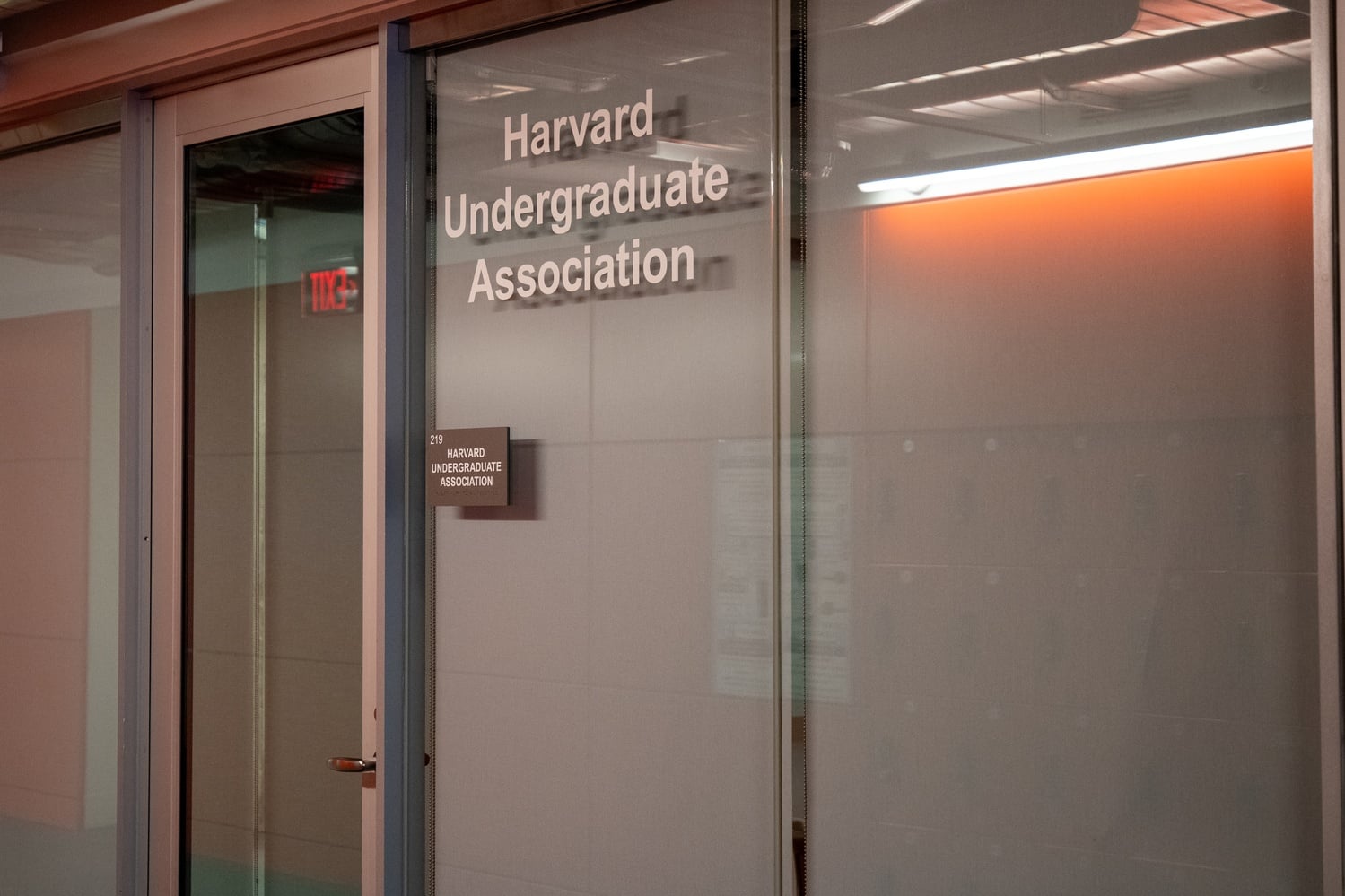
While bloat at Harvard is nothing new, the proliferation of co-presidencies among student groups is problematic. This is perhaps exemplified by the HUA — a body responsible for advising other student organizations, and one whose arguably limited capacity is compounded by a nonsensical, counterproductive leadership structure.
It is encouraging (and instructive) that the leaders of the Institute of Politics — ostensibly comprising some of Harvard’s most politically-inclined students — recently scuttled a plan to introduce a co-presidency following internal student resistance. Now, for the sake of broader club leadership, the same change is demanded of undergraduate government.
Otherwise, as Hamilton warns in Federalist 70, “A feeble executive implies a feeble execution of the government. A feeble execution is but another phrase for a bad execution: And a government ill executed, whatever it may be in theory, must be in practice a bad government.”
Jackson H. Barr ’29, a Crimson Editorial editor, lives in Canaday Hall. Taylor P. Beljon-Regen ’29, a Crimson Editorial editor, lives in Thayer Hall.
Want to keep up with breaking news? Subscribe to our email newsletter
Have a tip for The Crimson? Share it confidentially