Former NJ Governor Chris Christie Criticizes Gay’s Testimony, Says Universities and Trump Mishandled Antisemitism
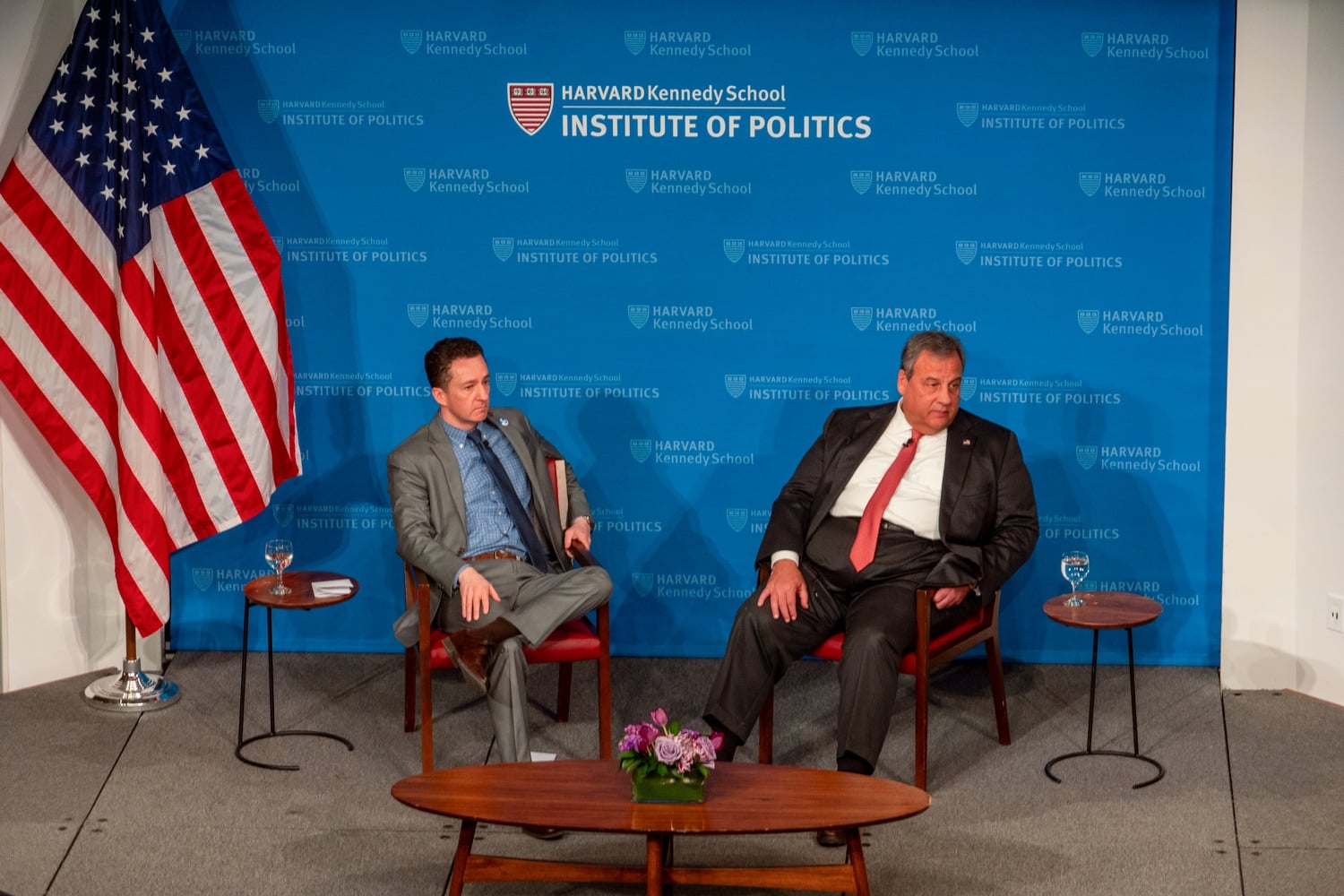
Former New Jersey Governor Chris J. Christie said Monday that both university leaders and politicians have mishandled campus antisemitism — calling former Harvard President Claudine Gay’s congressional testimony a failure of leadership and U.S. President Donald Trump’s response an overreach.
Speaking at a packed Institute of Politics talk, Christie sharply criticized Gay’s appearance before the House Committee on Education and the Workforce in December 2023, where she testified alongside the presidents of the University of Pennsylvania and the Massachusetts Institute of Technology.
“The testimony by some of the university presidents, including the one here, in front of Congress, was an unmitigated disaster,” Christie said. “You’re in charge of a university that is educating America’s youth. You have an obligation to answer some questions in a way that makes people think that you’re in touch with reality.”
Gay’s testimony drew national attention after a tense exchange in which she said that calls for the genocide of Jewish people would not necessarily violate Harvard’s policies on bullying and harrassment, instead depending on the context. The exchange quickly went viral and ultimately accelerated her shocking resignation from Massachusetts Hall in January 2024.
Christie dismissed the responses given by Gay as “just ridiculous,” arguing they eroded public confidence in higher education at a moment of heightened concern over antisemitism.
But Christie said that the political response — particularly from Trump — has been equally flawed.
“I think you’ve got a problem that needed to be fixed, and he screwed up fixing it,” Christie said.
He criticized the White House’s efforts to pressure universities by threatening to withhold research funding, arguing that such tactics have failed to produce meaningful change.
“He goes at it with a meat ax, rather than a scalpel,” Christie said. “He attacks a problem that can be excised and he does it and he just bloodies the whole thing.”
Spokespeople for Gay and the White House did not respond to requests for comment.
Get The Crimson in your inbox.
Christie added that attempts to force universities into compliance through federal pressure have largely backfired, weakening both the institutions themselves and broader efforts to address antisemitism.
At the same time, Christie argued that universities have contributed to their own political vulnerability, pointing to what he described as a lack of ideological diversity in faculty hiring.
“Part of the universities’ problems are self-inflicted, in my view,” Christie said, adding that concerns about political bias in academia have fueled backlash from both policymakers and the public.
He cited an anecdote about Princeton University to illustrate what he sees as a broader trend.
“I was at a conference when the president of Princeton was asked how many of your humanities professors are right of center, and he said 15 percent,” Christie said. “I texted my son — who is a Woodrow Wilson School graduate at Princeton.”
“He said, ‘take a one off the front,’” Christie added.
That perceived imbalance, Christie argued, has made universities more susceptible to political attacks — even as he maintained that those attacks have often been counterproductive.
Beyond higher education, Christie delivered a sweeping critique of American politics, arguing that both major parties are failing to meet the moment.
“Anybody who follows politics right now can tell there are no principles left in my party,” Christie said of the Republican party today. “Even for people who agree with some of the stuff the president’s doing, if you’re really honest with yourself, you know it’s not based on principle.”
Christie also criticized Democrats, saying they have relied too heavily on warning about threats to democracy without offering a compelling policy agenda.
“Democrats are wrong to focus on the threat to democracy,” he said, arguing that elections in the United States will continue, even as structural issues like gerrymandering persist.
Instead, Christie framed the country’s political challenges as a broader crisis of trust.
“He’s not a threat to democracy,” Christie said of Trump. “He’s a threat to the underlying institutions — their validity, their soundness.”
“The American people have never had less trust in their institutions than they do right now,” he added.
—Staff writer Sophia E. Alcacer can be reached at [email protected] and Signal at sophiaalcacer.88. Follow her on X at @sophiaalcacer.
—Staff writer Jen L. Phan can be reached at [email protected] and Signal at jenphan.74. Follow her on X at @jenllphan.
Want to keep up with breaking news? Subscribe to our email newsletter
Have a tip for The Crimson? Share it confidentially