Former German Chancellor Says U.S. Bid for Greenland Difficult to Square With International Law
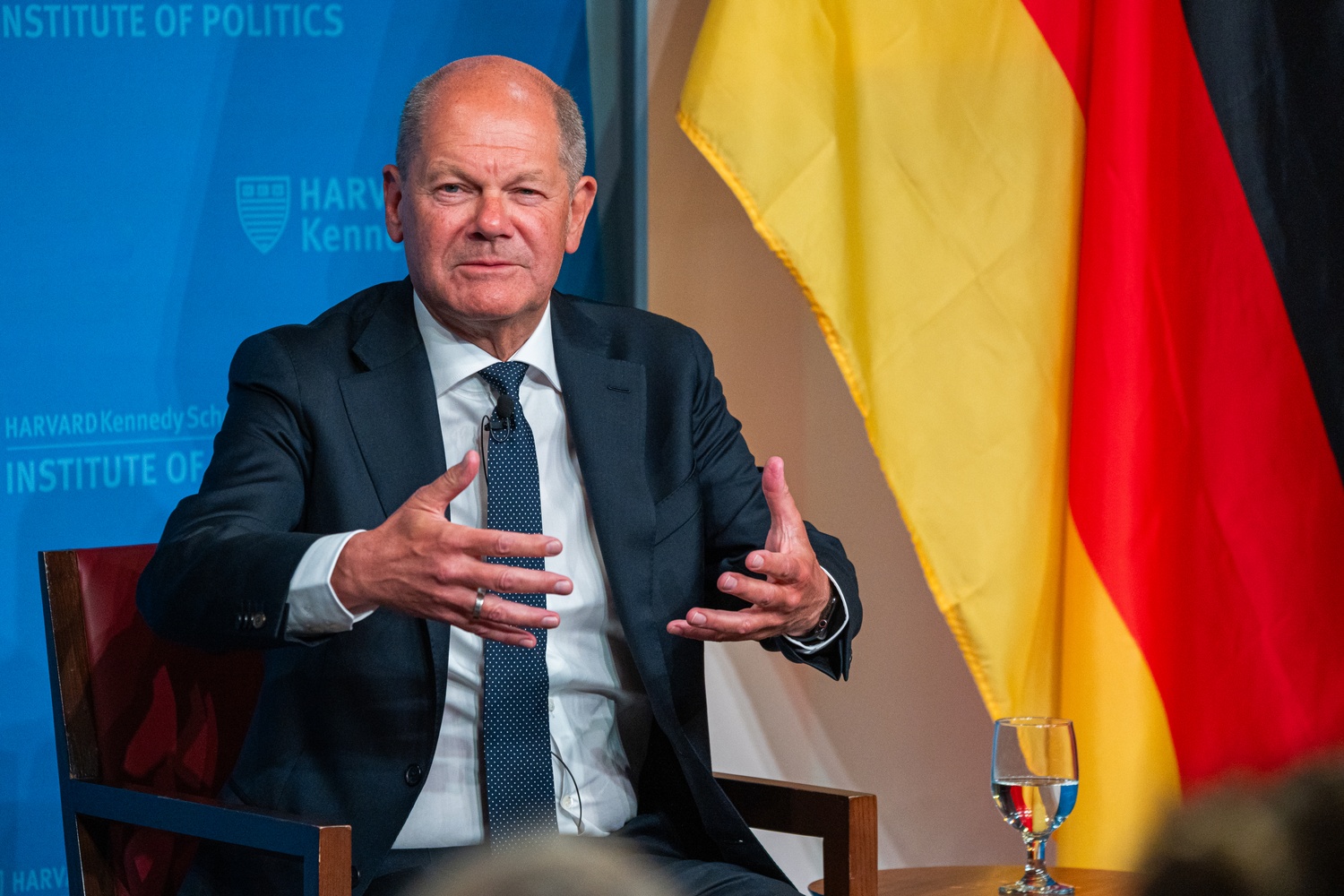
Former German Chancellor Olaf Scholz said United States President Donald Trump’s bid to acquire Greenland is difficult to reconcile with international law at an Institute of Politics forum on Thursday evening.
Scholz warned that the postwar rules against redrawing borders by force are now under pressure from Western powers and Russia, and pointed to the war in Iran as evidence that Europe cannot rely on American munitions indefinitely.
The forum was moderated by Harvard Government Professor Daniel F. Ziblatt.
Scholz, who served as Germany’s ninth chancellor from 2021 to 2025, traced the foundations of the rules-based order to philosopher Immanuel Kant’s 1795 essay on perpetual peace, which he said laid the groundwork for the United Nations Charter and the German constitution’s commitment to international law.
“It is difficult to see how recent actions taken by the United States regarding Greenland, Venezuela, or Iran could possibly be compatible with international law,” Scholz said.
He argued that the same principle that condemns Russia’s war in Ukraine must apply to powerful states everywhere.
“No state is merely the backyard of another global state,” Scholz said. “Every state, regardless of its size, has a right to territorial integrity.”
Scholz called Russia’s 2022 invasion of Ukraine a “turning point” because it broke with the principle that borders cannot be redrawn by force. He defended his decision that year to send German weapons to Kyiv as a sharp departure from postwar precedent.
“It was post-war praxis of my country that we did not deliver weapons into hot conflicts,” Scholz said. “So this is a big change.”
Get The Crimson in your inbox.
With Sweden and Finland joining NATO, Scholz argued, the response left Russian President Vladimir Putin further from his goals than when the war began.
When asked about strains in the U.S.-Europe relationship, Scholz urged European countries to expand their own defense capacity in the long term while preserving the transatlantic alliance.
“It would make no sense to break the transatlantic partnership,” Scholz said. “Since we are all democracies, and the United States is the oldest democratic republic in the world, it seems to be very important that we fight for it to continue.”
Scholz cautioned that meaningful European defense autonomy would take “a long time” to build. The recent war in Iran, he said, had shown that European stockpiles were insufficient to sustain a prolonged conflict without American backing.
He also linked the rise of the radical right in Europe — including Germany’s Alternative für Deutschland, now the largest opposition party in the Bundestag — to anxieties about a shifting global order. The economic rise of the Global South, he said, “creates a certain unrest that people aren’t sure that the future will be with them.”
Scholz claimed that right-wing populists capitalize on that anxiety by blaming foreigners and political opponents instead of proposing solutions.
“They offer enemies in the country and outside the country,” Scholz said.
He urged European leaders to approach the Global South with humility, warning that the legitimacy of any rules-based order depends on whether it is seen as universal.
“Europe can still contribute to the success of global law, but it can and will do so as a self-assured equal among equals,” Scholz said.
Pressed by a student on whether he would have made different decisions on Ukraine in hindsight, Scholz said he would not.
“I wouldn’t do really relevant things different,” he said.
Want to keep up with breaking news? Subscribe to our email newsletter
Have a tip for The Crimson? Share it confidentially