Swings and Strings: A Look Into the Lives of Harvard Students Who Excel in Both Athletics and the Arts
Balancing athletics and academics is hard enough at Harvard. A select group of Crimson athletes adds art into the calculus of their time-management.

arvard has many talented varsity athletes who also thrive in the arts, adding to their busy schedules and finding joy in the process of creating and performing. Though interests like water polo and contemporary classical cello seem disparate, for these student-athletes, the lessons and joys students receive from both their art and their sport are remarkably similar.
Junior Kaiya Brooks captains the women’s cross country team and is also a pianist for the Harvard Jazz Orchestra. She’s been running and playing piano since around third grade, and she said both disciplines push her out of her comfort zone. When running, she is physically tested with an objective goal, always trying to top her previous time, and, with improvisational jazz piano, she leans into her emotions and creativity. However, both skills require significant training for her to perform at her best.
“I think I learned a similar lesson through both of them,” Brooks explained. “You have to have, sort of like a bridge between working super, super hard and controlling everything you can and practicing and practicing. But then, when it comes to it, also just being able to let go and express and kind of free yourself of all of that.”
Junior Lucie Stefanoni, a three-time All-American squash player who has gone 35-4 across her collegiate squash career, is currently pursuing a secondary in Art, Film, and Visual Studies (AFVS). Stefanoni finds that art injects a sense of freedom into her competitive squash matches.
“With squash, I feel like I’ve become more accepting towards making mistakes. Just knowing that it’s [an] inevitable aspect of the game,” Stefanoni said. “And then treating it as performance helps. Not seeing it always as competition, but sort of taking out who I’m playing, what team I’m playing against, and being like, ‘You know what? I’m just playing for me, I want to perform to the best of my capabilities.’ And I think treating it as performance sort of aligns with my natural inclinations as an artist. So it’s like you’re performing and creating something.”
Though Stefanoni describes painting as her “first love,” she remains dedicated to both art and sport, crediting her AFVS classes for enabling her to spend time in the studio outside of her busy schedule of academics and practice.
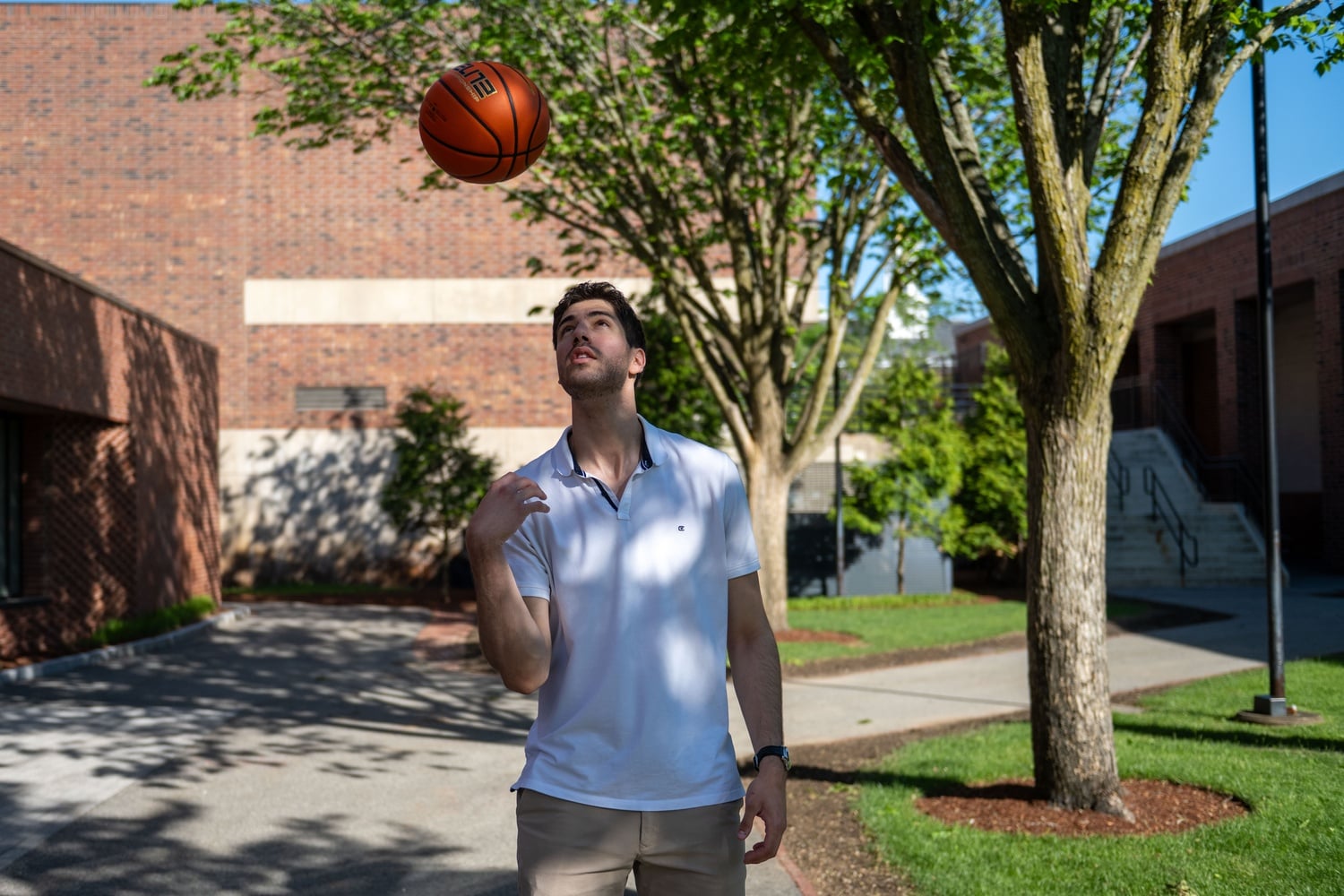
Evidently busy, freshman Avner Dror, a forward on the men’s basketball team, arrived at his interview with The Crimson with his guitar in hand, having just left the set of the First-Year Musical, where he performed in the pit. He said playing basketball from a young age has instilled a sense of discipline he uses when writing a new song, pushing him to stay on track and continue testing possibilities. On a more technical level, Dror said his musical prowess has helped him find his groove on the court.
“I think rhythm is very important in basketball. If you have rhythm in music, it helps your footwork on the court,” Dror said.
“It frees me a little bit. When you think of basketball like music, it’s like, how do I convey what I want to happen? There is something I want to do on the court, there is music, there is emotion I want to convey in basketball,” Dror added, explaining that he brings emotion and passion into his basketball play in a musical way, drawing from his artistic inclinations.
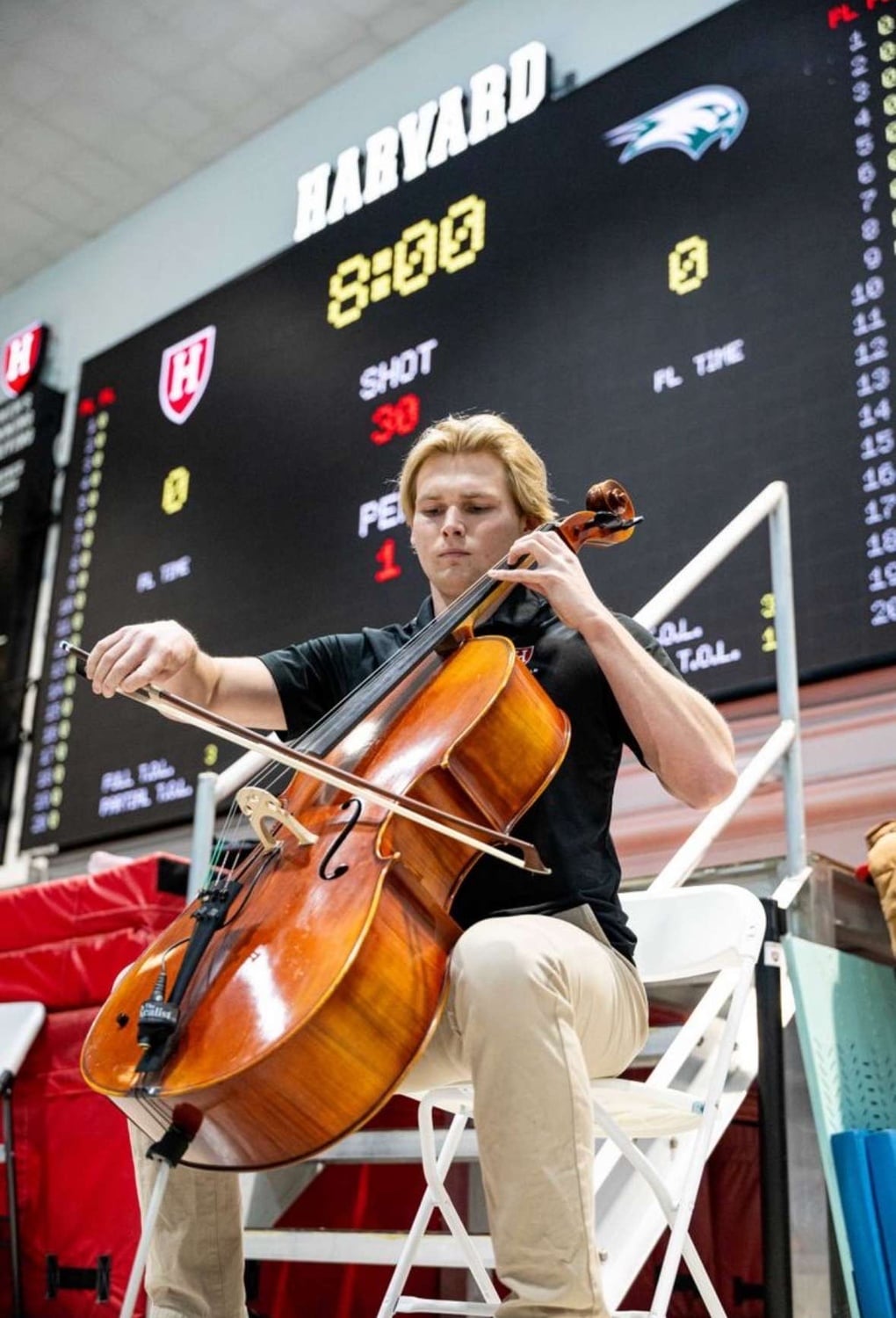
The influence of art on athletes isn’t just bound to land-based sports. Bradford Dickson, a junior attacker on the men’s water polo team, goes a step beyond practicing his art on Harvard’s campus — he is dual-enrolled at Berklee, where he is pursuing a degree in Cello Performance. He typically schedules his Berklee classes on Tuesdays, the one day the Crimson’s water polo team does not have practice. “Very much in the athlete fashion,” Dickson said he can be seen on his scooter, with his cello, as he heads to Berklee to arrive at rehearsals on time.
Dickson walked onto Harvard’s water polo team as a freshman and was named the program’s Most-Improved Player two years in a row — this season, he scored five goals and tallied eight assists. He said both his water polo team and his cello ensemble at Berklee help him learn and grow from his talented peers. For Dickson, his drive to play cello stems from a pure passion for the instrument, whereas with water polo, he wants to show himself that he is capable.
“Now I’m scoring in big games, and freshman year I wasn’t at all,” Dickson explained. “I’m trying to prove to myself I’m good enough and I can work hard enough to be there. And for cello, I just love it. I never regret picking up the cello and playing it. You know what I mean? I just absolutely love it.”
Dror similarly has an inherent love of music, which his mother says he has had since the day he was born. A songwriter, Dror spends much of his time listening to new music and finding inspiration from various basslines and chord progressions. Before coming to Harvard, Dror played for Team Israel at the 2023 European Championships, where the team finished second. His attention to creativity both increases his appreciation for others’ playing styles and adds originality to his own moves on the basketball court.
“When you shy away from that [uniqueness], you lose what makes you, you. You lose your originality. And for me, I also lose the joy of it. When I’m not me, it’s not as fun, right? Because I feel like I’m someone who I’m not,” Dror said.
Stefanoni said she is continuing to explore and expand her artistic style. Though she specializes in realism and typically uses acrylic paint, she has been dabbling in abstract art and has started using watercolor since it’s easier to clean up in her dorm. She sees both squash and painting as a respite from her challenging classes. By spending time on pastimes that bring her joy, she is able to be more mindful and focused on her academics.
“Being caught in the midst of finals or just a heavy workload amping up towards the end of the year, even taking like, 30 minutes to do a watercolor painting that I’ve been working on, I feel like it just reminds me that things aren’t that deep and there’s things I can enjoy and just sort of realizing that I can make things fun for myself,” Stefanoni said. “I guess with squash, it’s similar in that I just think taking a break during the day through exercise is just like releasing endorphins and then going back to doing work. It makes me more productive during the day. It just gives me more clarity and sort of lowers stress.”
In the future, Dickson doesn’t plan to stop studying music — after graduating, he hopes to earn a master’s degree in Contemporary Classical Music, which he describes as “atonal” and “crazy,” drawing influence from roots, rock, and classical musicians like Antonín Dvořák.
His peers on the team appreciate the music Dickson brings to practices and on long bus rides to games, and some have even been inspired to take up instruments themselves. Dickson said the only way he can handle his packed schedule is by integrating his two passions. After warming up for one match, he even played the national anthem on his waterproof carbon-fiber cello right before jumping back into the pool to compete.
Brooks, too, has whirlwind days, with her afternoon cross-country practice leading directly into her evening orchestra rehearsals. However, she doesn’t view her demanding schedule as a burden. She often thinks about how to balance unadulterated enjoyment with the pressure to achieve solid outcomes in both piano and cross country. Brooks strikes this balance, though, and practicing both uniquely clears her mind.
“I also love, about both of the disciplines, how they quiet my world in a way. I feel like, with running, when I’m just going for a long run, I just feel like my mind is so focused on just my breath and my steps and stuff that I just forget about all the noise around me,” Brooks said. “I think in some ways it’s like the dissolution of your ego. You just get so immersed in the flow state of the thing you’re doing that it’s like you forget about everything else.”
“I think the same thing happens to me with music,” the runner added. “I have a keyboard in my room, and when I’m just playing that alone, before going to sleep at night, I just feel like I am so present in some way, which is something that I think is very fleeting in my life here, because I’m always preparing for the future.”
—Staff writer Avani I. Shah-Lipman can be reached at [email protected].
Want to keep up with breaking news? Subscribe to our email newsletter
Have a tip for The Crimson? Share it confidentially