Strength and Conditioning: Building the Armor of Harvard Athletes
very student-athlete at Harvard is supported by a large network of professionals, including coaches, nutritionists, mental health staff, and a dedicated team of strength and conditioning trainers.
Coaches and trainers are specifically responsible for creating and executing training plans that optimize strength, speed, and efficiency for the largest Division I athletics program in the country, which boasts around 1,200 student-athletes across its 42 teams.
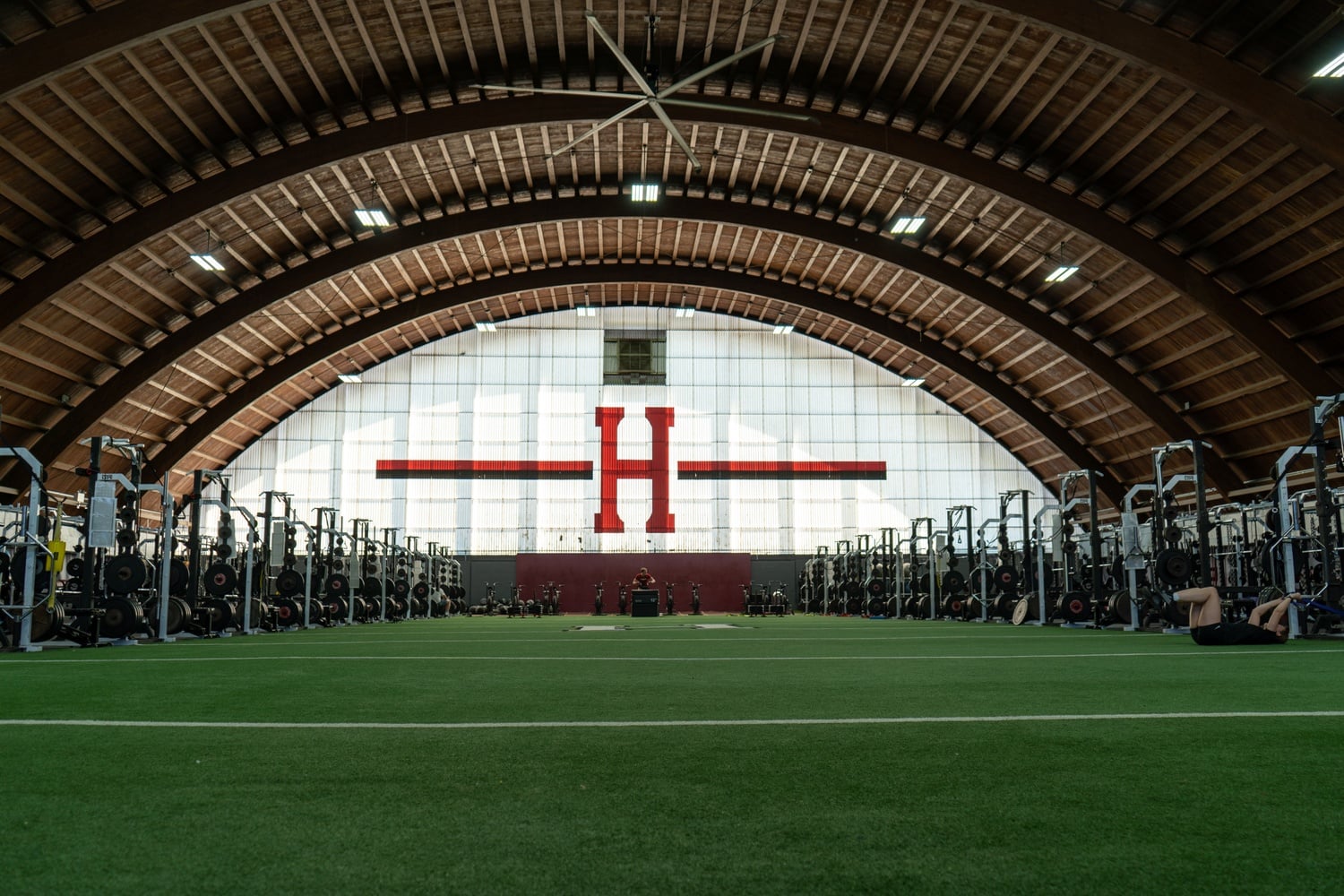
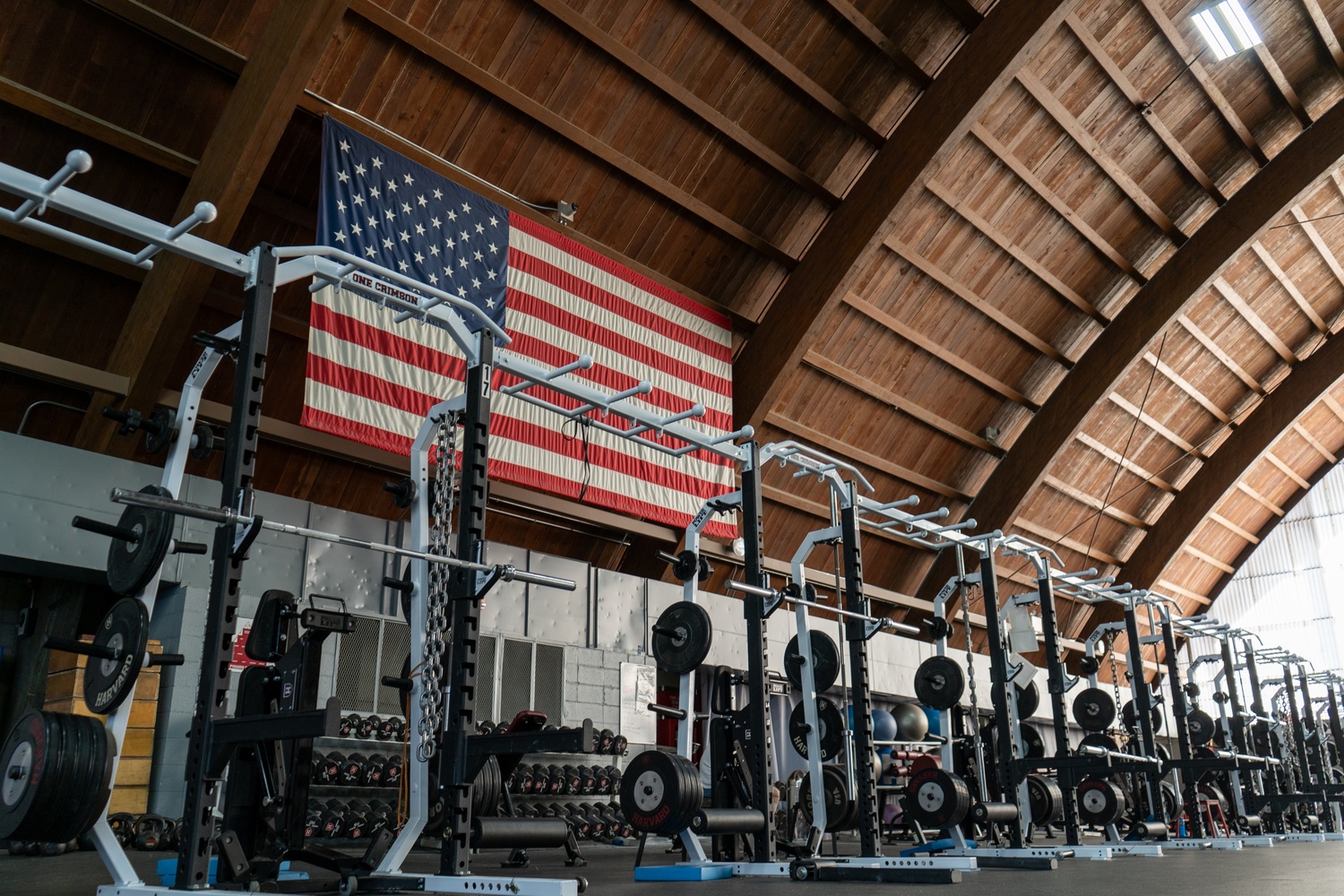
The large scale of the organization does not stop James Frazier, the Director of Strength and Conditioning, from greeting each athlete by name and running a full-service program that trains athletes methodically, efficiently, and compassionately out of Harvard’s Palmer Dixon Strength and Conditioning Center.
“We’re trying the best we can to help every single person in this department grow and become the best possible versions of yourself they can be, and, hopefully, win some championships in the process,” Frazier said about his staff.
Harvard and the rest of the Ivy League schools ensure that their student-athletes balance their rigorous academics and top-level athletics, which necessitates an efficient and effective strength and conditioning program. For Frazier, this means making sure that every aspect of the program, from people to exercises, is thoughtfully considered.

Frazier, the associate director, Tim Mullen, and assistant coaches Alex Curtis, Tim Kamibayashiyama, and Emily LoRusso are responsible for a cluster of varsity teams throughout the year.
The two goals of the program, Frazier said, are “to make our athletes as resilient towards injury as we possibly can, while getting them to be the best possible athlete they can be.”
Strength and conditioning falls under the preventative side of athlete health and performance, with the underlying hope that athletes become “so armor-proof that they never really need to go to athletic training for injuries,” the director explained.
The “armor” is the science and technology that is central to Harvard’s preventative resilience training. This can be summarized as a ground-based, three-dimensional, multi-joint movement approach.
Frazier is adamant about scientific principles supporting every aspect of the program to counter those who “view training and conditioning coaches as unscientific meatheads who just want to lift heavy stuff.”
Frazier broke down the important tenets of exercise science, explaining “sagittal plane, frontal plane, transverse plane. We’re going to utilize all those different planes.”
He also spoke to the diversity of the sports that Harvard’s program caters to.
“Once you join our training, we’re going to try to isolate certain movement patterns that we see across sports, and begin to integrate those patterns into more and more movements and more and more complexities over the course of time,” Frazier said.
Frazier, who was captain of the football team at Brown University, noted how strength and conditioning programs have evolved since he was competing at the collegiate level.
“The workout was written on the board,” he recalled. “One workout for the entire team.”
Now, at Harvard, every movement and exercise is tracked for each athlete, quantified using GPS technology.
“Instead of just saying, ‘hey, move the bar as fast as possible,’ we can quantify it,” Frazier said.
Every workout is personalized across teams and to the individual needs of each athlete.
“You have a team focus, in terms of reverse engineering their sport, trying to figure out ‘what are their needs’,” Frazier said. “Then you have the player focus, which is, ‘what are the individual student athletes’ needs within that sport?’”
Therefore, during strength training, each athlete is issued a lift card, which outlines their personalized exercises, weights, and reps.
“We have a lot of thought and consideration going into this,” he said.
Frazier’s also focuses on training and developing new coaches. Harvard runs a strength and conditioning internship that provides hands-on experience over the course of a semester. Graduates have transitioned into professional roles around the world. Frazier asserts that the program’s purpose is to create opportunities in a growing field and to ensure that care for athletes remains at the forefront of athletic training.
“The main question we’re trying to get them to start asking consistently is, ‘why?’” he shared.
Injury prevention and performance optimization are the broad goals of the program, but Frazier also emphasized the importance of interacting with athletes as “their whole person,” not just who they are on the field, court, or pool.
“The student-athlete population here is very, very, unique,” Frazier said. “They’re all very, very bright individuals, but they all come from such widely diverse backgrounds.”
In true Ivy League fashion, Harvard’s strength and conditioning program is committed to accommodating the student side of student-athletes first and foremost.
“Academics come first,” Frazier said.
To enable athletes to pursue excellence both in and outside of the classroom, strength and conditioning workouts are structured around class blocks, typically in the morning from 6:30 to 10:30 a.m., and again from 2:30 p.m. onward. If an athlete has to miss training due to an academic commitment, makeup sessions are arranged to accommodate.
“We will try to fit our training and lift times around the student athletes’ class schedules,” Frazier said. “There would never be a situation where you should ever go to your professor and say, ‘I can’t do this class because I have this sport.’”
Frazier is dedicated to getting to know the student-athletes on a personal level, improving both the care they receive and their overall experience as competitors in Cambridge.
“Constantly ask questions,” Frazier said. “Not just athletic questions or training and conditioning questions, but questions about them in general.”
“It’s not just like ‘hey, the only time I ever talk to you is when I’m telling you what to do,’” he added.
Frazier remarked that the personal relationships formed through the program are the most rewarding aspect of his role, and watching them extend beyond an athlete’s tenure at Harvard is especially meaningful.
“Treavor Scales,” Frazier mentions, was “a great football player, played here, I love the guy. So now every time my kids turn on ESPN, they’re looking at this guy, and I mean, I coached that guy, you know.”
The stellar work conducted by the strength and conditioning coaches has not gone unnoticed. In 2021, Frazier was awarded the James Herscot ’58 Coach of Excellence title for his leadership and his staff’s commitment during the pandemic season.
“I think the staff that we have is great, they’re very, very caring of the student athletes,” he said.
“My hope is that [Harvard’s student-athletes] look at our staff and say, ‘ this group truly loved us. They cared for us, and they did everything they could to serve us, and make sure that we could become the best possible student athletes that we can be,” Frazier said.
—Staff writer Bianca M. Egan can be reached at [email protected].
Want to keep up with breaking news? Subscribe to our email newsletter
Have a tip for The Crimson? Share it confidentially