
Harvard’s Institute of Politics Searches for a New Director — and a Way Back
When Laura C. Dove arrived at Harvard’s Institute of Politics in 2023, she had just come from the University of Chicago’s version of the same experiment.
The contrast was immediate.
Chicago’s Institute of Politics, where Dove spent the fall of 2022, felt “more like a clubhouse than anything else,” she said. Its staff worked out of an old house, students drifted in and out, and the atmosphere was scrappy.
“You can always get a taco and a conversation,” Dove said. “There’s always food there, and there’s always somebody who’s talking about something interesting. It just has more of a casual feeling.”
Harvard felt different.
Cambridge, Dove said, was “corporate” by comparison.
“They just can do more things because they don’t have all of these traditions, and they haven’t been doing it very long, so they get to try things,” Dove said of Chicago’s IOP, which was founded in 2013.
The comparison stings for some affiliates because Harvard invented the model Chicago now seems to have made its own. Sixty years ago, the IOP was the scrappy one — a venture run out of a small yellow house off campus, built as a living memorial to former U.S. President John F. Kennedy ’40 and designed to lure undergraduates into public service.
It became the first institute of its kind.

Get The Crimson in your inbox.
But as Harvard searches for its next IOP director, former staff, students, fellows, and advisers say the Institute has lost some of the informal energy and institutional muscle that once made it the national standard.
Over the past several years, they said, the IOP has been strained by staff turnover, weakened ties to former fellows and student leaders, a disengaged Senior Advisory Committee, and an uneasy relationship with the Harvard Kennedy School, where the Institute is housed.
“Turnover, tension with assorted Harvard administrations, and then exacerbated by the pandemic, and then the politics going on now,“ said Richard L. Berke, a former SAC member who stepped down in 2021. “There’s all kinds of unforeseen politics that crept in over the years.”
While the IOP litigated internal politics, its peers rose on the national stage.
Former Indiana Governor Eric J. Holcomb, a fall 2025 IOP fellow, called the moment “an IOP arms race.”
“There are IOPs all around the country, and Harvard just happens to be a true leader, and it’s because it’s been earned,” he said. “But that requires leadership.”
The Institute is now at the tail end of a months-long national search for that leader. It is currently run by interim co-directors Beth E. Myers and Ned C. Price, who stepped in after the unexpected death of Setti D. Warren, who led the IOP from 2023 to November 2025.
Whoever is ultimately selected will inherit an Institute with deep reserves — and deep repair work ahead.
“That’s going to require a director who will think tactically and strategically about ways to increase the value of the IOP experience, and not just rest on the laurels of those in the past,” Holcomb said.
An IOP spokesperson declined to comment on criticisms of the Institute’s turnover rate, direction, or leadership.
‘Unforeseen Politics’
The current search is being led by the Kennedy School.
HKS Dean Jeremy M. Weinstein has taken a hands-on role. His chief-of-staff Robert G. Berschinski is chairing the search committee, according to an IOP Student Advisory Committee member, which will then recommend candidates to Weinstein for the final decision.
To some former affiliates, Weinstein’s involvement is reassuring. After years of instability, they said, the IOP needs a dean who is paying close attention.
But the search also reflects how much the Institute’s balance of power has changed.
For much of the IOP’s history, the Senior Advisory Committee helped guard the Institute’s undergraduate mission and maintained ties to the Kennedy family. Now, authority is concentrated with HKS and the SAC appears to play a marginal role.
Berke, who served on the SAC for roughly two decades, said the IOP once carried unusual authority within Harvard because of Sen. Edward M. “Ted” Kennedy ’54-’56. That changed with his death in 2009, Berke said, after which the IOP gradually became more integrated into Harvard’s bureaucracy.
“There was more of an effort for the Kennedy School to treat it more — and for the president of Harvard, then — to treat it more as another piece of the larger sprawling Harvard landscape,” he said.
That shift accelerated in 2020, when Caroline B. Kennedy ’80 — the last direct descendent of John F. Kennedy ’40 involved in the IOP — resigned after a territorial dispute with former HKS Dean Douglas W. Elmendorf. Its chair, former Reagan Chief of Staff Kenneth M. Duberstein, left around the same time, and its vice chair, Manny A. Diaz, followed shortly after.
Three years ago, the board’s diminished influence became clear in another director search.
Elmendorf named Warren, then the IOP’s interim director, to the permanent role — over the objections of both student leaders and members of the Senior Advisory Committee, according to one person familiar with the board’s deliberations.
At the time, SAC chair Michael A. Nutter, the former mayor of Philadelphia, publicly praised the decision, calling Warren “the right leader at the right time.”
Warren, a former mayor of Newton and Navy veteran, had deep experience in public service and had already spent two years helping lead the Institute through a period of transition. Several students and staff credited him with caring deeply about mentorship and public service.
But privately, some students and advisers had raised doubts about whether Warren had the mandate to stabilize the IOP.
Student leaders did not rank Warren first among the four finalists. Notes taken during the process and obtained by The Crimson showed students ranked Warren a 6 out of 10 and questioned his creativity and vision for the Institute. During his interview, Warren answered prepared student questions in roughly 15 minutes, while other candidates used the full hour.
The students also wrote that Warren showed a “student focus and desire to mentor,” but said they had seen little evidence of broad mentorship beyond “one or two select students.”
Those concerns did not prevent his appointment.
The board has shriveled in the years since. When Warren was selected as director in 2023, there were 14 board members. Today, there are nine. Myers and Price have said they are searching for new appointments to the board, but no selections have been announced.
Two people familiar with the SAC’s work said some remaining members were disengaged during Warren’s tenure. The committee meets twice a year, but at a 2025 meeting, just two members appeared in person, according to a former IOP administrator. The rest joined on Zoom.
Pratyush Mallick ’25, who served as IOP president in 2024, said his leadership team’s relationship with the SAC rarely extended beyond end-of-semester updates.
“They would chime in and enter in either suggestions or elements of their network every now and then,” Mallick said. “They were alright.”
SAC member Joseph P. Kennedy III said the level of engagement among board members “varies person to person” and “time of year to time of year.”
“The members of the senior advisory committee choose to do this with their spare time as a commitment to the Kennedy School and the IOP,” Kennedy said. “And it’s because they want to be there.”
Eric R. Andersen, who spent 14 years leading the IOP’s flagship Fellows and Study Groups program, said the director selection process was once a shared responsibility. The dean “had some say,” he said, but SAC was a meaningful partner.
But Weinstein has taken ownership of the ongoing search, Andersen said.
“I think that the dean of the Kennedy School now is very concerned — in a good way — for the future of the Institute,” Andersen said. “From what I understand, the work to find the next director of the Institute of Politics is a priority.”
‘The Harvard Advantage’
If the SAC was the IOP’s outward-facing backstop, its staff was the inward-facing one.
For decades, the IOP was built to withstand changes at the top. Directors came and went — six have led the IOP in the past 15 years — but former staff and students said the IOP could rely on long-serving administrators and engaged SAC.
“The turnover wasn’t ideal, but the Institute is so strong, and I think that as a staff we were so committed that I don’t think it ever set us back,” Andersen said.
That structure depended on people who stayed. Cathy A. McLaughlin served as the IOP’s executive director from 1994 to 2016. Andersen was on staff for nearly 16 years. Other staff members spent a decade or more at the Institute, accumulating a wealth of institutional knowledge.
That stability has eroded today.
During Warren’s roughly two-and-a half-year directorship, 13 staff members left the IOP. The problems preceded him, increasing over the tenure of former director Mark D. Gearan ’78, who saw nine departures in about four years.
Two former staff members said they left because of the environment created by leadership.
Internal student notes from a September 2024 meeting with Weinstein show that student leaders had also raised concerns about the Institute’s culture and turnover over the years. The notes said the IOP had “immense potential” but was “currently stifled by leadership at the top,” citing high staff turnover and a “lack of collaboration.”
The same notes said student leaders had spoken with five former staff members and the previous two IOP executive teams about concerns inside the IOP.
Other students offered more mixed assessments, describing Warren as kind, eloquent, and an effective moderator, while still saying they wished he was more student-facing.
In the last decade, the executive director role — the Institute’s second-in-command position, responsible for day-to-day operations — has been especially unstable. After McLaughlin left in 2016, the position turned over four times in 10 years.
Dove, who served a six-month stint as the No. 2 in spring 2023, described the period as defined by “a lot of churn.”
“I think everybody just pitched in,” Dove said. “For the six months I was there, we were in constant ‘other duties as assigned’ mode.”
Morgan S. Brown ’06, who was hired as Dove’s permanent replacement, also departed after less than a year.
Former staff said the turnover weakened the relationships between students, staff, and fellows that made the IOP unusually valuable.
McLaughlin said the Institute’s network of fellows and student alumni was the “core” of the IOP and “the Harvard advantage.” But that network required maintenance.
“I think it’s important to have some continuity in some of the staff, so that you don’t lose track of things,” McLaughlin said. “I had 20 years with the students I could reach out to at any time.”
Nowhere is the loss clearer than in the Fellows and Study Groups program, long considered the IOP’s flagship offering.
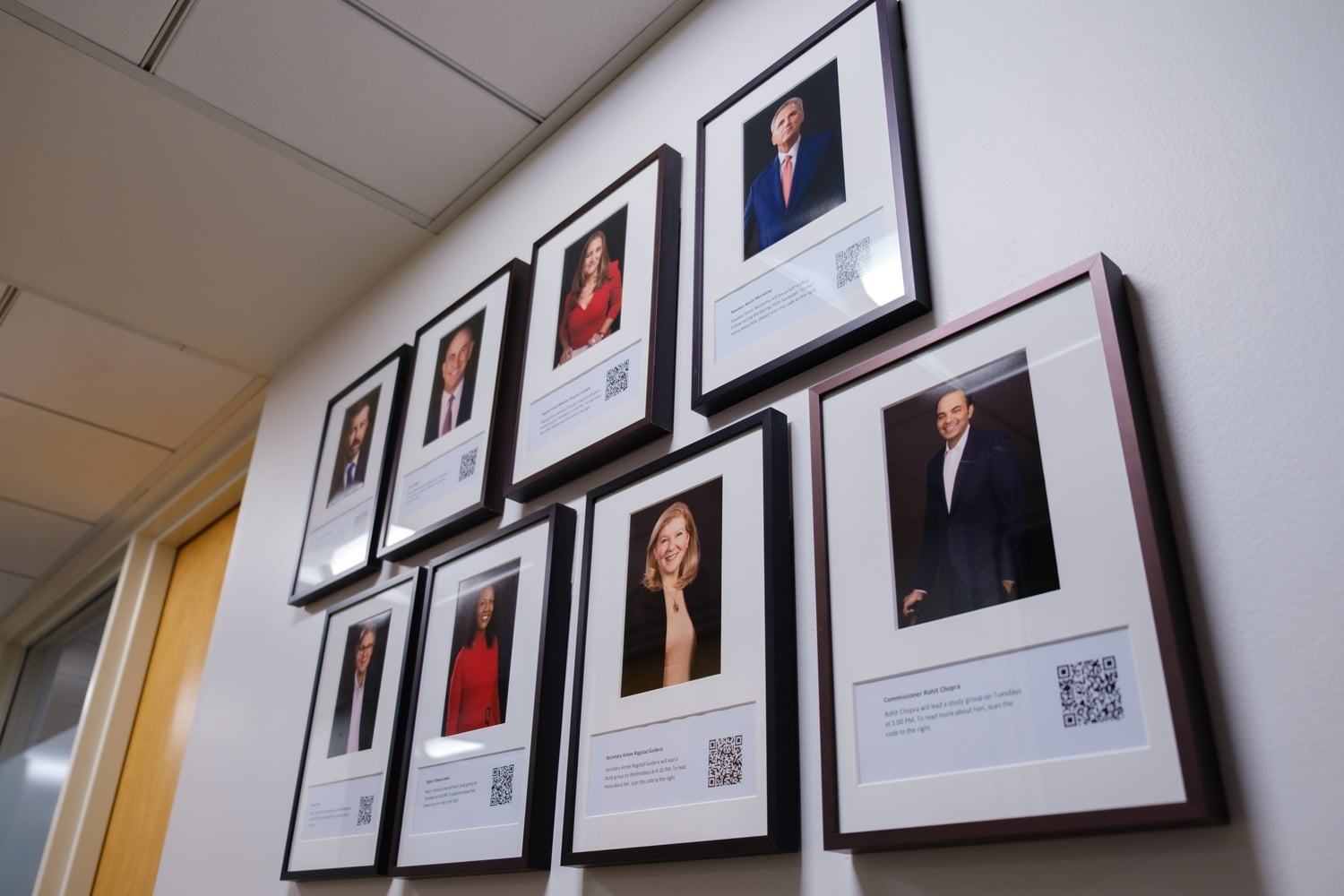
Each semester, the Institute brings a small group of political practitioners to campus to lead weekly study groups and mentor students. Anderson said assembling those classes meant building a “mosaic” — balancing ideologically, geography, experience, and the issues students wanted.
To recruit fellows, Andersen said he relied on former fellows, students, faculty, staff, and SAC members to suggest names and make introductions. He also created an informal advisory committee of former fellows to keep alumni connected to the Institute.
When Andersen left the IOP in 2017, much of that network left with him.
Many of the 34 former fellows The Crimson spoke with said they remained in touch with Andersen. Far fewer said they had sustained contact with the IOP itself.
“I haven’t been back to the IOP for programming. I’d love to, but more often it’s been through Eric over at the School of Public Health,” said former U.S. Rep. Robert D. Inglis, a former fellow.
Christopher Smart, another former fellow, said Andersen was “sort of the glue” that kept fellows connected.
“Since he left, I’ve lost touch,” Smart said.
Carol A. Giacomo, a fellow during the Covid-19 pandemic, said she has not been contacted by the Institute since her semester ended.
“I haven’t been asked to do anything. Nobody’s really reached out,” Giacomo said. “I don’t really know the people who are running the show now.”
‘Walking the Walk’
By 2025, the IOP had begun trying to rebuild.
After student leaders raised concerns about staff turnover to Weinstein, the Institute hired aggressively, appointing six new staff members. Myers and Price said the Institute is now fully staffed and more stable than it was a year ago.
But Warren’s death left the IOP in another leadership transition. Myers and Price have spent the past six months trying to keep the IOP steady until a permanent director is selected. Both have said they are not seeking the role.
The next director will inherit an Institute that has started to refill its staff chart. But former students and staff said the harder task will be rebuilding the relationships that once made the IOP dominant.
“The IOP is a collective of staff members of students and people. Without those people there, it doesn’t really exist,” Mallick said. “It’s done a good job, especially this year, hiring. It just has to keep those people engaged.”
One early test of that rebuilding effort will be whether the IOP can attract and welcome conservatives — a challenge that has dogged the Institute for decades and become more difficult as Harvard’s reputation among conservatives has worsened.
Over his tenure, Warren made explicit efforts to expand viewpoint diversity at the IOP and make the space welcoming to conservatives. That same philosophy guided the selection of Myers, a Republican, and Price, a Democrat — a pair chosen in part to signal representation across the aisle.
Under Warren, the IOP established a conservative mentorship program that connects conservative students with former IOP fellows, HKS alumni, and SAC members to provide career guidance and help students secure early professional opportunities in politics.
Mallick said during his time at the IOP, the coalition moved from an “appendage” to a central voice in student leadership.
“Instead of pandering and getting ‘XYZ’ conservatives to come, we mutually respect them,” Mallick said. “We say that you’re members of our leadership team.”
But sustaining that work will require more than programming.
Though Dove said the conservative coalition was built out during her time on campus, it was still a “hard sell” to convince conservatives to come to Harvard.
“People are suspicious of the Ivy League and of Harvard in particular,” Dove said.
“It’s a challenge in the university environment to get really smart conservatives to come in,” she added.
That challenge intensified after Mallick, then the IOP president, published an op-ed in November 2024 arguing that the Institute should move away from strict nonpartisanship after U.S. President Donald Trump’s reelection.
According to one person familiar with the Fellows and Study Groups program, the backlash made it harder to recruit some conservative fellows, some of whom questioned whether they were genuinely wanted at the Institute.
Dove said she would not attribute skepticism among conservatives solely to the op-ed, but said the IOP’s efforts to welcome conservatives must be visible and credible.
“Harvard students are really smart, and they’re going to know if you are walking the walk,” Dove said. “You have to have authentic diversity.”
Price and Myers wrote in a statement that they “intentionally bring voices to campus from across the political spectrum” and cited a list of conservatives hosted at the IOP in the past two years, including former Vice President Mike Pence and former House Speaker Kevin McCarthy.
At its best, former affiliates said, the Institute depended on networks that built on one another — fellows who returned, students who stayed connected, staff who remembered both, and advisors who could open doors.
That is the version of the IOP McLaughlin said she believes can be restored.
“The importance of the fellows and Student Advisory Committee network can’t be underestimated,” McLaughlin said.
“They need that opportunity to know, ‘What could they have?’” she added of the IOP’s students. “With an engaged network of former fellows and former students, I think the Institute’s unstoppable.”
—Staff writer Elise A. Spenner can be reached at [email protected] or on Signal at elisespenner.82. Follow her on X @EliseSpenner.
—Staff writer Jen L. Phan can be reached at [email protected] and Signal at jenphan.74. Follow her on X at @jenllphan.
Want to keep up with breaking news? Subscribe to our email newsletter
Have a tip for The Crimson? Share it confidentially