Scholars Tie Campus Anti-Israel Rhetoric to Christian Tropes at Harvard Symposium on Antisemitism
Scholars at a Harvard symposium earlier this month argued that left-wing campus hostility to Israel often carries an unacknowledged imprint of older Christian theological tropes about Jewish people, even when expressed in secular terms.
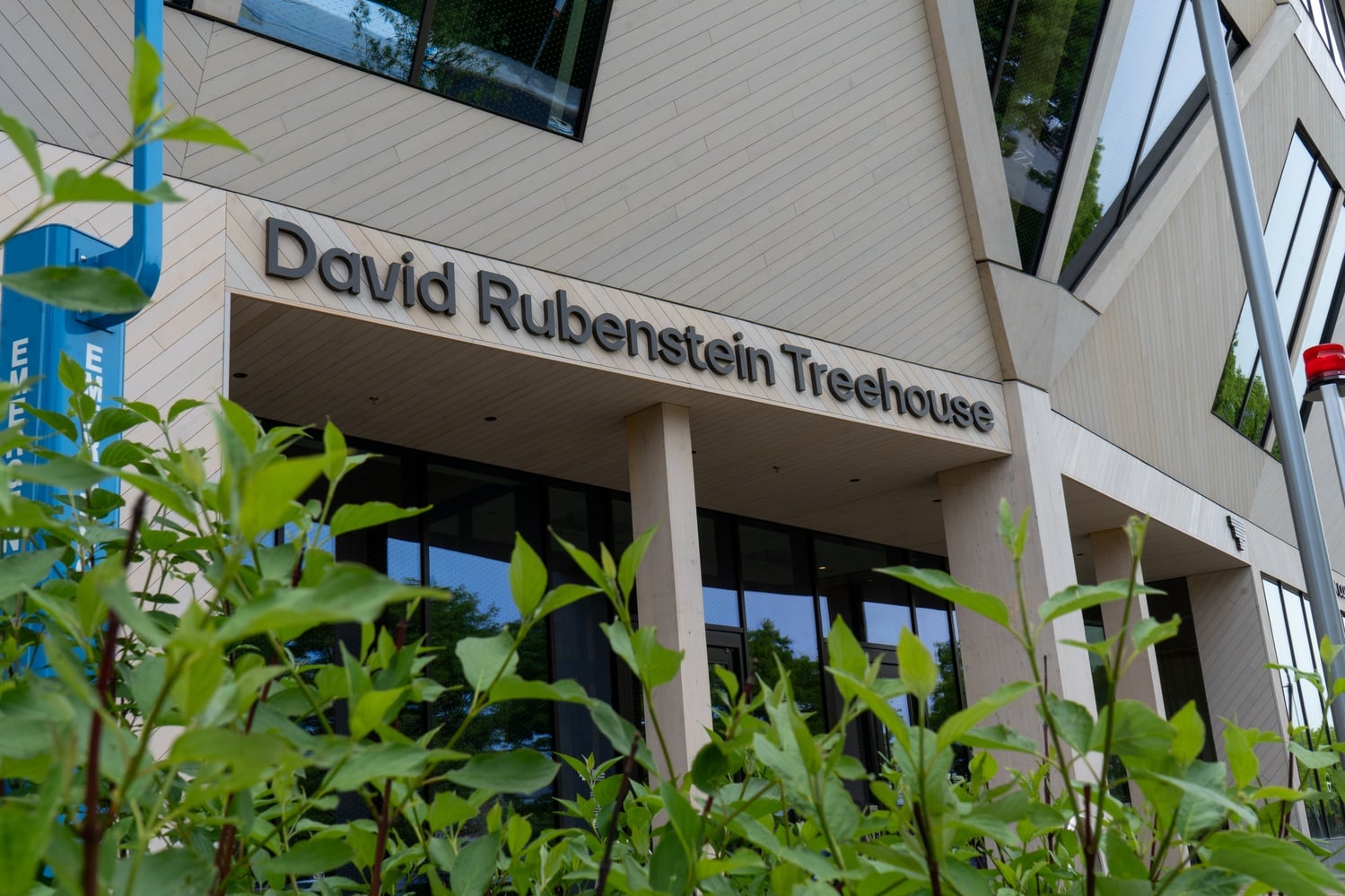
The day-long event, titled “Antisemitism and Universities,” drew more than 50 people to the Rubenstein Treehouse in Allston and was co-sponsored by the Center for Jewish Studies, the Harvard Law School Julis-Rabinowitz Program on Jewish and Israeli Law, and the Office of the President and Provost.
Dartmouth Jewish studies professor Susannah Heschel claimed that the focus on Gaza in university programming carried theological weight.
“Gaza sort of symbolizes, to me, Christ on the cross,” Heschel said. “In that sense, the worst possible suffering is the suffering of Christ on the cross. And of course, the Jews did it.”
By identifying with Gaza, she added, observers position themselves as moral atoners.
“Those who identify and speak out for Gaza become at the highest level,” Heschel said.
The symposium is the first in a three-part series on Jewish identity, according to Harvard Jewish studies professor Jay M. Harris, who co-hosted with Harvard Law School professor Noah Feldman, director of the Julis-Rabinowitz Program.
Panelists included Berkeley history professor David A. Hollinger, Harvard English professor Stephen Greenblatt, Johns Hopkins Jewish history professor James Loeffler ’96, and Ben-Gurion University historian Arieh Saposnik. Harvard Government professor Eric Nelson delivered the closing response.
The symposium comes two months after the Department of Justice sued Harvard over its handling of campus antisemitism, alleging the University was “deliberately indifferent” to harassment of Jewish and Israeli students after Oct. 7, 2023. The suit asks the court to cut off federal funding and claw back nearly $1 billion in grants. Harvard moved to dismiss the case earlier last week.
Get The Crimson in your inbox.
Nelson, who synthesized the day’s panels, extended Heschel’s argument. Anti-Israel discourse on the secular left, he said, often projects onto Jews “whatever it is that the society in question regards as the ultimate evils.”
“It’s just that the evils have changed, and now they are things like imperialism, colonialism, genocide and apartheid,” Nelson said.
He framed his own position as one of cognitive dissonance — privileged by external measure, but shaped by family history.
“I am among the least oppressed people I’ve ever met in my life,” Nelson said. “And yet, my mother was born in a displaced persons camp in Germany, and most of my family died in the Holocaust, and the ones who didn’t were survivors with whom I grew up.”
That dissonance, he argued, makes Jewish people fit awkwardly into prevailing humanities frameworks. Cultural appropriation discourse leaves little room for a people who “have always been guests everywhere,” he said, while post-colonial theory in practice casts Jews “as an alien European population foisted upon the Middle East by Western imperialists.”
Hollinger viewed the religious reading more cautiously. The campus focus on Gaza, he said, reflects American foreign policy more than Christian theology.
“If there’s a doctrine of the atonement involved, I think it’s more that there’s an atonement for what the United States has done to support Israeli policy uncritically,” Hollinger said.
Saposnik pushed back against what he called “the supposedly unproblematic and unproblematized notion that Zionism” is “a form of Western colonialism,” calling the framing “at best, a flattening of the picture.” Early Zionist thought, he said, grew out of a critique of Ashkenazi Jewish life and engaged seriously with Sephardic and Mizrahi traditions, even as some early leaders held prejudiced views.
Heschel closed with an account of how Dartmouth’s Jewish studies department, which she chairs, navigated the aftermath of Oct. 7. She and colleagues in Middle Eastern studies convened joint faculty panels to model what a university conversation should sound like.
“Most of all, we wanted to show them that at a university, there is a way to speak,” Heschel said. “It’s not how you talk when you’re with your friends in the dorm lounge or the restaurant. It’s a way of speaking with respect and with dignity, because we’re here for building, after all, and maybe we need to return to that.”
—Staff writer Alexa M. Schmitt can be reached at [email protected] or Signal at alexaschmitt.15. Follow her on X @alexa_m15_s.
Want to keep up with breaking news? Subscribe to our email newsletter
Have a tip for The Crimson? Share it confidentially