Narvekar Remade Harvard’s Endowment. Trump’s Tax War May Define Whether It Was Enough.
A year before Washington raised Harvard’s endowment tax to eight percent, HMC chief Narv Narvekar warned alumni that politics had become a risk the world’s richest university could no longer fully hedge.
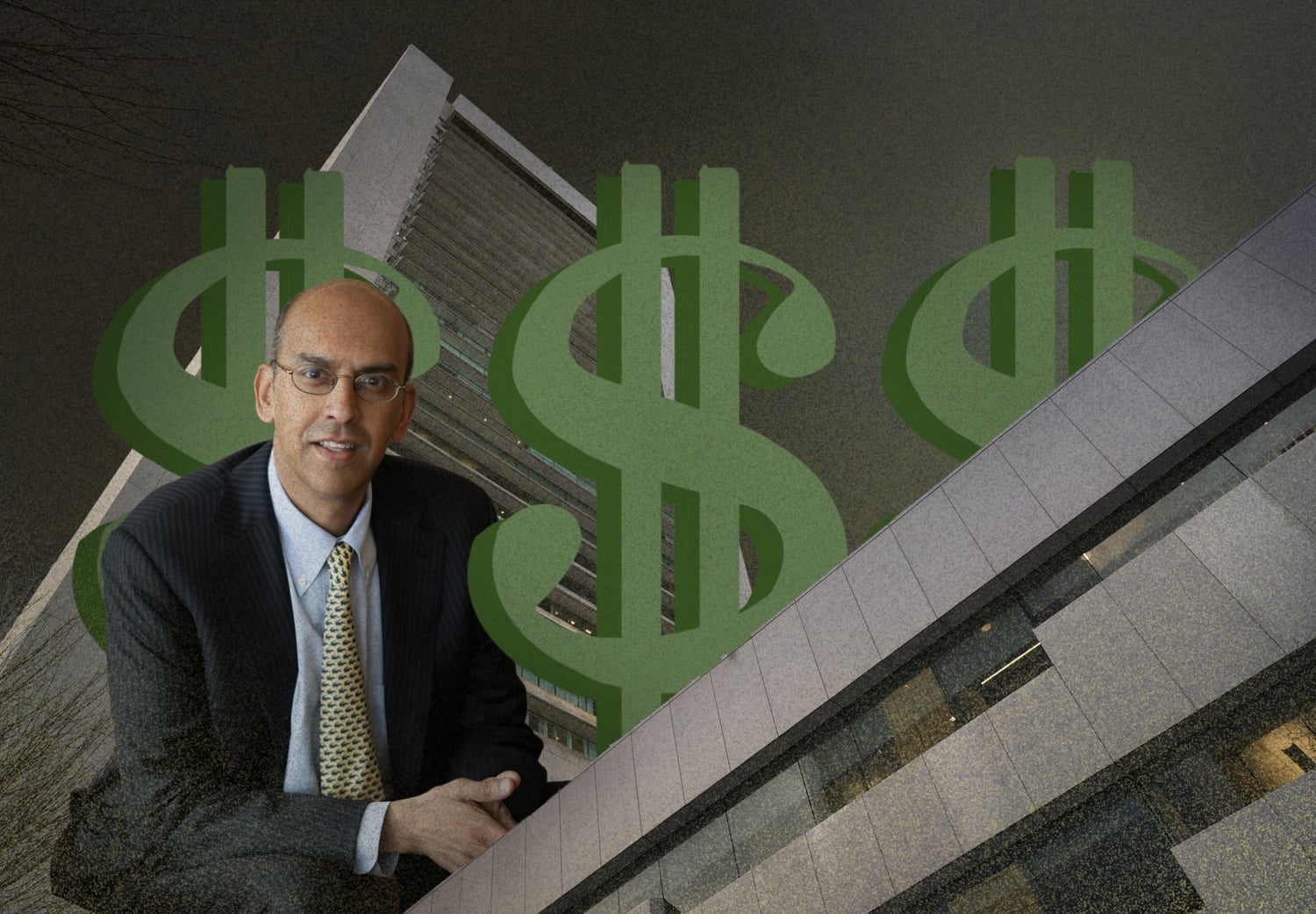
One month before Donald Trump won back the White House, Harvard Management Company Chief Executive Officer N.P. “Narv” Narvekar warned alumni in Singapore that the University’s endowment was exposed to a threat no investment strategy could fully hedge: Washington.
At a September breakfast hosted by the Harvard Club of Singapore, Narvekar and several colleagues fielded questions from roughly two dozen guests gathered in a living room.
Much of the discussion followed familiar ground: portfolio construction, HMC’s relationship with the University, Harvard’s returns relative to peer schools, and how the endowment fielded opportunities across public markets, private equity, real estate, and energy.
But one question loomed over the room: what would a second Trump presidency mean for Harvard, and for the tax on its endowment?
The tax — imposed during Trump’s first term — requires wealthy private universities to pay a levy on the investment income their endowments generate. For Harvard, where the endowment funds more than 37 percent of the University’s operating budget, even a small tax on investment gains carries serious consequences.
On the campaign trail, Trump threatened to renew attacks on wealthy universities and their tax-exempt status — raising fears that the 1.4 percent tax could climb much higher under a second administration.
Jasper L. Camacho, a managing director at investment firm Marius International who attended the Singapore event, said the prospect of another Trump administration was “interspersed in the conversation.”
When one attendee asked Narvekar directly about the election, Camacho said Narvekar made clear that he was watching the race closely.
“They definitely highlight that as a key risk,” Camacho said.
“The level of uncertainty of who was going to be in power was probably at an all-time high,” he said.
Get The Crimson in your inbox.
Narvekar’s response, Camacho recalled, was pointed: a major change to the endowment’s tax treatment would alter how HMC invests, allocates capital, works with donors, and supports the University.
When it came to the prospect of a hiked tax, Camacho recalled Narvekar saying HMC was “watching it, keeping track of it.”
Less than a year later, that warning has become Harvard’s reality. A July 2025 law raised the endowment tax on Harvard’s investment income from 1.4 percent to 8 percent, a hike expected to cost the University more than $200 million annually.
As Narvekar nears his tenth year leading HMC — and has told the board he plans to retire as early as late 2027, according to a person familiar with the matter — the tax fight may become the final test of his tenure. He arrived in 2016 with a mandate to repair a sprawling and underperforming investment office and now leaves having made it leaner and more disciplined.
But the question that has dogged HMC for years remains unresolved: why does the world’s richest school still so often trail its peer institutions? And as Washington takes a larger cut of Harvard’s investment gains, that question is becoming harder for it to outrun.
Narvekar declined repeated requests to be interviewed for this article.

The Outsider Brought In to Rebuild HMC
When Narvekar arrived in December 2016, HMC found itself under pressure from every direction.
For years, alumni critics had attacked HMC’s compensation system, arguing that investment staff received steady payouts even when Harvard’s endowment lagged behind peer institutions.
Inside HMC, the problems were deeper. A 2015 review by consulting firm McKinsey & Company found an institution with weak internal accountability and a culture described by its own employees as “lazy, fat and stupid” and centered on “stable, rather than smart, capital.”
By fiscal year 2016, the endowment had posted a negative 2 percent return, its worst showing since the 2008 financial crisis. That year, Harvard’s 10-year annualized returns stood at 5.7 percent, well behind Yale University and Columbia University’s 8.1 percent.
The central problem identified internally, according to seven people at HMC at the time, was its aging “hybrid” model. Harvard managed some assets in-house through specialized teams, while also placing capital with external managers.
The model had once been a strength. Under former HMC CEO Jack R. Meyer, who left in 2005, Harvard’s investment teams generated strong returns, and several later spun out into major investment firms. But by the mid-2010s, the structure had become harder to defend since the best internal managers could earn more outside Harvard.
“At the time he joined, we were investing roughly 65 percent with external managers, 35 percent internal, and we realized that that was not the appropriate strategy going forward,” said Paul J. Finnegan ’75, the former chair of the HMC Board of Directors. “He was hired to change that.”
Narvekar fit the job Harvard wanted done. Harvard had concluded that it needed to move closer to the structure used by Columbia and Yale: a smaller team of generalist investors allocating capital to external managers, rather than large internal teams managing separate pools of money.
Narvekar, who had spent 14 years shepherding Columbia’s endowment, was then a natural pick.
Former HMC board member Jeremy C. Stein wrote in a statement that Narvekar’s experience at Columbia was “one helpful aspect of his candidacy.”
Stein wrote that “the fact that he had run a generalist model in his prior position at Columbia was certainly a plus.”
“And it was understood that he was hired at Harvard with the charge to implement this change at HMC,” he added.
Finnegan said the board was explicit about the scope of the job.
“When we went out to recruit a new CEO, part of the discussion was HMC was in need of a major restructuring,” he said. “Narv came from a world of external management, so he was very comfortable pursuing the changes.”
The Changes
Narvekar moved quickly.
Within weeks of taking office, HMC announced a major restructuring that cut roughly half of its staff and accelerated its shift away from internal management.
Several specialized teams were spun out or moved to external managers. HMC’s real estate team became part of Bain Capital in 2018. Its private credit team launched Evolution Credit Partners the same year, earning a $300 million principal investment from HMC.
Its natural resources team also spun out to form Solum Partners, a food and agricultural investment firm that received a $200 million from HMC. That move was intended in part to help distance Harvard from natural resources holdings that had drawn scrutiny from environmental activists, according to one former employee.
Today, roughly 90 percent of the endowment is managed externally.
The restructuring was also designed to change how HMC employees were evaluated. Under the old model, internal managers could be rewarded for the performance of their own slice of the portfolio even when the endowment as a whole lagged. Under the new structure, investment staff would be compensated based on the performance of the full portfolio.
Finnegan said the restructuring was a necessary correction, saying Narvekar spun out internal teams in real estate, fixed income, natural resources, and hedge funds and reduced HMC’s staff from more than 200 people to roughly 100.
“This is really quite stunning when you step back and think about the extent of that restructuring,” Finnegan said.
HMC spokesperson Patrick S. McKiernan declined to comment on Narvekar’s tenure.
Narvekar also reshaped the portfolio itself. When he arrived, private equity and venture capital made up roughly 16 percent of the endowment, according to Finnegan. By fiscal year 2025, private equity alone accounted for more than 40 percent of the portfolio, while hedge funds made up another large share.
The shift reflected a broader bet on alternative assets, investments outside traditional stocks and bonds. The strategy depends on the idea that universities, with long time horizons and less need for immediate liquidity, can accept more illiquid investments in exchange for higher returns over time.
HMC also expanded its physical footprint under Narvekar. In 2022, it opened a satellite office in Singapore to increase access to private and public market investments in the Asia-Pacific region. HMC has also opened an office in San Francisco in the last year, giving the endowment closer access to Silicon Valley venture capital firms. (Only a handful of employees work from the sites, according to two former HMC employees.)
HMC has continued to use secondary sales of private equity stakes to manage liquidity and rebalance the portfolio. In April 2025, Harvard sold roughly $1 billion in private equity stakes to Lexington Partners. HMC had previously sold nearly $1 billion in stakes to Ardian in 2021 and more than $2 billion to Lexington Partners in 2017.
Such transactions are common among large endowments and can free up capital for new investments or University spending needs. But the timing of the 2025 sale, amid heightened federal pressure on Harvard and billions of dollars in frozen research funding, underscored the extent to which HMC’s portfolio decisions now sit inside a volatile political environment.
How Experts Judge Narvekar’s Record
Narvekar’s record is easiest to defend against the benchmark HMC set for itself.
In his fiscal year 2025 annual letter, Narvekar wrote that HMC had generated a 9.6 percent annualized return since the start of the current management team’s tenure eight years earlier, exceeding the endowment’s long-term 8 percent target. (The target accounts for roughly 5 percent in annual distributions to the University and roughly 3 percent in inflation.)
But the comparison becomes less favorable when Harvard is measured against public markets.
Over roughly the same period, the S&P 500 delivered annualized total returns in the range of 13 to 15 percent. Compounded across a nearly $57 billion endowment, the gap between Harvard’s returns and public-market returns represents tens of billions of dollars in foregone value.
Jason Furman ’92, former chair of the Council of Economic Advisers, said Harvard’s private equity-heavy strategy has not clearly outperformed a simpler public-market approach.
“My stock portfolio has done better than theirs, and I’m just literally like the S&P index fund,” Furman said.
That comparison is not perfect. Harvard is not an index fund, and HMC has to manage thousands of restricted funds. But it captures a central tension in judging Narvekar’s tenure: he improved HMC’s structure, but he did not make Harvard’s returns clearly superior. And now, as Washington takes a larger share of Harvard’s investment gains, the cost of that unresolved question is becoming harder to ignore.
When the Trump administration first imposed the 1.4 percent endowment tax, HMC leadership largely regarded it as a “rounding error,” according to a former employee. But officials also worried that the rate could rise under a future administration — a concern that became reality in July, when the White House raised it to 8 percent last July.
Experts said Narvekar can blunt the tax only at the margins.
Alan J. Auerbach, an economics professor at University of California, Berkeley, said Harvard could defer some taxable income by avoiding sales of appreciated assets, since capital gains are taxed only when assets are sold.
But those choices are constrained by Harvard’s need for cash.
“They’re selling assets in order to get the money for current expenditures,” Auerbach said. “And they can’t really avoid doing that.”
Kimberly A. Clausing, a tax law professor at the University of California, Los Angeles, said the tax may affect close calls. If HMC is nearly indifferent about whether to sell an appreciated asset, the new rate could push it to hold longer.
“Let’s say you’re really, really close to indifferent about whether to sell an asset or not,” Clausing said. “At this point, you might be like, ‘Well, it might be slightly better to hold on to it, because then I’ll avoid realizing gains in these years when this endowment tax is in place.’”
The opacity of Narvekar’s HMC has made that record harder to evaluate. Since his arrival, HMC has reduced the detail in its annual reports, stopped disclosing performance by asset class, and ended the release of internal benchmarks.
The lack of disclosure is especially significant because Narvekar’s strategy has leaned heavily into alternative assets — which tend to be more difficult for outside observers to benchmark. The endowment is invested 41 percent in private equity and 31 percent in hedge funds, combining for a 72 percent total investment in alternative assets, according to the University’s financial report for fiscal year 2025.
David L. Yermack ’85, an NYU finance professor and former Crimson managing editor, wrote that Narvekar has “always been an unapologetic fan of having lots of alternative assets in the portfolio.”
“That’s extraordinarily high, and I would argue that it should be zero,” Yermack wrote.
Yermack argued that the alternative assets space has become too crowded for investors to expect strong returns going forward. Charles M. Elson, a retired corporate governance professor at the University of Delaware, said many institutions have reached the same conclusion.
“I think a lot of institutions have discovered that those long-term private equity funds and hedge funds don’t do as well as they think they are going to,” Elson said.
Scott L. Bok, the former chair of the University of Pennsylvania Board of Trustees, offered a more favorable assessment of Narvekar’s tenure, framing his defense around the limits of what Narvekar could control.
“Driving one of these things is a little bit like driving a supertanker,” Bok said. “You don’t make sharp turns.”
–Staff writer Graham W. Lee contributed reporting.
—Staff writer Megan L. Blonigen can be reached at [email protected] and on Signal at megblon.50. Follow her on X at @MeganBlonigen.
Want to keep up with breaking news? Subscribe to our email newsletter
Have a tip for The Crimson? Share it confidentially