David Parkes Has a Plan for SEAS. His Hardest Decision Still Looms Over It.
SEAS Dean David Parkes is trying to rally Harvard’s youngest school around AI, climate, and entrepreneurship — but after layoffs that strained staff, students, and faculty, his biggest challenge may be rebuilding trust at home.
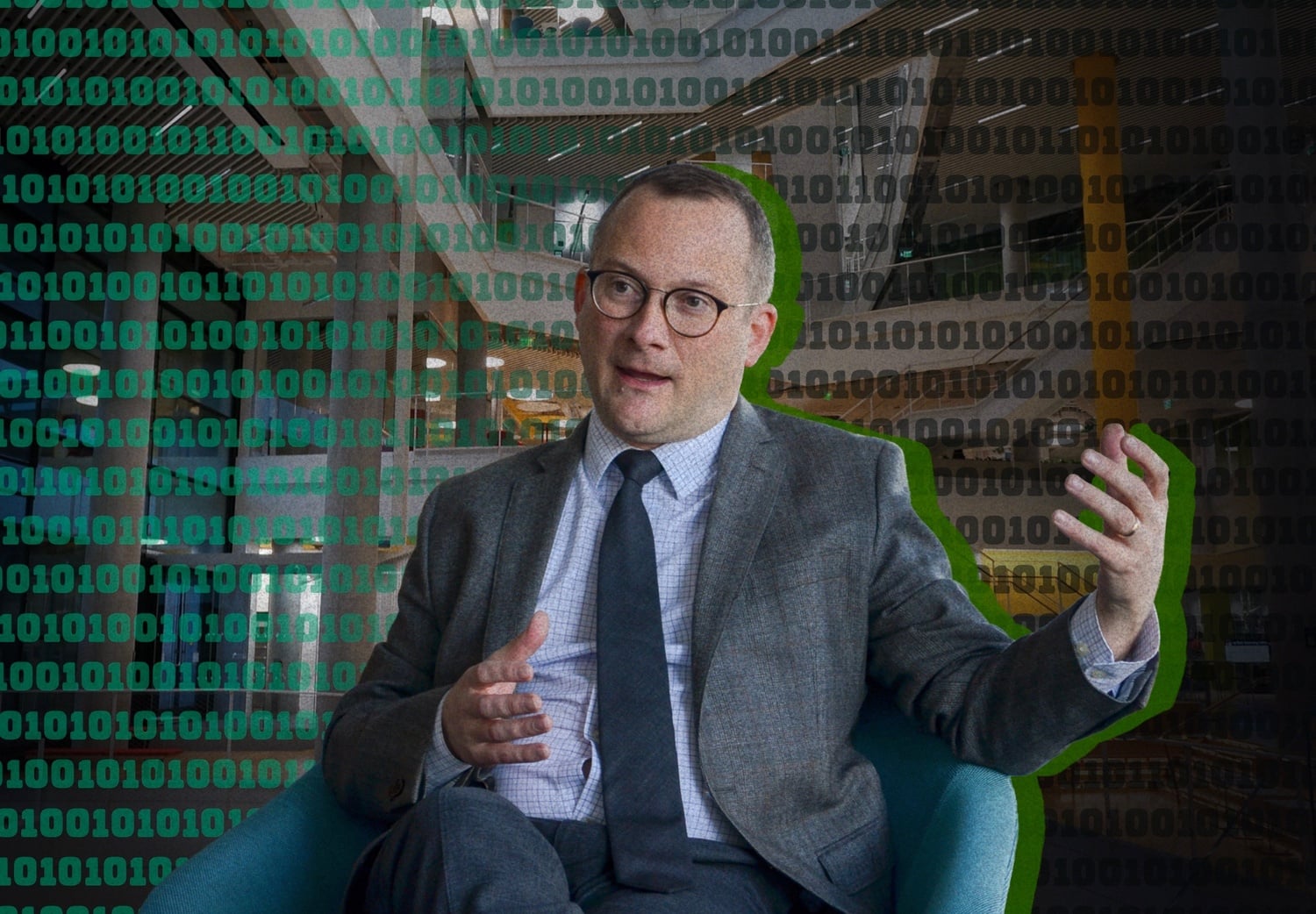
Faculty, students, and staff who stop by the Science and Engineering Complex to see David C. Parkes are often offered coffee or tea. The meetings tend to follow a familiar rhythm: Parkes listens carefully, asks questions, and seldom cuts the conversation short.
That habit has helped define Parkes’ reputation at Harvard. To many colleagues, he is a computer scientist with a gift for building bridges — between disciplines, between schools, and between academia and industry.
But less than three years into his tenure as dean of the School of Engineering and Applied Sciences, Parkes is facing the hardest test yet of that approach.
Last October, Parkes approved layoffs affecting nearly 15 percent of SEAS staff, citing financial pressures on Harvard’s youngest school. The cuts eliminated nearly a dozen-student facing roles and marked the most controversial decisions of his young deanship.
Since then, the conversations Parkes is known for having have grown more fraught. Staff members say workloads have grown. Students say advising and hands-on engineering support have been strained. And faculty have questioned whether they were sufficiently consulted before the cuts.
At the same time, Parkes has begun to articulate a more focused vision for SEAS behind closed doors, centered around three key priorities: artificial intelligence, climate sustainability and energy, and health engineering. He has also cast entrepreneurship as a throughline across those areas — a way, he argues, for SEAS to move research from labs into the world.
The result is a deanship defined by two competing realities: Parkes is trying to position SEAS for the future, while much of the school is still absorbing the costs of the present.
The Crimson spoke with nearly 20 SEAS faculty, students, staff, and affiliates for this story. Many described Parkes as accessible and willing to engage with critics. But several said his leadership is now being tested by whether he can rebuild trust inside SEAS while also asking the school to rally behind an ambitious new agenda.
A ‘Homegrown’ Dean
Parkes’ rise at SEAS began long before he became its dean.
Get The Crimson in your inbox.
He joined Harvard’s faculty in 2001, when the University was still building out computer science as a field that could reach beyond engineering into public life. Venkatesh Narayanamurti, SEAS’ first dean, said Parkes was one of the early faculty members hired with that broader vision in mind.
“He was interdisciplinary and believed in the vision that computer science should have larger interactions with society,” he said.
Parkes’ research sat at the intersection of computer science and economics, focusing on market design, artificial intelligence, and multi-agent systems. That work positioned him in a field that has since become central not only to SEAS, but to Harvard’s broader ambitions in AI.
Narayanamurti later appointed Parkes to a junior faculty advisory group during the creation of SEAS, saying Parkes already showed an ability to work across disciplinary boundaries. He said Parkes’ role in Harvard’s Data Science Initiative — a cross-school effort spanning SEAS and the School of Public Health — later strengthened his case for the deanship.
“I’m sure his work as head of the Data Science Institute was also important in him being named Dean of SEAS in the sense it shows his abilities to work across schools and boundaries,” he said.
When Parkes was tapped for the deanship in 2023, Narayanamurthi described the appointment as a milestone for SEAS: for the first time, the school would be led by someone who had come up through its own faculty.
“Finally, somebody who was homegrown is now the dean of SEAS,” he said.
Parkes’ colleagues and former students described that same quality in more personal terms. Mark Goldstein, a former teaching fellow and mentee of Parkes, said Parkes stood out as a professor because he was unusually attentive to students at different levels.
“He’s always really about meeting people where they are at,” he said.
Goldstein said Parkes could be quiet in public settings but became “more present” in one-on-one conversations, especially when students came to him with anxiety or confusion.
“If you just ask him either personal questions or express your own anxiety or confusion about something, he becomes suddenly more present,” Goldstein said.
That reputation followed Parkes into administration. Several staff and faculty members said they believe Parkes cares deeply about SEAS and has made himself more available than previous deans.
Allison O. Choat, a SEAS faculty coordinator, said Parkes regularly attends meetings of the school’s Committee on Culture and Community — something they said previous deans did not always do.
But the qualities that made Parkes an appealing choice for dean have also raised expectations for how he should lead. And last fall, those expectations collided with the most difficult decision of his tenure.

‘Taking the Wheels Off a Bus’
Parkes’ deanship has unfolded during a period of mounting uncertainty for SEAS.
In October, SEAS announced layoffs affecting roughly 35 staff members, or about 15 percent of the school’s staff. The cuts also affected about a quarter of staff represented by Harvard Union of Clerical and Technical Workers.
Parkes cited an increase in the federal tax on Harvard’s endowment income, anticipated reductions in federal reimbursements for indirect research costs, and changes to the allocation of research funding as financial pressures facing the school.
The layoffs were announced in mid-October, but most affected staff members were not laid off until mid-December — just before the holidays. Two staff members said requests to delay the layoffs until after the holiday season were dismissed. The timing, they said, made it more difficult for laid-off employees to find new jobs.
Faculty coordinators — staff members who manage administrative and operational tasks for faculty — met with Parkes and then-SEAS Executive Dean for Administration and Finance Timothy Bowman in early November to discuss the school’s financial situation.
In those meetings, Matty Regan, a laid-off faculty coordinator, said Bowman often took charge while Parkes was “woefully unable to answer” specific financial questions.
“Parkes was kind of out of his depth — like this is not a place he wanted to be,” they said. “He didn’t really have any good answers. He couldn’t give us any information that was helpful or even felt honest.”
Evelyn L. Hu, an Applied Physics and Electrical Engineering professor, said faculty did not appear to have been sufficiently consulted on recent decisions.
“Consulting every single person is not reasonable,” Hu said, suggesting that the issue could have stemmed from a lack of communication between SEAS area chairs and faculty members in their areas. “But I think trying as much as possible is important, because jobs are at stake, people are at stake, and the healthy continuation of that environment is at stake.”
A SEAS spokesperson wrote in response to a request for comment that Parkes “worked with input from across the School, including faculty and faculty leaders, to develop a plan to reduce budgets and grow financial capacity.”
Choat said administrators described the layoffs as “a really difficult and really substantive decision” meant to prevent deeper financial challenges later. The magnitude of the cuts, Choat said, was presented as a way to avoid similar decisions in the future.
Still, the aftermath has been frustrating for staff who remain. While faculty and postdoctoral hiring has continued, support staff hiring has not, leaving remaining employees with larger workloads, according to three current and former staff members.
The effects have been concrete. One staff member pointed to reduced loading dock hours at the SEC as one example. The dock, which used to remain open until 5 p.m., now closes at noon, meaning packages delivered later in the day may sit outside and not reach labs until the following morning.
Matthew G. Zahnzinger, a SEAS staff member and union representative, said the layoffs disrupted what he saw as a promising start to Parkes’ deanship.
“He was on track to really make a tonal shift coming out from Frank Doyle — who was fine, if a bit detached from staff, in my opinion — to building a more supportive and collaborative school,” he said. “Unfortunately, he got saddled with the second Trump administration.”
Zahnzinger said he does not begrudge Parkes personally, but he criticized the way the cuts were carried out.
“I do think the decision to lay off staff in the way that it was done feels like taking the wheels off a bus while it’s in motion,” he said.
The Big Bets
Even as SEAS manages the fallout from the cuts, Parkes has tried to define what the school should become, suggesting the school orient itself around three key pillars.
The priorities are not meant to replace SEAS’ traditional strengths. In conversations with donors, Parkes has emphasized that the school remains committed to core areas including computer science, electrical engineering, and bioengineering.
But the pillars are intended to focus fundraising, research, and teaching around areas where SEAS can have broad social impact, according to documents leaked by ShinyHunters.
In particular, Parkes has considered implementing two new undergraduate tracks — Energy and Sustainability and AI Management and Ethics. Parkes was a supporter of the new Energy, Climate, and the Environment concentration and a SEAS track within it called Science and Engineering for Sustainable Solutions. The school has also discussed a new master’s program in AI and Management and a potential center in mathematics, statistics, and AI.
AI has been the most visible part of Parkes’ agenda — and the area most closely tied to his own academic background.
Yaron Singer, a former Harvard professor who left his tenured position to co-found the AI security company Robust Intelligence, said Parkes pushed SEAS to be more open to industry and innovation.
“He’s been really pushing hard and looking at making things very open and embracing innovation,” he said.
Boaz Barak, a SEAS professor who now holds a part-time catalyst professor position while working at OpenAI, said Parkes supported his transition into the hybrid role.
“In my biased opinion, I think the university is enriched by having professors that have an industry background and industry is enriched by having people with academic backgrounds,” he said.
Parkes’ AI push has also become a fundraising priority. In December 2024, Parkes secured a $5 million donation from Reina and Alastair M. “Alex” Rampell ’03 to endow a professorship in AI to support faculty recruitment in a competitive landscape.
“I took Prof Parkes’s class (CS 286r) as an undergraduate, it had a profound effect on my career (a paper I wrote was the genesis of a company I started), so I wanted to give back when he became Dean,” Alex Rampell wrote in a statement to the Crimson.
But Parkes has also seen some pushback from donors who argue that AI is too broad to function as a priority.
In response, Parkes has used climate and sustainability as a more concrete test case.
One proposed initiative, focused on sustainable electrification, would focus on the growing electricity demands of AI and data centers. Another, sustainable computing, would address the environmental costs of computing infrastructure. A third would use sensors and AI tools to monitor wildfires, climate, and extreme weather events.
Fiamma Straneo, an Environmental Science and Engineering and Earth and Planetary Sciences professor, said Parkes has put a premium on climate work at SEAS. Straneo was recruited as part of a climate-related cluster hire that began under Doyle and continued under Parkes.
“I think that, in and of itself, is an example of Dean Parkes’ awareness of the importance of climate,” Straneo said.
Parkes has also pushed entrepreneurship as a defining feature of SEAS, arguing it helps move research “from lab to market.”
In particular, he has worked with the Grid, Harvard’s entrepreneurship and technology transfer accelerator, on undergraduate access to entrepreneurship. According to Paul Hayre, the Grid’s executive director, several of the office’s recent initiatives originated with Parkes — including its startup trek to San Francisco.
The trek brought 15 SEAS concentrators to San Francisco during the January term to meet with alumni venture capitalists and early-stage founders. Parkes connected the Grid with alumni in the region who wanted to support students on their entrepreneurial paths.
“Alums give him a lot of signals about what we need to do to continue to evolve and improve the school,” Hayre said.
Hayre said Parkes has committed SEAS funding to the Grid and helped solicit philanthropic support for the programs. Before becoming dean, Parkes himself applied for a Grid accelerator grant with one of his postdoctoral fellows.
“He walks the walk,” Hayre said.
That sense of commitment is shared even by some of Parkes’ critics.
Zahnzinger said he once asked Parkes whether he regretted taking the job as dean. His response was terse.
“I did ask him at one point, ‘Do you regret taking the job of dean?’” Zahnzinger said. “And he said, ‘Absolutely not.’”
“He really does love the school,” he added.
—Staff writer Sidhi Dhanda can be reached at [email protected] and on Signal at sdhanda.05. Follow her on X @sidhidhanda.
—Staff writer Stephanie Dragoi can be reached at [email protected] and on Signal at sd3.28.
Want to keep up with breaking news? Subscribe to our email newsletter
Have a tip for The Crimson? Share it confidentially