Harvard’s Commencement Was Calmer This Year. The Union Made Sure It Wasn’t Quiet.
Striking graduate student workers made themselves heard from beyond Harvard Yard’s gates Thursday, but the University’s 375th Commencement proceeded largely undisturbed, offering a muted return to normalcy after two years of politicized ceremonies.
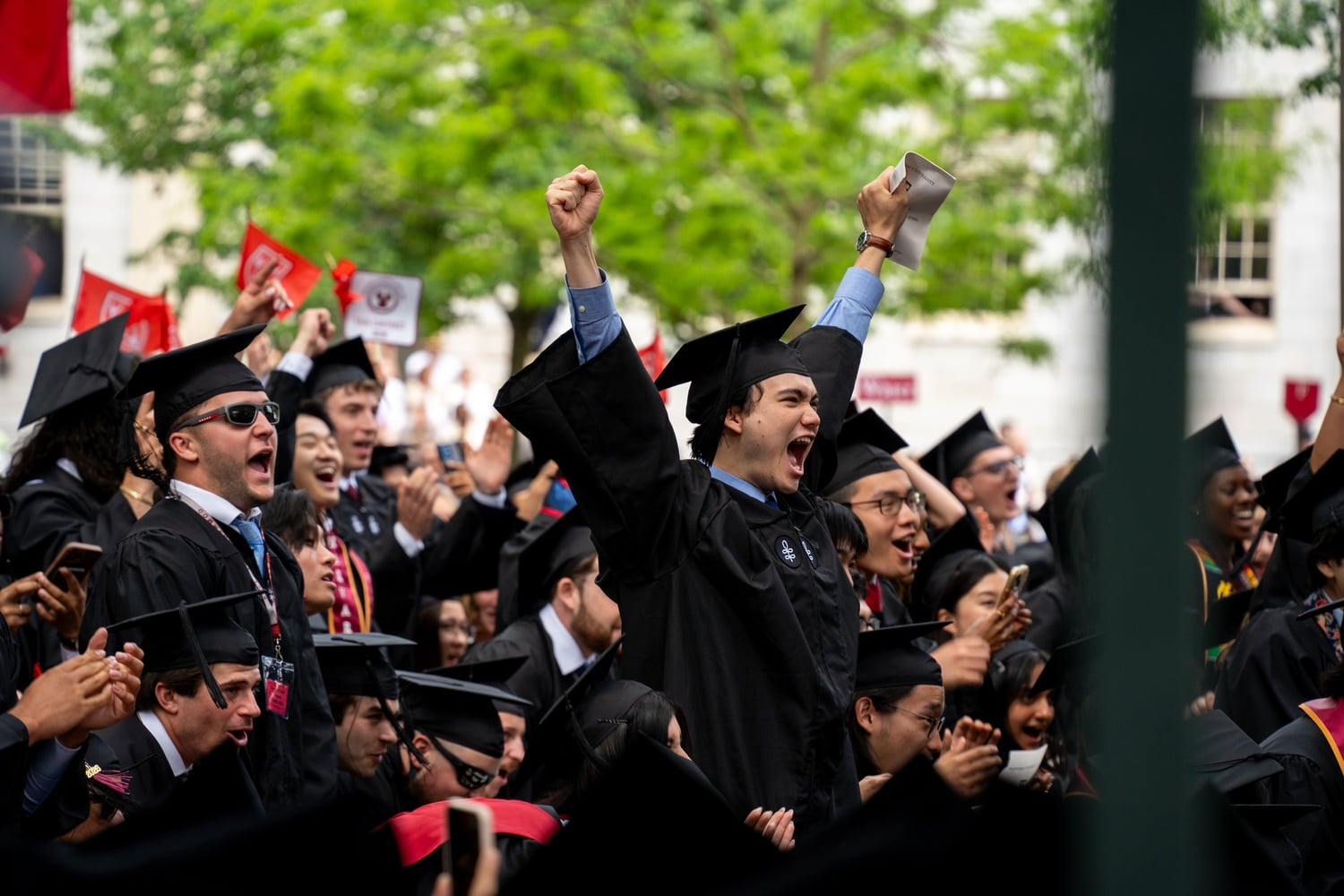
When Harvard President Alan M. Garber ’76 began speaking to graduates Thursday morning, his words had competition.
From just beyond the gates of Harvard Yard came the sound of sirens, bucket-drums, cowbells, and chants from striking graduate student workers, loud enough to reach students and families seated inside Tercentenary Theatre. Each time Garber or Provost John F. Manning ’82 spoke during the conferral of degrees, the noise from the gates was unmistakable.
But administrators and their fellow speakers at the 375th Commencement proceeded without pause.
For a campus now accustomed to politicized Commencements, the noisemaking never threatened to overtake the day’s celebratory mood. If anything, a year after Harvard’s graduation ceremony was shaped by a courtroom battle over the fate of its international students — and two years after thousands of students and faculty walked out in protest of the University’s decision to withhold degrees from pro-Palestine activists — Thursday’s ceremony marked a return to relative normalcy.
During his address, Garber stuck to familiar terrain, focusing in large part on academic freedom. He pointed to the University’s effort to bolster open inquiry and encouraged graduates to continue defending the “unfettered pursuit of knowledge.”
The speech had its political moments. Garber acknowledged criticism levied against the University and commended graduates for helping to rebuild trust in Harvard’s academic mission.
“Our cause is just. Our principles are worthy. And our contributions to the common good are vital,” Garber said. “This moment demands of us ongoing vigilance and unyielding effort as we continue to defend the university and its ideals.”
But Garber did not mention U.S. President Donald Trump by name. And he did not dwell on the lawsuits that have made Harvard one of the most visible targets of the White House’s campaign to reform elite higher education.
That restraint marked a shift from last year’s Commencement, when Harvard’s confrontation with Washington broke into the ceremony in real time.
At the tailend of keynote speaker Abraham Verghese’s address, students and faculty refreshed their phones to the news that a federal judge had extended a temporary order blocking the Department of Homeland Security from revoking Harvard’s certification to enroll international students.
This year, Harvard’s conflict with the White House entered the proceedings differently: as the punchline of a joke.
Get The Crimson in your inbox.
Midway through his speech, comedian and commencement speaker Conan O’Brien ’85 parodied the Trump administration’s lawsuits by pitting them against grievances from his undergraduate years, including a metal bed frame, course scheduling, a shoddy romantic career, and bad food.
“I’m confident that my claims will have more merit than those filed by the President of the United States,” O’Brien quipped.
“Harvard, I’ll see your ass in court,” he added.
But even O’Brien did not let Trump dominate his address. Instead, he kept his remarks light-hearted, promising graduates they would not be replaced by artificial intelligence, poking fun at the College’s new grade cap, and mocking students for their relatively trivial complaints.
“I asked the Provost office for intel on all your concerns, and I was told the following: you’re obsessed with doing laundry now that it’s free,” O’Brien said. “You bemoan the lack of fresh berries. You’re upset that not all the dining halls have hot breakfast, and you’re alarmed that the Kennedy School has stopped providing complimentary coffee.”
“If these are indeed your concerns, you sicken me,” he added.
O’Brien’s sprawling address ended with an earnest plea for graduates to stay humble rather than pursue titles and material achievements.
“My wish for you is not that Harvard becomes the last thing people know about you, but instead that Harvard becomes the least important thing people know about you,” he said in his concluding remarks.
But Harvard’s name is exactly what has kept Trump’s attention trained on the institution as a stand-in for his larger push to fundamentally alter higher education.
Andrew J. O’Donohue ’18 — the graduate student speaker — used his address to connect those tensions more directly.
While he praised Harvard’s initial legal action to recover federal funding and protect international students, O’Donohue said the University had not done enough in the year since to safeguard academic freedom on its campus.
“The past few years have put the ideals of our university to the test,” O’Donohue said. “Harvard did not get an A.”
“Our university must do more to protect academic freedom and free speech rather than restrict them,” he added. “Our university must improve its efforts to support students from different backgrounds, rather than pull back.”
O’Donohue was also the only speaker to nod — even subtly — to the protesting graduate students.
“At Harvard, I’ve also been a student worker and a member of our union, and I’ve wondered, are universities treating their workers well?” he said.
Swaths of the crowd cheered at the line. But it was the only clear acknowledgement the union received from the stage, even as picketers continued to make themselves heard outside the Yard after the close of morning exercises.
Though the University’s decision to fight the White House last April did not come up on Thursday, Garber instructed the graduates to carry forth the same values he followed then.
“If, in the years to come, you are given the opportunity to stand on principle in defense of teaching and research — in defense of curiosity and discovery — in defense of the highest heights of understanding to which human beings can hope to rise — we know that you will,” he said.
—Staff writer Hugo C. Chiasson can be reached at [email protected] or on Signal at hcc.35. Follow him on X @HugoChiassonn.
—Staff writer Elise A. Spenner can be reached at [email protected] or on Signal at elisespenner.82. Follow her on X @EliseSpenner.
Want to keep up with breaking news? Subscribe to our email newsletter
Have a tip for The Crimson? Share it confidentially