Wu Commits to Rebuilding Jackson Mann in Neighborhood Meeting
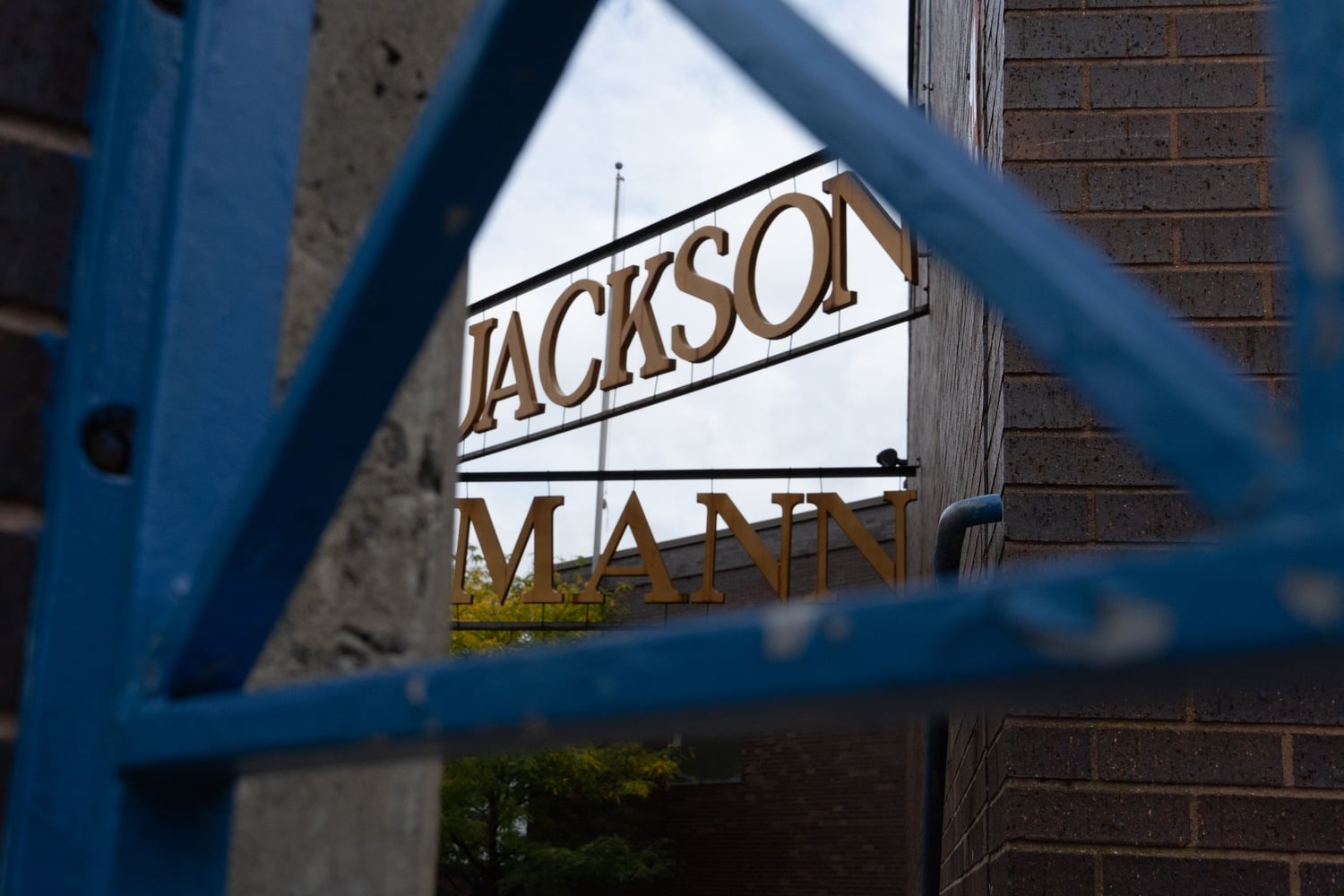
Boston Mayor Michelle Wu ’07 committed to building a community center in Allston-Brighton at a meeting with residents on Thursday, marking the city’s first verbal commitment to the long-demanded project.
The meeting came more than a month after Wu proposed a budget that did not include any additional funding for the Jackson Mann Community Center — a move that sparked significant backlash from residents who have said the current facilities no longer serve the neighborhood
More than 200 residents attended the meeting — held in the Jackson Mann building off Cambridge Street — along with Boston City Councilor-at-Large Henry Santana and Council President Elizabeth A. “Liz” Breadon. Nearly all of the neighborhood’s Beacon Hill delegation also attended, including state Reps. Michael J. Moran and Kevin G. Honan, state Sen. William N. Brownsberger ’78, and his challenger, Daniel A. Lander ’14.
“First, yes, the community center is happening,” Wu said, receiving applause from attendees. “It’s always been the intention of the city, and I’m sorry if it at any point felt like we weren’t communicating that clearly, or there were delays and confusion about whether that commitment was intended to be acted upon, and acted upon quickly.”
Wu said the Jackson Mann site poses unique challenges for the city to plan around given its capacity for multipurpose use and the size of the lot, which total 130,000 square feet across two plots.
“I want this neighborhood to push us to think beyond our usual standards and functions,” Wu said at the beginning of the Thursday meeting, pointing to Allston-Brighton’s reputation as one of the most creative parts of the city of Boston.
The city has weighed a number of possible future uses for the site — including housing, retail, and reopening a public elementary school. It most recently released the fourth feasibility study done on the site to assess the possibility of developing housing on April 29, two months after its original February deadline.
At the meeting, Patricia Cafferky, Boston’s deputy chief of operations, acknowledged the delay in releasing the study results.
“I missed that deadline. I take full ownership of that. I wanted to have this meeting with you all three months ago as did the mayor, but we’re here now — we had extra work to do on editing it, so that is the study that was released on April 29 earlier this year,” Cafferky said.
In order for the project to move forward, the neighborhood must come to a consensus with the city about what the Jackson Mann site will ultimately be used for — an agreement Wu said she hoped to reach by the end of the calendar year.
Get The Crimson in your inbox.
After Wu’s speech, city staff presented the results of the feasibility study and tentative timelines for redevelopment depending on the selected use for the site. The presentation outlined three possible timelines for the design of the community center, depending on if the parcel would also host a pre-K through sixth grade school or housing.
With a community center and housing on the site, seven to nine months would be dedicated to selecting a developer for housing on the site before planning could begin on the joint design for the parcel.
“A complex site like this can take a lot longer, and part of why is because it’s potential for the site to have multiple developers on different parts of the site,” Cafferky said.
Having a school on the site would add “significant complexity” to the project due to the need to apply for state funding, according to Cafferky. In the plan that would include a community center, school, and housing, the project is projected to complete its first design phase in the summer of 2030.
The findings from the housing feasibility study are now open to a 30-day written comment period, after which the city aims to provide an update in the form of additional community meetings before the end of the year.
Twenty-eight residents spoke during the meeting, offering comments and asking questions. Many urged the city to consider creating opportunities for homeownership on the parcel instead of rental housing, and creating facilities that would support families in Allston-Brighton.
Given the challenges of adding a school to the site, residents also called for the city to share more information about the neighborhood’s current enrollment and projected student enrollment for greater transparency around the need for an additional school.
Ellen L. Krause-Grosman, a Brighton resident of more than twenty years, said the meeting exceeded her “very low” expectations.
“I thought the presentation was really solid,” Krause-Grosman said. “I thought the showing of who was here was solid. I really credit City Councilor Breadon with doggedly not letting the administration turn their head away from this issue.”
“If this is the first meeting of this caliber, and it is followed by other meetings of this caliber, this will be a turning point with Allston-Brighton’s relationship with the city of Boston that will be absolutely historical,” she added. “If this is a one-off, it will be very disappointing.”
But Breadon emphasized that major questions about the site’s future remain unresolved until residents can agree on a use for the site.
“I feel that this is like a step up on the journey,” Breadon said in an interview. “We’ve done the test-fit, the land use study — there’s still a lot of questions. I feel that this is the moment, and that was why I had this call to action for the neighborhood to stay involved.”
—Staff writer Thamini Vijeyasingam can be reached at [email protected]. Follow her on X @vijeyasingam.
Want to keep up with breaking news? Subscribe to our email newsletter
Have a tip for The Crimson? Share it confidentially