Inaugural National Geography Bee Brings High School Finalists to Cambridge
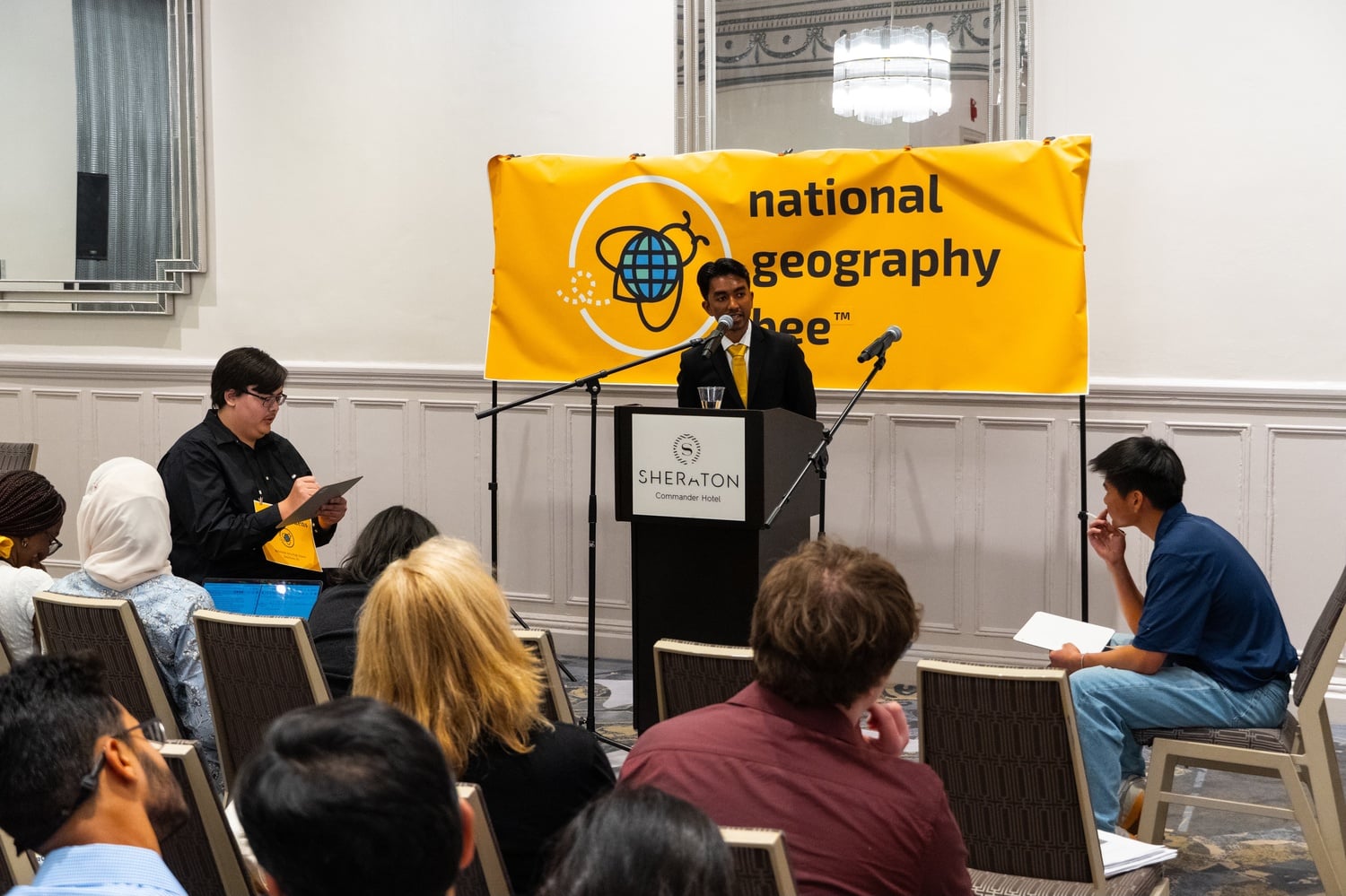
The inaugural National Geography Bee brought 38 high school finalists to Cambridge last month, reviving a national geography competition years after the National Geographic GeoBee was discontinued.
After a day of questions on maps, graphs, currencies, and cultural landmarks, Alexander J. Duan, a 10th-grader from Lexington, Mass. was crowned the competition’s first champion.
The bee was founded earlier this year by Rahem D. Hamid ’25, a former Crimson News Editor, and Pranay Varada ’25, who said they hoped to bring back a national stage for students interested in geography. Both competed in the National Geographic GeoBee as middle schoolers, and Varada won the competition in 2017.
The National Geographic GeoBee ran for 33 years before it was discontinued in 2020. Hamid and Varada’s version differs from the original competition by focusing on high school students rather than middle schoolers.
Varada said he and Hamid wanted to reach students who were old enough to more seriously develop an interest in the subject. The two, he said, saw high school as an “environment where students could find their passion for geography.”
Roughly 6,000 students competed in school-level rounds before the field was narrowed to 38 national finalists. The competition began in classrooms before advancing to schoolwide bees, whose winners automatically qualified for the national finals. Other top finishers were invited to compete in a qualifying round for remaining spots.
Varada said finding schools willing to host the Geography Bee was one of the organizers’ biggest early challenges, but added that the school-based format helped expose more students to geography.
“By having this competition based at the school level, we have schools getting students involved — students that may not have had exposure to geography beyond the occasional social studies lecture or an AP course,” Varada said.
Organizers said they also hope the school-based model will increase participation among girls. Of the 38 national finalists; only one was a girl — a disparity Varada said mirrored the National Geographic GeoBee, which historically had far more boys than girls among its finalists.
“The competition was technically made accessible to all students, but only students who said they wanted to participate would participate in the classroom round,” Varada said. “But hopefully by just increasing accessibility, making sure that all the students at a school participate in the tournament, we can have more women at the high school level compete.”
Get The Crimson in your inbox.
Saturday’s competition opened with preliminary rounds that narrowed the field to 10 finalists. Finalists then competed in a series of formats, answering questions at microphones, writing responses, and deciding when to lock in answers using clue-based “pyramid” questions.
The questions asked competitors to identify places using clues ranging from city metro maps to national currencies.
After six final rounds, five competitors were eliminated. Six rounds later, Duan and Adam L. Brookens, an 11th-grader from Bellefonte, Pa., advanced to the championship round.
In the final round, the two answered seven questions simultaneously, writing their responses on whiteboards after 15 seconds of consideration. By the sixth question, Duan led Brookens four correct answers to three.
“Mount Tai, the most revered mountain in Taoism, and Qufu, the birthplace of Confucius, are two significant religious and cultural sites that lie in the same Chinese province. Name this province, where the Yellow River empties into the Bohai Sea,” Varada read.
Duan correctly answered Shandong, clinching the title of the first National Geography Bee champion.
“I was really surprised and really happy that I won,” Duan said. “So that felt good.”
Before his victory, Duan said he “was really nervous” throughout the competition.
“The whole day, my heart was thumping,” he said.
Gabriel Cabio, a 10th-grader from San Antonio who finished in third place, said he also felt pressure during the daylong contest.
“Earlier today I was kind of nervous,” Cabio said. “I was stressed out.”
But competitors said the event remained supportive despite the pressure of the final rounds.
“There’s obviously a competitive kind of atmosphere, but it’s friendly, and everyone really wants other people to win,” Duan said. “We’re all supporting each other.”
Brookens said he hopes to return to the competition next year.
“This atmosphere is quite unique,” he said. “It’s something I haven’t had in a long time, and I’m hoping to be back here next year, see what’s changed, see what stays the same.”
“The last thing I said to my opponent, Alexander Duan, is ‘I’ll be back,’” Brookens added.
Correction: July 28, 2026
A previous version of this article misstated the number of students who competed and Adam L. Brookens’s hometown. In fact, approximately 6,000 students competed, and Brookens is from Bellefonte, Pa.
—Staff writer Chantel A. De Jesus can be reached at [email protected] and on Signal at chantel.27. Follow her on X @c_a_dejesus.
—Staff writer Claire A. Michal can be reached at [email protected] and on Signal at ClaireMichal.154.
Want to keep up with breaking news? Subscribe to our email newsletter
Have a tip for The Crimson? Share it confidentially