Bush v. Gore: When the Harvard-Yale Rivalry Reached the White House
As the 2000 election unfolded into a recount battle, Harvard students watched a national crisis play out through campus ties and dorm-room televisions.
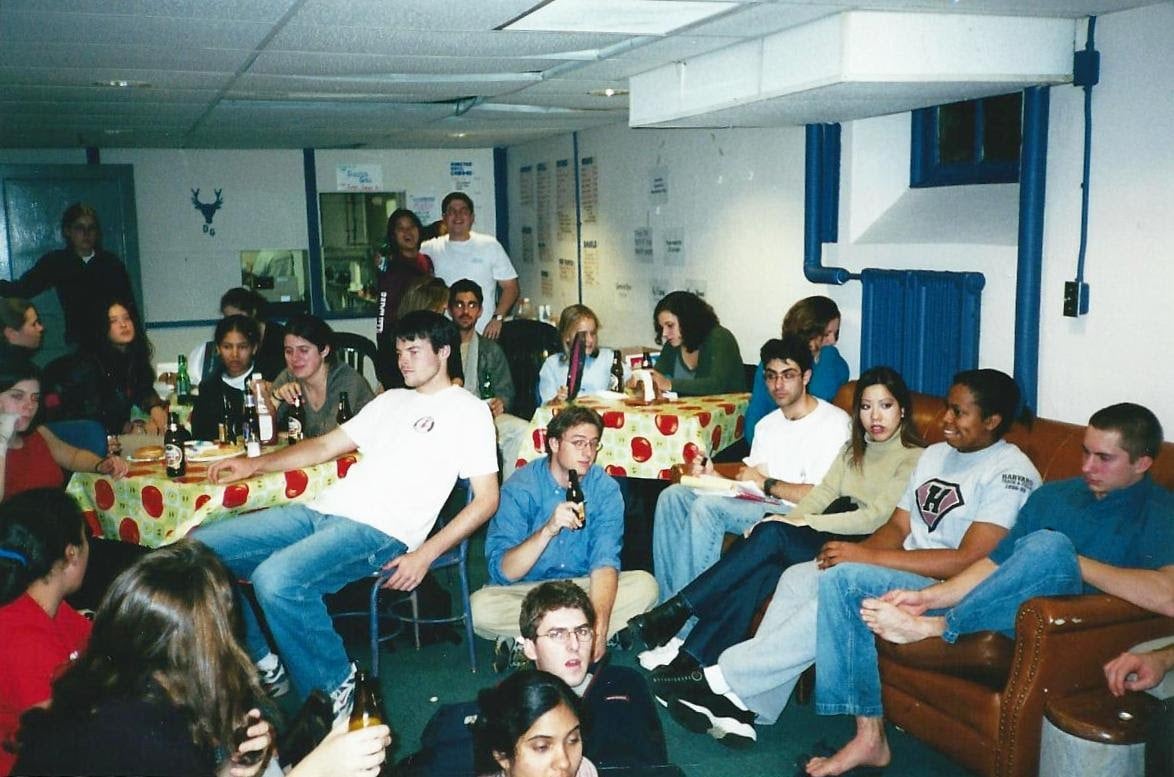
Watching the 2000 presidential election results trickle in on a television in his Adams House room, Geoffrey Harriman ’01 slowly realized that his own vote — an absentee ballot sent to Florida — sat at the center of a national controversy.
“The presidency of the United States was being decided by fewer people than were in our Harvard class,” Harriman said. “I can remember thinking, ‘Well, mine is one of those votes that they’re looking through and talking about.’”
His friendship with Sarah Gore ’01, daughter of Democratic nominee Al Gore ’69, only made the night feel more “disquieting.”
“Sarah was in our class, and I remember thinking about her and her family all night,” Harriman said. “It must be an awful, wrenching night for them, to have come so far and not know whether they’d won.”
In interviews with The Crimson, more than 20 members of the Class of 2001 recalled an election night that began as a campus watch party and became a weeks-long political cliffhanger with Harvard unusually close to the center of it.
Less than two weeks before the Harvard-Yale football game, election night doubled as a presidential precursor to the rivalry. Gore and all four of his children, Sarah among them, graduated from Harvard. On the other hand, George W. Bush earned his undergraduate degree from Yale, like his father, George H.W. Bush, and his daughter Barbara.
Six Harvard alumni had reached the Oval Office before 2000, against four from Yale.
Adam I. Arenson ’00-’01, a former Crimson Editorial editor, said Gore kept a visible presence on campus.
“He’s someone we saw with some regularity as a parent on campus,” Arenson said. “There was a sense that George W. Bush had a connection to Yale and to Texas, so for people who viewed it as a Harvard vs. Yale situation, there was more of an affinity to Gore.”
For Jeanna L. Kinnebrew ’01, Gore’s allegiances felt personal.
“I felt a little almost proprietary — like, ‘No, we can’t let Sarah’s dad lose,’ which is very silly to look back on,” Kinnebrew said. “It was very much like, ‘Oh, he’s one of us. He’s one of our guys.’”
Get The Crimson in your inbox.
Not everyone found the connection remarkable. Marianne E. McPherson ’01 said a Harvard tie near the top of the ticket felt routine.
“It feels like there’s always someone with a Harvard connection close to the top of the ticket, if not at the top of the ticket,” McPherson said. “That didn’t really feel unique.”
For Brian C. Grech ’03, a former Harvard Republican Club president, the University had a stake in either outcome.
“Gore was an alum, and Bush was a Business School alum, so either way, Harvard was going to claim a president,” Grech said.
The rivalry reached into the newsroom, too. After The Crimson decided the race was too close to call on election night, former Crimson News editor David S. Stolzar ’01 pulled up the website of the rival Yale Daily News.
“We felt really good about the decision, because then we went on the Yale Daily News website, and they had called it for somebody,” Stolzar said. “Obviously, no one knew the next morning who had actually won.”
The Harvard presence ran deeper than the candidates, said former Crimson News editor Marc J. Ambinder ’01.
“The Harvard mafia concept is real,” Ambinder said. “There were a lot of people who had cut their teeth in politics or journalism at Harvard who were now on the ground in Florida on either side.”
Quincy House residents watch NBC coverage of the disputed 2000 presidential election. As Tim Russert and Tom Brokaw discuss the unresolved Bush-Gore race on a non-HD broadcast, someone says, “This is history in the making,” before another voice cuts in: “Can we put on the game? |” Courtesy of Carrie L. Simpson ’01
Students had already gotten a preview of the race at close range. The first presidential debate took place less than 10 miles from campus, at the University of Massachusetts Boston, and members of the Harvard Republican Club went to watch from a nearby street.
“It was still several miles away, but we could see it from a distance and hear it on speakers,” Taylor West ’01 said. “Trying to get as close as you could — that was a fun memory.”
On election night itself, students packed dorm rooms and common spaces. At a gathering in the Dunster House Grille, partygoers assigned a beer to each candidate, Andrew P. Marcus ’01 recalled.
“People picked their beer for their candidate: Busch for Bush, Amstel Light (A.L.) for Al Gore, Rolling Rock (because it’s green) for Nader,” Marcus wrote in a statement. “Gore was the winner by this particular metric.”
In Eliot House, Robert A. “Adam” Lauridsen ’01 watched his roommate, Nicholas M. Goedert ’01, pull up the Florida Secretary of State’s website to track the raw count himself.
“We had the experience of watching them call Florida on TV, and my roommate kept saying, ‘No, they’re calling it too early,’” Lauridsen said. “He was completely right.”
Richard L. Freed ’01 followed the night from the orchestra pit of a Harvard-Radcliffe Dramatic Club rehearsal.
“The whispers rippled through the band,” Freed wrote in a statement. “‘Bush won Florida!’ Then we would run through another song. ‘No wait: Gore won Florida!’ Another dance number. ‘Strike that: Bush won Florida!’”
For the Harvard Republican Club, the night ended in the streets after Florida was called for Bush.
“Everyone leaped into the air — cheers just rang out instantaneously,” West said. “We just poured out into the streets and marched up and down.”
“It was just pure exaltation, pure joy, pure relief,” West added. “It was a total blast.”
The certainty did not last. As the legal disputes stretched into December, the recount reshaped how some students followed the news.
“This was the key moment in my relationship with using the Internet,” said Roman Martinez V. ’01, a former Harvard Salient editor. “I was just constantly trying to hit refresh and go to different websites and find news.”
Michael W. Weller ’01 said the saga blurred together.
“It felt a little bit like Groundhog Day,” Weller said. “Every morning would be a story about the election, and the same recounts and court cases. It just felt like it went on forever.”
For Jaime C. Leifer ’01, the case left a mark on the gradebook. A professor, Keith Bybee, had bet the class that the dispute would never reach the Supreme Court, promising five bonus points if it did.
“He may have regretted that eventually,” Leifer wrote in a statement, “but given how much we ended up learning about Article II and the equal protection clause because of it, maybe not.”
—Staff writer Wyeth Renwick can be reached at [email protected]. Follow her on X @wzrenwick.
Want to keep up with breaking news? Subscribe to our email newsletter
Have a tip for The Crimson? Share it confidentially