‘That’s Our Job’: How Harvard Students Occupied Mass. Hall for a Living Wage
Lynne Elena Lyman was told to pack a backpack for an overnight stay in a building — flashlight, food, a change of clothes — and to be ready to move within two hours of a call.
She didn’t know which building she would occupy, or what day the call would come.
But on the night of the annual Harvard Kennedy School ball, Lyman, then president of the Kennedy School’s student government, got the call.
Around 50 undergraduates and graduate students, members of the Progressive Student Labor Movement, gathered in a basement to hear the plan. At the shift change of the police guard, they would run single-file into Massachusetts Hall and surround its ground floor.
“Whoever was on lookout said, ‘Go,’ and we ran out. We got in the building, we sat down, and we linked arms in less than a minute,” said Lyman, a 2001 Kennedy School graduate.
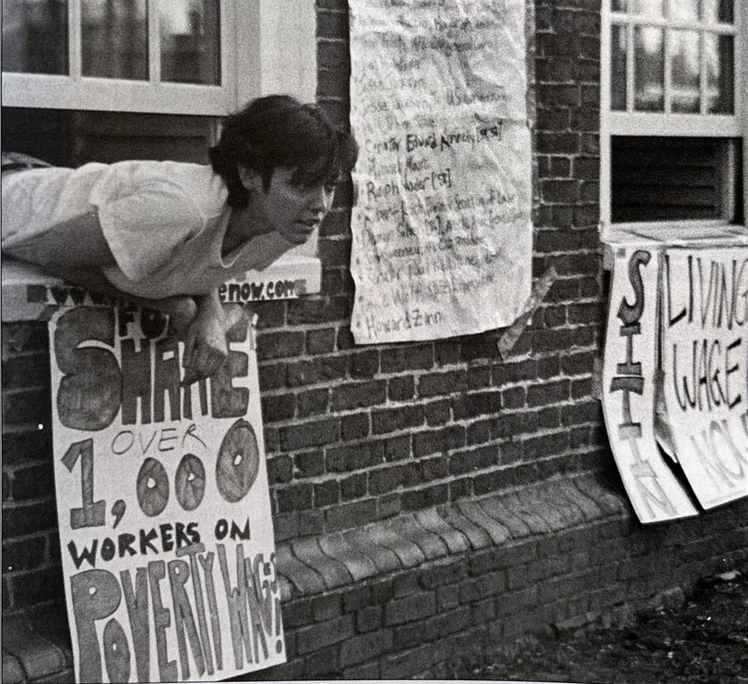
The students would hold the building — home to then-University President Neil L. Rudenstine’s office — for three weeks. Most did not step back into Harvard Yard from April 18, 2001, until May 9, 2001, 21 days later. Their demand was that Harvard guarantee its lowest-paid workers a living wage.
For the Class of 2001, the occupation would color the final weeks of their time on campus — turning Massachusetts Hall into the center of a debate over labor and the obligations of the University itself.
The campaign behind the occupation had been building for two years. Less than two years earlier, Cambridge had passed a Living Wage Ordinance requiring employers to pay workers at least $10 an hour, calling the floor necessary for a reasonable standard of living. PSLM wanted Harvard, the city’s largest employer, to do the same for the custodians, dining hall employees, and security guards who kept the University running.
Over those two years, students sought meetings with administrators, staged protests, and met with workers to hear about their conditions.
“I was just really struck, from talking to the janitor in Matthews and other people, by the enormous disparity between the prestige and the fanciness of the University experience and all the people who are making it possible,” said Benjamin L. McKean ’02, a PSLM member.
Get The Crimson in your inbox.
“It was just striking to find, in Cambridge’s largest employer, so many people who are not making what the city had set as the living wage level,” he added.
The group’s demonstrations drew press during parents’ weekend and Visitas, and members crashed Rudenstine’s Christmas celebration, according to PSLM member Amy Offner ’01.
Rudenstine eventually convened an Ad Hoc Committee on Employment Policies, which in 2000 recommended expanding access to free education classes through Harvard’s Bridge to Learning and Literacy rather than raising wages.
“We sort of knew at that point we would have to do something different in order to change the dynamic and demonstrate to the University how much support for a living wage there was,” McKean said, “by showing that we were willing to do more than just have another protest or rally.”
Over the following months, they settled on a sit-in inside Massachusetts Hall.
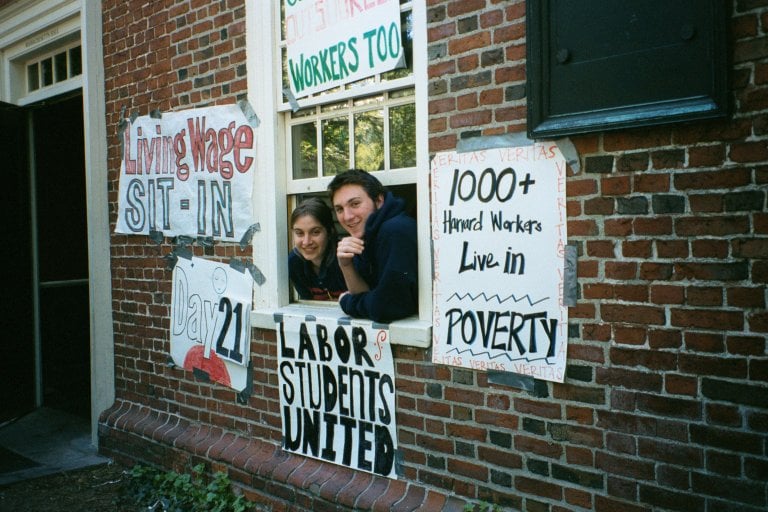
It was unclear what would happen once they entered, and some were prepared to be arrested. HUPD officers had previously asked them to keep their demonstrations outside University Hall, according to McKean.
“What I was a part of inside the Living Wage Campaign was more important than being a college student or getting good grades, or avoiding getting in trouble with the administration, or even getting arrested,” said Stephen N. Smith ’02, a PSLM member.
“The decision to be involved in the campaign and to sit in, and the fight that we still had to engage in afterwards, did as much to define the next 25 years of my life as being a student in the classroom,” he added.
The officers did not arrest the students inside. They stood outside instead, blocking further access.
“My first goal was not to call the police and not to harm any students,” Rudenstine said in a Wednesday interview. “So whatever we did afterward had to be consistent with that purpose.”
‘That’s Our Job’
Ed Childs, a longtime labor organizer and former Harvard dining hall worker, said dining staff gathered after their shifts and brought 40 pizzas to the students on the first day.
“The police surrounded the building and said, ‘You can’t get in, nothing gets in, nothing gets out.’ We said we’re here to feed our students,” Childs said. “Some of us went around the back and started delivering the pizzas through the windows.”
The officers eventually let the pizzas through.
“We made a statement to the press then that their struggle is our struggle, and that we will feed our students because that’s our job,” Childs added.
Outside, PSLM built a “Tent City” on Harvard Yard, a numbered array of tents whose occupants checked in daily to verify attendance. Picketers kept a 24-hour rotation, with a rally each day at noon and a vigil at 8 p.m.
“People who had been involved in some way before were getting more involved, people who had been supportive but never really involved were getting involved,” Offner said. “It was an absolutely remarkable experience to see massive collective action.”
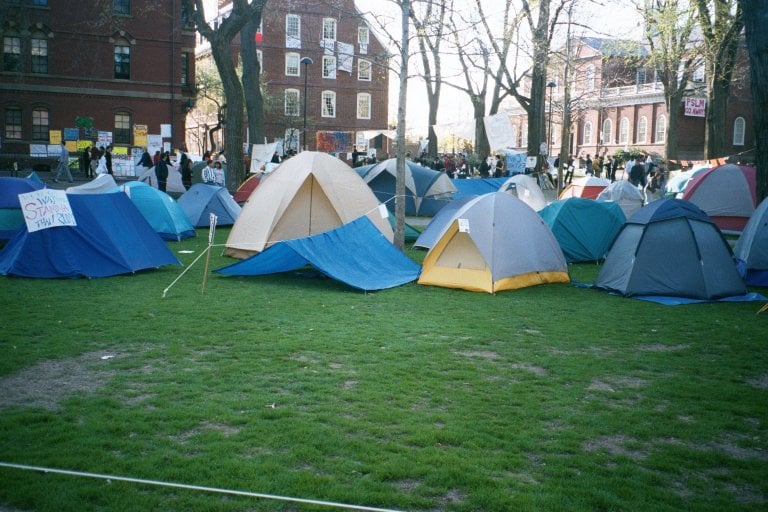
Some faculty moved their classes outside Massachusetts Hall so participating students would not miss attendance requirements. Smith said several of his sociology classes met outside the windows, and Lyman recalled Kennedy School professors Archon Fung and Marshall Ganz — who had strategized with the United Farm Workers and Cesar Chavez — teaching at the building.
“By your third class, your grade would start to drop drastically,” Lyman said. “Many of my professors brought the class and taught outside the window, so I could participate.”
“That was really just a beautiful show of solidarity from the professors,” she added.
The sit-in also drew a slew of high-profile visitors, including former U.S. Senators Edward M. Kennedy ’54 and John F. Kerry.
John Trumpbour, research director of the Center for Labor and a Just Economy at Harvard Law School, said Kennedy tried to enter Massachusetts Hall but was turned away by police.
“I was out there during the day, and Ted shows up. He doesn’t have an entourage or anything. He just comes in on the side by Johnston Gate,” Trumpbour said. “And he says, ‘Where are the students?’ I said, ‘Come this way, Senator.’”
“He got up in front of Mass Hall and just gave a stump speech on his own. It was very ad-libbed,” he added. “The word got out, and it was a very huge audience for him in a short time.”
The campaign had drawn celebrity attention even before the occupation. A year earlier, Ben Affleck — whose father had worked as a Harvard janitor — and Harvard dropout Matt Damon had spoken at a living wage rally.
The celebrity support carried into the occupation. Pacho F. Velez ’03 filmed from inside Mass Hall for a documentary, ‘Occupation: The Harvard Living Wage Sit-Ins,’ which Affleck narrated.
“We sent him a page of text, and he sent us back a tape,” Velez said. “It arrived maybe five days before the premiere. We suddenly had to cut it all in before the big screenings at the Harvard Film Archive.”
“Matt and Ben were really Boston neighborhood guys, and that was their ethos, that was their roots,” he added. “They were excited to pull for their community too.”
The film sold out two screenings on its premiere night, roughly 600 to 700 tickets by Velez’s count, and was later sold to broadcasters abroad, including in Japan. Velez said national labor organizations used it as a model for organizers on other campuses.
The students drew pushback closer to home, too. Massachusetts Hall remained a first-year dormitory above the president’s office throughout the sit-in, and at one point residents lowered a banner reading “PSLM: Pinko Socialist Leninist Marxist.”
Rudenstine publicly called the occupation an attempt at “coercion” that was “inconsistent with the fundamental principles of a university.”
“It is also their right to express their views, with vigor and passion,” Rudenstine wrote at the time. “But it is not their right to occupy a University building, to interfere with the conduct of work inside it, and to disrupt the lives of nearby student residents, in an effort to force a different decision.”
The Katz Committee
The occupation ended on May 9, after three weeks inside. Around the time of the students’ exit, following negotiations that drew in the organizers and national AFL-CIO leaders, Harvard agreed to convene a new committee on its labor practices. Unlike its predecessor, the committee would seat students and union representatives alongside faculty and administrators.
Rudenstine, who established the committee, was already set to step down that June, with Summers announced as his successor.
The participants drew varied levels of discipline. The Administrative Board issued three-week suspensions, the Kennedy School took no official action, and the Law School issued reprimands. Summers later signaled he would have gone further.
“It is very wrong when attempts are made to shut down portions of the University to intimidate people from carrying on their work,” he said at a 2002 Undergraduate Council meeting.
The Harvard Committee on Employment and Contracting Policies — dubbed the “Katz Committee” after Economics professor Lawrence F. Katz, a former chief economist at the Labor Department — seated undergraduate and graduate representatives and members of the University’s three largest unions, alongside faculty such as Law School professor Martha Minow and Kennedy School professor David Ellwood, who each later became dean of their school.
“The formation of the committee would not have happened as a serious committee with student representation and union representation without the students active in the Living Wage Campaign and the takeover of Mass Hall,” Katz said in a Wednesday interview.
“Before that, the University’s response had been to set up committees that they controlled that didn’t have any real independent ability to get feedback,” he added.
The committee did not ban contractors or set a minimum wage. Instead, it produced what became the Wage and Benefit Parity policy, requiring contractors to match the wages and benefits of internal unionized employees and undercut the savings from outsourcing. Summers adopted the recommendations, and the policy remains in effect.
Offner said the campaign shifted power on campus “in ways that I never thought possible.”
“For a time, the Harvard administration and the Harvard Corporation decisively lost the power to make unilateral decisions about the lives and the livelihoods of low-wage workers,” she said. “And that was because we built a coalition that meant that workers and unions were no longer fighting alone.”
Katz said the recommendations endured because they addressed the underlying problem rather than the politics of the moment.
“The recommendations stood the test of time because they were actually conceptually solid,” he said. “It actually tried to diagnose the problem and think about a lasting solution, and I think that’s ideally the lesson one gets from this.”
Rudenstine, for his part, has let the dispute rest.
“My own feeling is that the quarrels of the past remain in the past,” he said. “This is their 25th reunion, and I want to congratulate them and wish them a very happy time.”
—Staff writer Uy B. Pham can be reached at [email protected] or on Signal at ubp.88. Follow him on X @uybpham.
Want to keep up with breaking news? Subscribe to our email newsletter
Have a tip for The Crimson? Share it confidentially