When Harvey Mansfield Took On Harvard’s A’s
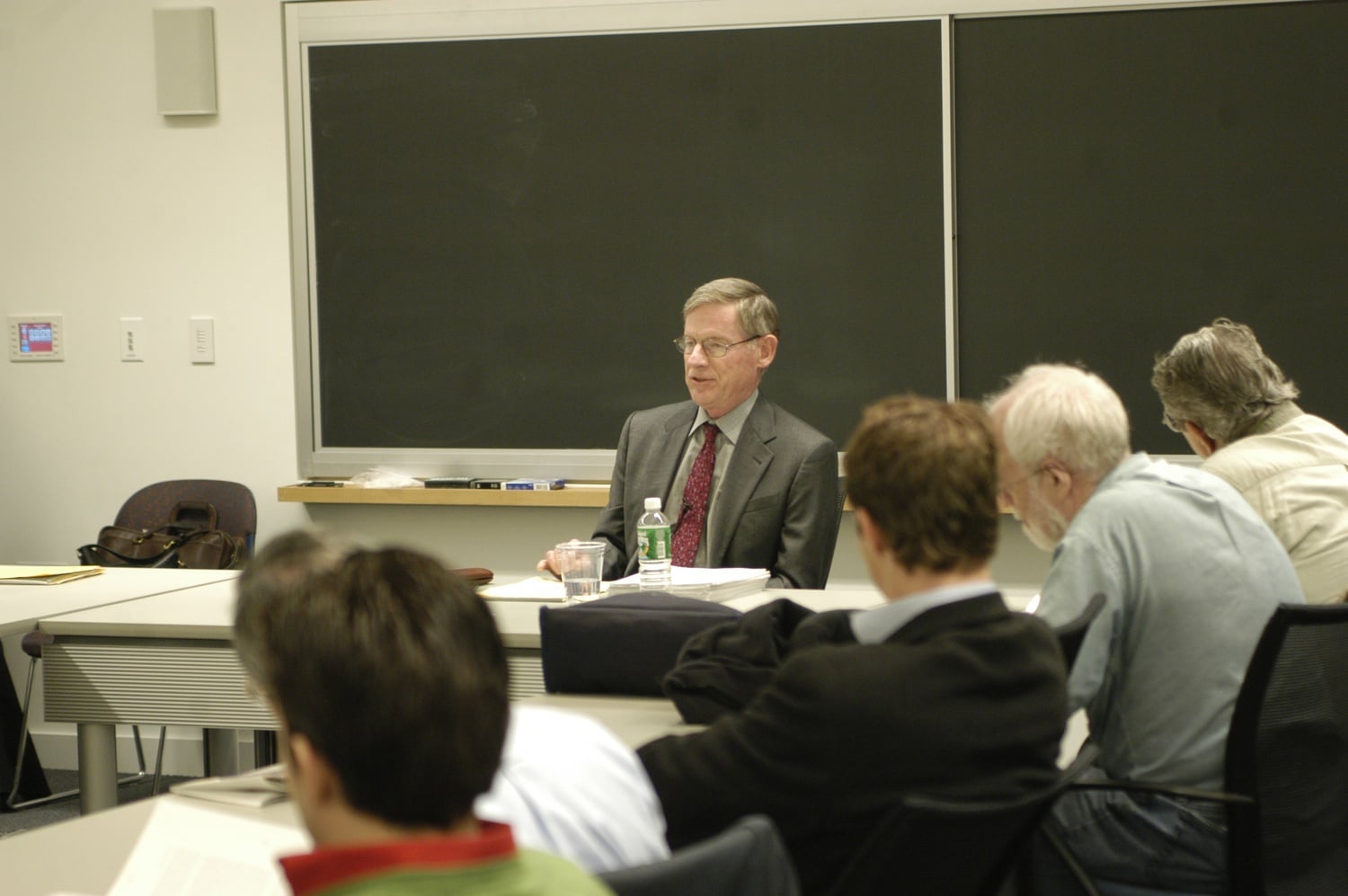
In the spring of 2001, Harvey C. Mansfield ’53 decided strict grading was no longer enough.
The longtime government professor already had a reputation. He was one of Harvard’s most prominent conservatives, a political theorist known for his sharp views and famously stingy grading. Students gave him a nickname that stuck: Harvey “C Minus” Mansfield.
But that semester, in his Government 1061 course — “The History of Modern Political Philosophy” — Mansfield announced that he would give students two grades. One would reflect what he believed their work actually deserved. The other, that would appear on their transcript, would be adjusted upwards so as to not “punish” anyone for taking his course.
He called it “ironic grading.”
“My two-grade policy could be called a publicity stunt,” he wrote in a statement to The Crimson.
To James Y. Stern ’01, Mansfield’s campaign against grade inflation made him stand out.
Stern, who took Mansfield’s course Moral Reasoning 17 course, “Equality and Difference,” said Mansfield “championed the cause in a very sort of obvious way.” Though Stern said it was hard to believe no other faculty members were worried about grade inflation, he said there was little action at the time.
“If they were concerned, there wasn’t much to show for it,” Stern said.
Richard L. Freed ’01, who attended some of Mansfield’s lectures, remembered the nickname.
“He had the nickname Harvey ‘C-minus’ Mansfield, for being a notoriously hard grader,” Freed wrote.
Get The Crimson in your inbox.
To Freed, Mansfield’s campaign amounted to “a principled stand,” even if he was “a bit of a vox clamantis in deserto” — a voice calling in the wilderness.
At the time, Mansfield believed Harvard grades had become so inflated that they no longer measured achievement. A spring 2001 grade inflation report revealed that roughly 91 percent of Harvard undergraduates were graduating with honors, and nearly half of all grades were A’s — a sharp increase from the 23 percent of A’s awarded in 1986.
Twenty-five years later, Harvard has moved closer to Mansfield’s position. In May, nearly 70 percent of voting faculty backed a policy that will cap A grades in undergraduate courses at roughly 20 percent of enrollment, beginning in fall 2027.
But in 2001, few faculty took as strong a stand as Mansfield. Faculty made some changes the next year, capping Latin honors at 60 percent of each class and moving Harvard to a 4.0 grading scale, but Mansfield’s policy remained the loudest challenge.
Mansfield’s “stunt” gained national traction, with coverage from outlets including The Washington Post and ABC News.
“One of my colleagues said it would make me famous, which it did in a small way,” Mansfield wrote.
But the attention was not only national. On campus, Mansfield’s comments also provoked backlash, especially after he linked grade inflation to affirmative action.
Mansfield wrote that, as Black students came to Harvard in greater numbers in the late 1960s, some faculty became reluctant to give them low grades.
“At the time the administration said this tendency wasn’t so, but they never released the figures they held,” he wrote. “I saw it in action and even felt it myself.”
The remarks drew a silent protest in Mansfield’s Gov 1061 class in February 2001. More than 60 students, many of them members of the Black Students Association, filed into Harvard Hall during his lecture on Machievallie and stood in silence for the 90-minute class.
Mansfield began the lecture by inviting the protesters to speak.
“If you have anything to say or protest, say it now because the lecture is on the topic of Machiavelli, not on anything else I’ve said,” he said at the time.
No one did. BSA officers had asked protesters to remain silent to avoid disrupting the class.
“Sometimes silence is more powerful than words,” then-BSA President Aaliyah N. Williams ’02 said at the time. “Our goal was to make a statement that we were aware of Mansfield’s statements and that we wouldn’t let them go unaddressed.”
Mansfield also praised the civility of the sit-in. After class, he approached Williams and BSA Treasurer Brandon A. Gayle ’03 to set up a meeting with the BSA officers.
“In a friendly gathering at one of the Houses convinced them I wasn’t a racist,” Mansfield wrote.
The controversy underscored how Mansfield saw grade inflation as more than an academic problem.
“More seriously,” Mansfield wrote “I was teaching students that politics often requires using irony toward those with greater power.”
For many government concentrators, though, Mansfield’s fight with grade inflation was just one element of the course.
Raphael “Rafi” S. Cohen ’04, who received a letter of recommendation from Mansfield after taking his political theory course in the spring of 2001, said the two-grade policy loomed largest at the beginning of the semester.
“In some ways I remember it being a big deal at the very beginning of the class,” he said. “It got the attention grabbing headline that he wanted.”
Cohen said Mansfield’s reputation as a hard grader also shaped expectations in his smaller classes. In Mansfield’s sophomore tutorial, Cohen said, the professor imposed a cap on A grades.
“It was a little bit of a sigh of relief,” Cohen said of receiving his final grade.
But Mansfield’s own courses did not always match his “C Minus” reputation. Stern, the 2001 graduate, said he received an A-minus in Mansfield’s course, though he said he was unsure whether the standard was more forgiving because it was a Core course.
Stern said Mansfield may not have directly caused Harvard’s new grading policy. But he said Mansfield helped keep the question alive.
“He kept the issue alive,” Stern said, adding that Mansfield may have helped to open up the space more readily for this kind of a reform.”
Still, Stern said Mansfield was “in many ways a lonely voice in the wilderness.”
Asked about the new grading policy, Mansfield wrote that the College still has further to go.
“Harvard needs to rediscover a bell curve in grading,” he wrote. “ The new formula is a step in the right direction.”
—Staff writer Alexa M. Schmitt can be reached at [email protected] or Signal at alexaschmitt.15. Follow her on X @alexa_m15_s.
Want to keep up with breaking news? Subscribe to our email newsletter
Have a tip for The Crimson? Share it confidentially