‘It Was Him Personally’: How Sherman Holcombe Organized Harvard’s Dining Workers Into a Campus Force
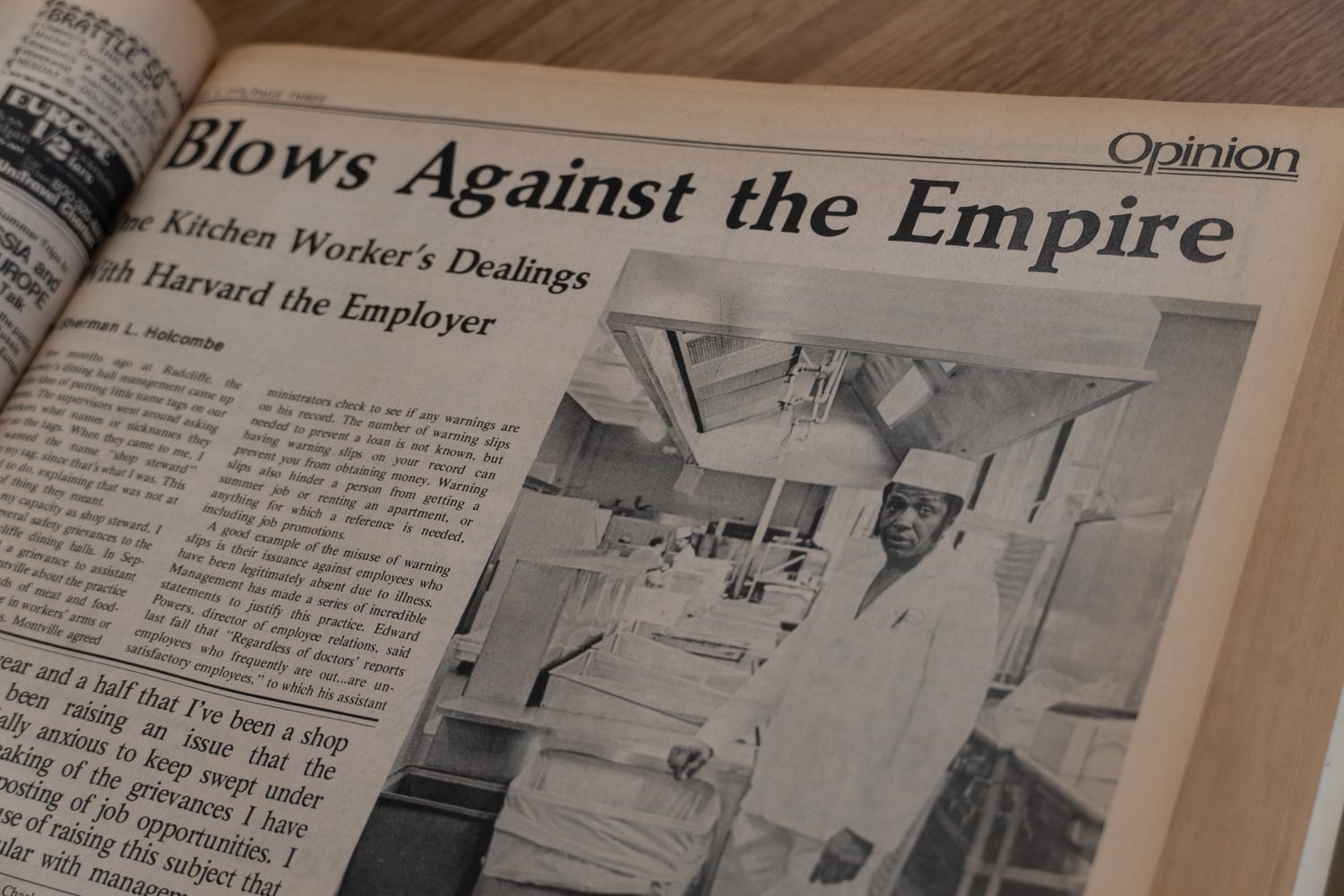
When Harvard management suspended dining hall worker Sherman L. Holcombe in 1976, it pointed to a tray of cauliflower au gratin, prepared too early.
Two hours earlier, Holcombe had reported something else. As union shop steward in the Radcliffe dining halls, he had flagged that kitchen staff were being ordered to portion ice cream by slicing it with a long knife while spinning the tub.
The “indefinite” suspension that followed would define the Class of 1976’s senior spring. By several accounts, it was the first time Harvard students and faculty had rallied so forcefully behind a non-academic worker.
“There was a lot of not particularly well organized but almost spontaneous response,” said Neal I. Koblitz ’69, then an assistant professor of mathematics who joined the effort to reinstate him.
It grew more organized as Holcombe’s newsletter spread and faculty signed on, Koblitz said.
“It quickly became very well known. It’s certainly the biggest controversy at Harvard, as far as I was aware, that year,” he added.
Holcombe had made himself a fixture among the dining staff long before. As shop steward for Local 26 — still the union representing Harvard’s dining workers — he circulated a newsletter that reached both workers and the student employees in his cafeteria.
Edward B. Childs, a dining hall worker who met Holcombe in 1975 and remains a union organizer, said his presence alone changed how managers behaved.
“The workers would love Sherman to be around because the bosses were all on edge and were less harsh on the workers when Sherman was around,” Childs wrote in a statement.
Koblitz said the real conflict ran deeper than any single dish.
Get The Crimson in your inbox.
“The main thing that caused confrontation between Sherman Holcombe and management was safety issues and affirmative action issues,” he said.
It also exposed a divide most of campus never saw. The administrators who ran Harvard’s classrooms were not the ones who ran its kitchens, Koblitz said, and the case taught the community “a lot about the differential treatment according to class at Harvard.”
“This was sort of an eye-opener for us, that anybody who had a responsible position at Harvard as some sort of supervisor or manager would ever insult someone using the N-word,” he said.
The response built fast. Supporters formed the Committee to Reinstate Sherman Holcombe, dining staff circulated a petition, and students boycotted brunch at North House — now Pforzheimer House — cutting attendance by roughly 270.
The committee reviewing Holcombe’s case was headed by one of his managers: the same supervisor he had recently accused of directing a racial slur at him.
Holcombe laid out that grievance, and the University’s slow response to it, in a Crimson op-ed written during his suspension, “Blows Against the Empire.”
Childs wrote that such language was routine, with managers aiming racial slurs at Black workers and sexist slurs at women, but holding back when Holcombe was near.
Fear ran through the workforce even as support grew, he wrote. Many backed Holcombe quietly, while only a few would stand openly beside him.
Holcombe returned to work eight days later. Koblitz said the terms fell well short of vindication.
“When they reinstated him, they did not restore his pay,” he said. “The same boss who had insulted him with the N-word wrote the statement to him about how he’d better behave in the future.”
“Even in the immediate aftermath, there is not any clear-cut evidence of improved behavior by Harvard,” he added.
Koblitz traced the scale of the response back to Holcombe himself.
“I think it was him personally,” he said. “He was an extremely articulate and a careful person, and it was his initiative that got this newsletter going.”
Holcombe also worked to organize a workforce that spoke Spanish, Portuguese, and Greek. Koblitz recalled enlisting a Greek graduate student in the math department to translate the newsletter.
“He was very aware of the need to bring people in from different races, ethnicities, class backgrounds,” Koblitz said. “He was very good at talking to the students and faculty.”
“He was a shop steward leader in the union, but by far the most active and successful one in getting other people involved,” he added.
That organizing outlasted him. Childs credits the atmosphere Holcombe built with making the dining workers a campus force, and with bringing up the younger stewards behind “50 cents or strike,” the first campus fight for a living wage.
Holcombe did not see how far it would reach. He died in 1979 of injuries from a truck accident in Harvard Square, three years after the Class of 1976 graduated.
“Sherman Holcombe taught me and other union members and students that the struggle is hard and can be demoralizing,” Childs wrote. “Besides being strong, what is more important is that we need to organize and develop more leaders.”
—Staff writer Celine Muir can be reached at [email protected] or Signal at celinem.33. Follow her on X @celinemuir1.
Want to keep up with breaking news? Subscribe to our email newsletter
Have a tip for The Crimson? Share it confidentially