The First Women in Harvard Yard Remember a Campus Built for Men
When women in the Class of 1976 became the first female first-years to live in Harvard Yard, they found both history and a campus still built for men.
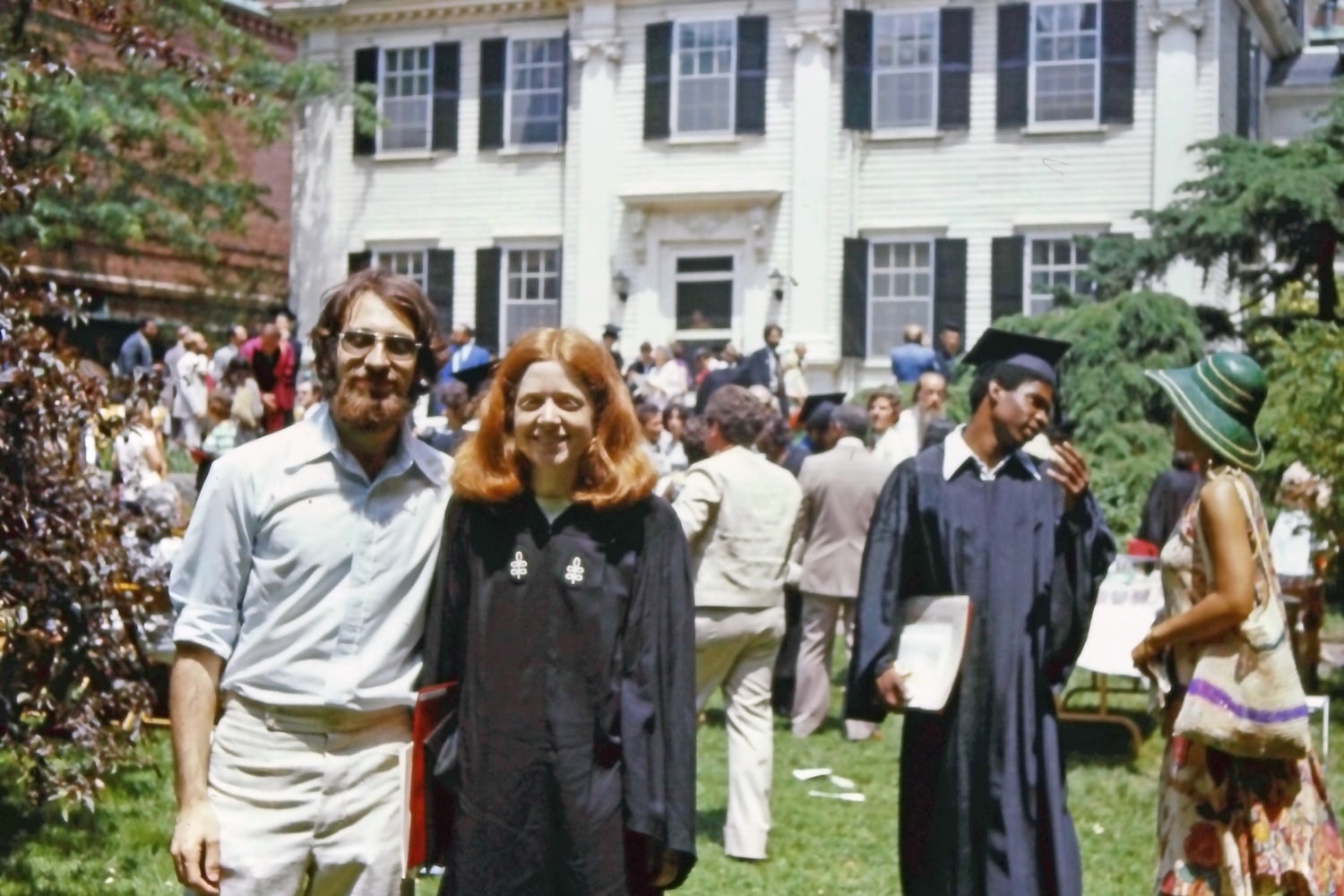
Not long after Katherine Richardson ’76 moved into Grays Hall, men began knocking on her door.
They were not classmates. They were older alumni, curious enough about Harvard Yard’s newest residents to come see them for themselves.
“We had these old men coming and knocking on our dorm room doors just to see if there were really women in my room,” Richardson said.
For more than three centuries, Harvard Yard had been almost entirely male. That changed in the fall of 1972, when President Derek Bok approved a plan to house roughly 200 freshman women from the Class of 1976 in the Yard alongside about 1,000 men.
For some first-year women, the moment felt historic.
Carol J. Spack ’76 remembered walking into her room in Stoughton Hall for the first time.
“It wasn’t just moving into a building at this location,” she said. “We were making history.”
But the Yard had not been built with women in mind.
Spack described the unusually large beds in Stoughton Hall, used to accommodate men much taller than she was. In Hollis Hall, where Marcia A. Angle ’76 lived, the closets were too short for dresses. Angle said she circulated a petition asking Harvard to install longer closet space.
“Seems a little comical in retrospect,” she said.
Get The Crimson in your inbox.
The petition did not lead to any immediate change, Angle said.
In Grays Hall, Richardson said janitors were shocked by the amount of toilet paper the women used. And in Thayer Hall, Maria T. Escalera ’76 and her floormates improvised in bathrooms designed for men.
“They had paid no attention to what women might need,” Escalera said. She added, “We used to all wash our underwear and hang them on the urinals. That’s what we had.”
Richardson said women in some dorms found another use for the urinals: They were the right height for shaving their legs.
“There was a good deal of accommodating,” she said.
Still, some women said the experience quickly began to feel ordinary.
“It was clear to us that this was an experiment,” Richardson said. “But, since we hadn’t known anything else, it was college.”
Elizabeth L. Haven ’76 said the change felt less like a break from tradition than the start of college life.
“I can see where it might have seemed like a very radical change,” she said. “But to us, it was just sort of a norm.”
The gender imbalance was harder to miss. The ratio in the Yard was about five men for every woman, and Natalie L. Wexler ’76 said it was immediately visible in the freshman dining hall.
“Walking in there was kind of like running a gauntlet,” she said. “There’d be a lot of stares from the guys.”
The imbalance lingered beyond the dining hall. Katie Klapper ’76 wrote in a statement that the gender imbalance was harder to navigate than she had expected.
“If I had it to do again, I’d have chosen to live at the ‘Cliffe with dorm-mates of different ages and experience,” she wrote.
Beth P. Stephens ’76 said the uneven ratio cost her something she did not fully understand until later.
“Looking back, I think there just were very few women around me,” she said. “There were not very many opportunities, or fewer opportunities, to meet other women.”
But several women said the men in their dorms were largely welcoming. Escalera recalled the men on her floor becoming something like family.
“They turned into our siblings, our brothers,” she said. “They were great.”
Amy Wilentz ’76, who lived in Thayer, felt the same.
“I loved it and felt only gratitude from the men that were there,” she wrote.
Milbry C. Polk ’76 said all of her closest friends that year were men.
“I had some wonderful friendships, and now it’s the 50th reunion and I’m still seeing some of those same people,” she said. “I know some people had negative experiences, “but I didn’t, honestly, experience that negativity.”
At the Radcliffe Quadrangle, students were navigating a different version of coed life. There, the ratio was closer to equal, with 150 freshman men and 250 freshman women living together.
Wexler, who chose to live at Radcliffe her freshman year, said the more balanced ratio mattered.
“I think being somewhere where there was a 1-to-1 ratio rather than a very lopsided male to female ratio was good for me,” she said.
But the Quad came with its own surprises. Charlotte Ackert ’76, who lived at Radcliffe, remembered discovering coed bathrooms — something the Yard, with its sex-segregated floors, did not have.
“You’re taking a shower and in the next stall is a guy,” she said. “For an 18-year-old, that’s a real awakening.”
For many of the women living in the Yard, Radcliffe barely figured into daily life.
“I’m glad that Radcliffe still existed,” Spack said, “but as a functional everyday matter, it wasn’t prominent if you were living in Harvard Yard.”
Escalera described a similar feeling.
“I set foot at Radcliffe like twice in my entire life that I was there. I had absolutely nothing to do with Radcliffe,” she said.
In hindsight, however, many said they underestimated what the Quad might have offered — and what they had given up by choosing the Yard.
”I think Radcliffe, as a place that might have been supportive, would have been helpful.” Stephens said. “I would have been much happier if I had been in the Radcliffe dorms with a 50-50 ratio and had a chance to meet more women.”
Polk, who said she spent her undergraduate years largely detached from Radcliffe, later came to see the community she had missed.
“It’s only been since I’ve graduated, which is very sad, really, because I lost four years, that I’ve discovered how wonderful Radcliffe is,” Polk said. “The women of my class are really interesting people who have done a lot of interesting things with their lives. I wish I had had more female friendships.”
For Spack, the decision to live in the Yard still carried its own meaning.
Five decades later, Spack still remembered sitting on the steps of Memorial Church late at night, looking out at the Yard in the rain. It was then, she said, that Harvard began to feel like hers.
“This is my place,” Spack said. “This whole university is my place.”
—Staff writer Riya S. Shah can be reached at [email protected] and on Signal at riyas.23. Follow her on X @RiyaShah233.
Want to keep up with breaking news? Subscribe to our email newsletter
Have a tip for The Crimson? Share it confidentially