Yo-Yo Ma ’76 Was Already a Prodigy. He Came to Harvard to Learn.
Yo-Yo Ma ’76 came to Harvard already a prodigy, but classmates said his years on campus pushed him beyond the usual path for a solo performer and exposed him to new ways of thinking about music.
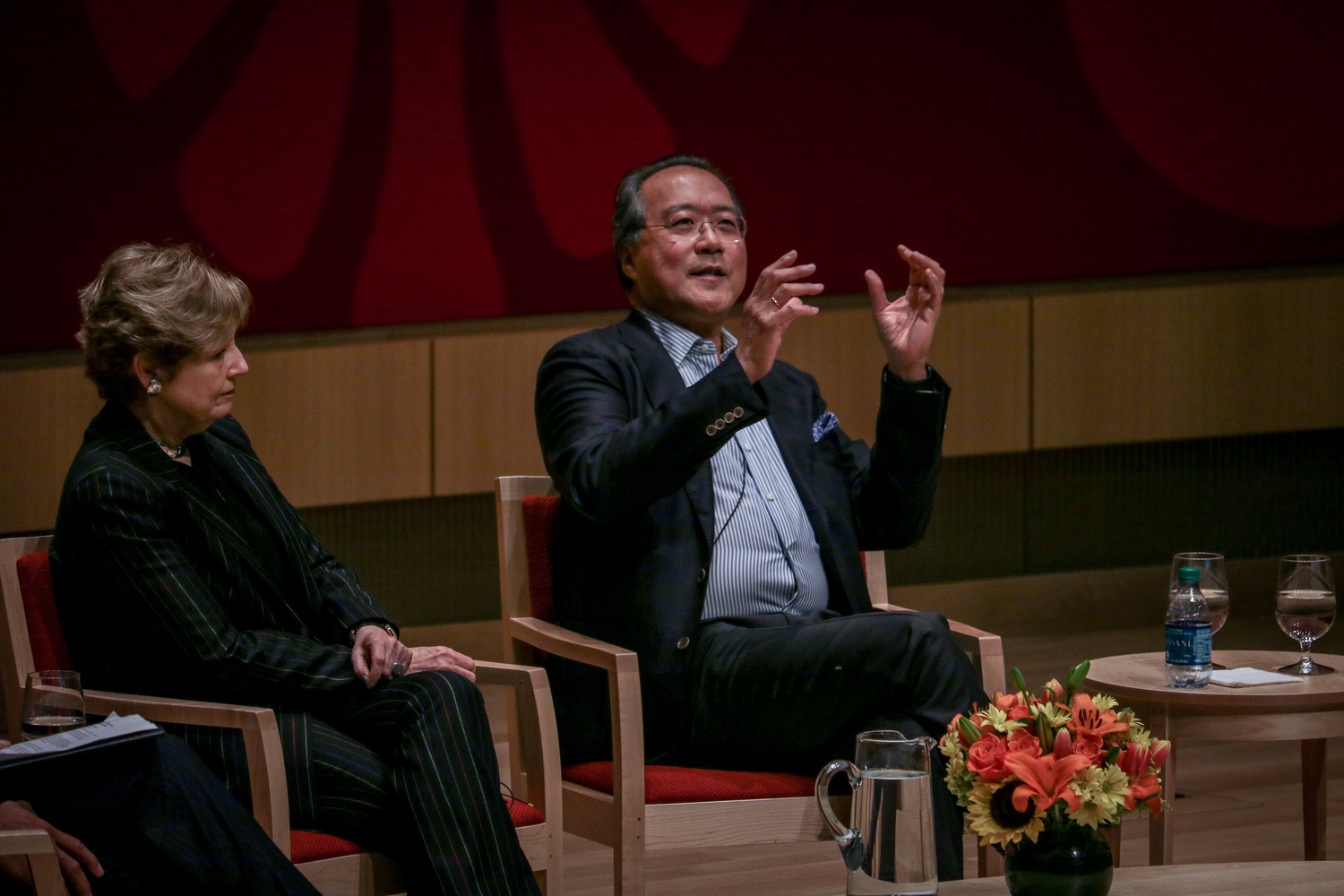
By the time Yo-Yo Ma ’76 arrived at Harvard at 16, he had already spent most of his life with a cello in his hands.
Ma began playing cello at 4 and appeared in his first nationally televised performance at 7. After seven years studying at Juilliard, he chose Harvard not as a detour from music, but as a place to pursue the liberal arts education he had never fully had.
Jonathan L. Weker ’76, a college friend of Ma’s, said his enrollment was a deviation from the usual path — and a sign of Ma’s inquisitiveness.
“This was not the usual career path, even at that point, for someone with his degree of talent who was clearly heading towards a career as a solo performer,” Weker said in an interview. “That says a lot about him and about his curiosity.”
In the 50 years since, Ma has become one of the world’s most acclaimed cellists, earning the National Medal of Arts and the Presidential Medal of Freedom and performing at nine presidential inaugurations. He has released more than 120 albums, 20 of which have won Grammy Awards.
He has also expanded his career beyond music, joining the board of trustees of the World Economic Forum and serving as a United Nations Messenger of Peace.
In interviews, Ma’s former classmates described him as enthusiastic and generous, with musical talent that was apparent even as an undergraduate and a genuine interest in learning from and connecting with others.
‘What a Madman’
The first time Keith C. Cheng ’76 met Ma, he was looking for a piano.
As a first-year living in Harvard Yard, Cheng — who was used to playing piano every day before college — did not have easy access to an instrument. His search for a place to play led him to North House, now Pforzheimer House, where he ran into Ma for the first time.
Get The Crimson in your inbox.
“He asked me what I was doing there,” Cheng recalled. “I said, ‘Oh, I’m from Harvard Yard, and I’m desperately looking for a piano to practice on, because I’m used to playing every day, and now I’m kind of in withdrawal here.’”
Ma, who was on his way to the airport to fly to South America for a tour, told Cheng he could stay in his North House room for the two weeks he was gone.
“Before I know it, he’s taken his room key off of his key chain, and he hands it to me. He says, ‘Why don’t you stay in my room while I’m gone? My roommate won’t mind,’” Cheng said. “I was quite flabbergasted.”
Cheng — who would go on to become friends with both Ma and his roommate, Cameron S. “Scott” Thompson ’76 — said the moment reflected Ma’s generosity, enthusiasm, and willingness to connect with others.
Thompson also remembered Ma’s openness, alongside his bravery and “playfulness.”
Despite arriving at Harvard with a long list of accolades, Ma never shied away from a prank, Thompson said. The tendency dated back to Ma’s time as a Juilliard pre-college student, when he was demoted from first chair all the way to last chair because of his antics.
“He’s a lunatic, but a glorious, wonderful, humane, loving, and all-embracing lunatic,” Thompson said. “He’s a madman, but what a madman.”
It is something Thompson said he takes inspiration from.
“I feel as though my life is, you know, enriched by that,” he said. “I try to be more of a lunatic.”
‘The World’s Best’
As it had been for almost his entire life, music remained central to Ma’s undergraduate years at Harvard. He performed with the Harvard-Radcliffe Orchestra, the Bach Society Orchestra, and more informally in Harvard’s Houses.
Harvard is also where Ma began performing with pianist Richard J. Kogan ’77 and violinist Lynn Chang ’75, after the three were assigned to perform a piece together for a class. It was the beginning of a musical collaboration — and a friendship — that has lasted decades.
The three performed together often at Harvard, calling themselves “the Harvard trio.” A 1976 Crimson review of one of their performances described them as playing “on what must be described as a musical level comparable to the world’s best.”
Ma, a child prodigy, was already known for his cello-playing by the time he arrived at Harvard.
Born in Paris in 1955 to Chinese parents, he began cello lessons with his father at 4 and gave his first public performance a year later at the University of Paris. He moved with his family to New York City at 7, where he continued studying cello at Juilliard.
He reached a wide American audience as a child when he appeared with his sister in a televised performance at a fundraiser for the National Cultural Center, attended by then-President John F. Kennedy ’40. The siblings’ popularity grew further when they appeared on “The Tonight Show Starring Johnny Carson” two years later.
After coming to Harvard at 16, Ma continued to perform on and off campus. Weker, who attended Ma’s shows as an undergraduate, remembered his skill and passion for music 50 years later.
“For all of his good-naturedness, he just had an enormous amount of passion at the time,” he said, pointing to a performance Ma gave during their sophomore year in Sanders Theatre.
“That performance was just so breathtaking, that at the end of the first movement – this was in Sanders — the whole place just went quiet for a few seconds, and then everybody just burst out into spontaneous applause,” Weker said.
Ma continues to perform live today, playing cello alongside orchestras for international audiences. And his repertoire now extends far beyond Western classical music to include experimental works and covers of several pop songs.
According to Kogan, Harvard gave Ma the opportunity to encounter many styles of music for the first time.
Kogan said Harvard exposed Ma to popular American music, including the Beatles and “White Christmas” — much of which, to Kogan’s surprise, he had not heard before.
“At the time that Yo-Yo entered Harvard, he had a career as a musician, he did a lot of performance, but he was pretty sheltered,” Kogan said. “There were lots of things, even about music, that Yo-Yo didn’t know.”
Ma told Harvard Magazine in a 2000 interview that Harvard “was the first place in my life where I was systematically introduced to different worlds and ways of thinking.”
Kogan characterized Ma’s time at Harvard as a learning experience — one that Ma willingly embraced.
“He was open to everything, never jaded, and just always kind of expanding,” Kogan said.
‘A Musician Who Would Communicate’
But music was not Ma’s only interest. At one point, he faced the possibility of being forced to stop performing entirely.
In his early 20s, Ma was diagnosed with a severe form of scoliosis worsened by a lifetime of playing cello, and required corrective surgery. At the time, it was unclear whether he would be able to continue playing — a possibility Thompson said Ma approached with openness.
“He, I think, realized, especially that he could really do just about anything,” Thompson said. “He’s interested in everything. He’s an exceptionally bright guy.”
Ma approached much of his undergraduate education with that openness, taking courses in languages and literature while formally earning a degree in anthropology. And while Ma ultimately pursued music as his career, his former classmates continue to see his broader interests reflected in the projects he has chosen to pursue.
According to Kogan, Ma knew he intended to be a musician when he enrolled at Harvard — but he had yet to determine what that would look like.
“While he was at Harvard, he really worked at developing and finding his own voice,” Kogan said. “He became a musician who I think really focused not on being an instrumentalist, on being a cellist — and even a spectacularly great cellist — but by being a musician who would communicate, who would bring cultures together.”
Throughout his career, Ma has remained interested in connecting music with culture. In his latest project, a podcast series and companion EP called “Our Common Nature,” he traveled around the United States performing alongside people “who have deep connections to the earth.”
Nearly two decades earlier, in 1998, Ma launched the Silkroad Ensemble — a gathering of musicians from places located along the Silk Road, aimed at promoting cross-cultural dialogue. Weker described the project as “of a piece” with his College classmate, whose interests ranged from anthropology to astronomy.
“Who he is as a person and who he is as a musician are pretty inseparable,” Weker said.
To Kogan, Ma’s skill as a cellist exists alongside his capacity for friendship.
“What Yo-Yo is — as great a cellist and musician as he is, he is an even greater human being, and he is just a terrific friend,” he said.
—Staff writer Sebastian B. Connolly can be reached at [email protected] or on Signal at sbc.23. Follow him on X @SebastianC4784.
Want to keep up with breaking news? Subscribe to our email newsletter
Have a tip for The Crimson? Share it confidentially