Harvard Management Company Founder Walter M. Cabot ’55 Remembered as Endowment Pioneer
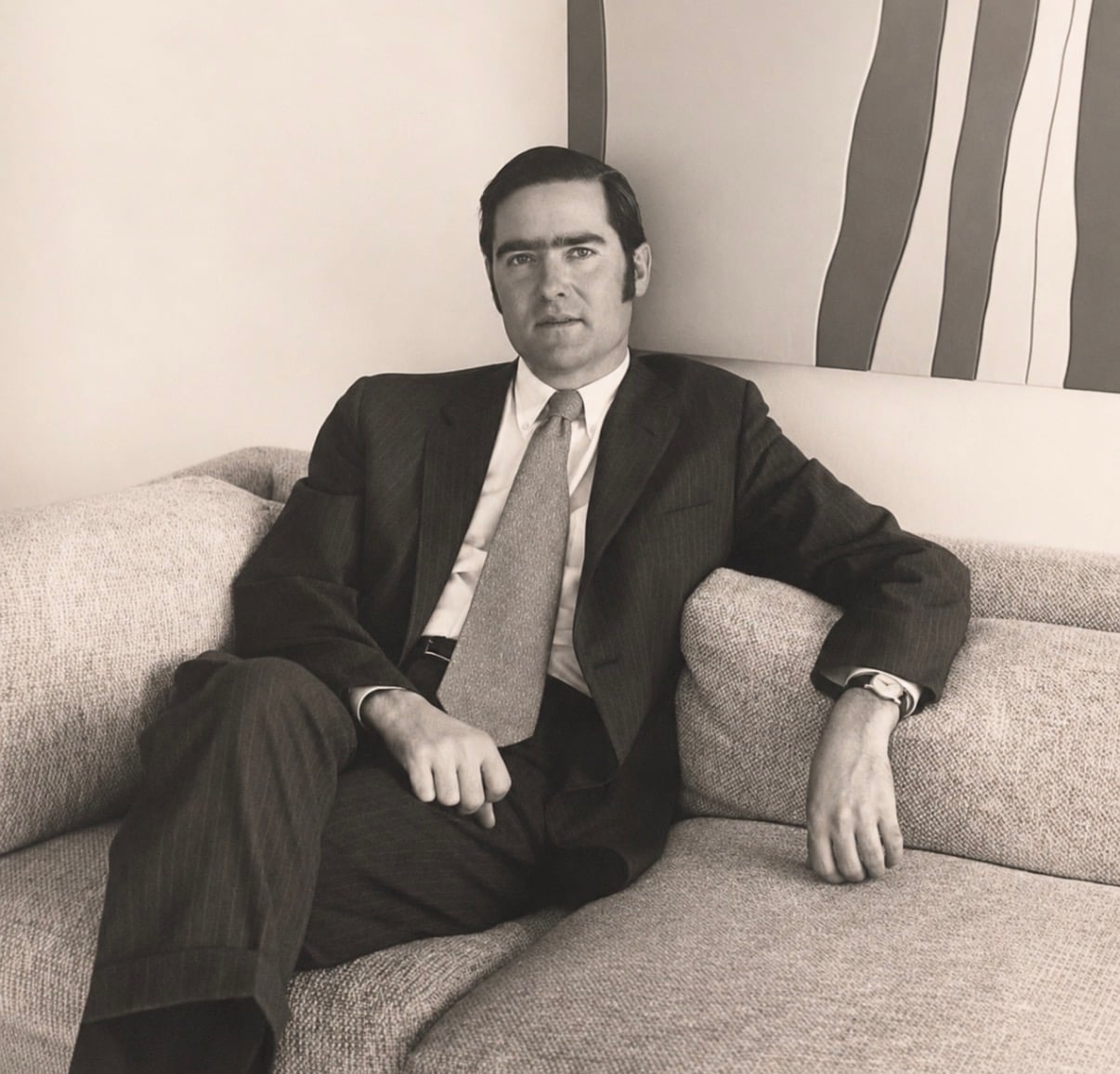
Walter M. Cabot ’55, the founder and first president of Harvard Management Company who helped pioneer a new model for university endowment management, died in June at 93.

When Walter M. Cabot ’55 joined the newly established Harvard Management Company in 1974, “he was excited to build something new,” his daughter Linda N. Cabot ’80 said.
As HMC’s founder and first president, Cabot took the reins of an endowment valued at $1.4 billion. In the following 16 years of his leadership, Cabot steered Harvard through a market crash and established investment strategies that helped HMC’s portfolio grow roughly fivefold to more than $5 billion.
“He was just thrilled, because obviously he loved Harvard,” Linda Cabot said. “He had a chore to really create something unique and different in the investing world, and I think that just filled him with so much excitement.”
After a decades-long career helping reshape university endowment management, Cabot died in June at the age of 93.
Current HMC chief executive officer N.P. “Narv” Narvekar wrote in a statement that Cabot remained involved in HMC even after leaving the role in 1990 and “continued to offer assistance wherever he could.”
“He was kind enough to reach out to me shortly after I started at HMC,” he wrote. “In addition to benefiting from his wealth of knowledge on the University, HMC, and more, I remember being truly impressed by his unyielding commitment to Harvard’s success.”
Jane L. Mendillo, who served as HMC chief executive officer from 2008 to 2014, said Cabot was “a real Harvard person through and through.” Mendillo first worked with Cabot when she was hired at HMC as an equity analyst.
“He really cared about the university and that connection of Harvard Management Company with the university, and that came through in a lot of his leadership style,” Mendillo said.
Mendillo said Cabot was “gracious and inquisitive” and remembered him as “a fundamental value investor” who focused on the core drivers of value.
Those traits shaped the culture of the young HMC, where Cabot encouraged staff across investment teams to exchange ideas. Philip Gross, a former HMC analyst who later co-founded Adage Capital Management, said Cabot “wanted to create a collaborative culture of information and thought sharing.”
Get The Crimson in your inbox.
As an undergraduate, Cabot lived in Eliot House as a government concentrator and served as president of Hasty Pudding Theatricals. In a 2005 interview with The Crimson, Cabot also recalled a lighter side of his college years, describing a game in which students tried to cram into a telephone booth.
“You put the heaviest guy on the bottom and the lighter guys piled in on top of him,” he said. “I suspect we knocked over a few telephone booths that way.”
After graduating, Cabot served in the armed forces before returning to Harvard to attend the Business School. He later worked at Putnam Management Company and Wellington Management.
Putnam Management founder and former University treasurer George Putnam Jr. ’49 initially pushed to move Harvard’s investments in-house in 1973, alongside then-President Derek C. Bok. HMC was formed the next year, and the Harvard Corporation asked Cabot to lead the newly minted company.
HMC, the first university management company of its kind, was still in its early days when Cabot took over. Linda Cabot said her father remembered the beginning as “bare bones and minimal,” as he worked to build a staff and develop a new investment model.
Cabot began investing in private companies and venture capital, a new model for endowment management at the time. He also helped establish HMC’s Aeneas Group, a subsidiary focused on alternative investments.
HMC also endured the market crash in 1987 during Cabot’s tenure. The value of Ivy League endowments suffered losses of at least $40 million each in the wake of the crash, but Harvard “lost a lot less money than the market,” according to Cabot’s son David R. Cabot ’82.
“A lot of it was because of these trading strategies my father put in place,” David Cabot said.
“I laugh because the Yale model, in fact, followed the Harvard management company model,” David Cabot said. “Harvard had already been doing it when the Yale model was established.”
In the years leading up to Cabot’s tenure, HMC had faced fierce backlash against Harvard over its holdings in Gulf Oil, which was deeply tied to the Portuguese occupation of Angola, and criticism over Harvard’s investments in apartheid South Africa. HMC, with Cabot at the helm, would “try to avoid putting Harvard money into companies which, in their opinion, are not socially responsible,” according to a Crimson article from 1974.
Apartheid in South Africa was a defining issue in his HMC tenure, Cabot said in a 2024 interview with The Crimson. While HMC never fully divested, Cabot said he worked to “put pressure on companies to reduce the pressure of apartheid and we were selective in our portfolio.”
“He certainly didn’t like the apartheid regime, but whether it was effective from an investment point of view — or whether Harvard should wade into it from a political point of view — I think he was cautious about,” David Cabot said.
Cabot went on to serve as treasurer and trustee of Wellesley College for two decades, guiding the expansion of the school’s investment strategy and pushing for the addition of a chief investment officer to its leadership. Mendillo, who later returned to HMC to serve as CEO from 2008 to 2014, was appointed as Wellesley’s first chief investment officer.
“He really did bring the best of Harvard’s ideas that were applicable to Wellesley,” said Victoria Herget, who served on the board of trustees with Cabot.
Herget said Cabot was “very prominent in the investment community in Boston” and helped Wellesley access investment opportunities that might have been difficult for a smaller institution to reach.
David Cabot said his father’s passion for higher education extended beyond Harvard or Wellesley, saying he had a “love-hate” relationship with HMC’s top rivals.
“He wanted them to do well too, even though they always competed against each other,” Cabot said. “I don’t know what you call that, but he shared a lot of his wisdom and portfolio experience running an endowment with Yale, MIT, Princeton, others.”
Cabot was a prominent figure on various boards and trusteeships. He held roles at the Noble and Greenough School, Tufts Medical Center, St. Paul’s Church, and many other organizations.
Cabot’s passion for Harvard remained clear even after his retirement. Linda Cabot said her father was “so upset” to see Harvard’s ongoing fight with Washington over federal funding, saying he always admired the University’s “amazing research.”
“Harvard is both Harvard University and the Harvard Management Company,” David Cabot said. “He cared a lot about both.”
—Staff writer Megan L. Blonigen can be reached at [email protected] and on Signal at mblon.50. Follow her on X at @MeganBlonigen.
—Staff writer Graham W. Lee can be reached at [email protected]. Follow him on X @grahamwonlee.
Want to keep up with breaking news? Subscribe to our email newsletter
Have a tip for The Crimson? Share it confidentially