More Than 4,000 Nurses Strike at Harvard-Affliated Brigham and Women’s Hospital
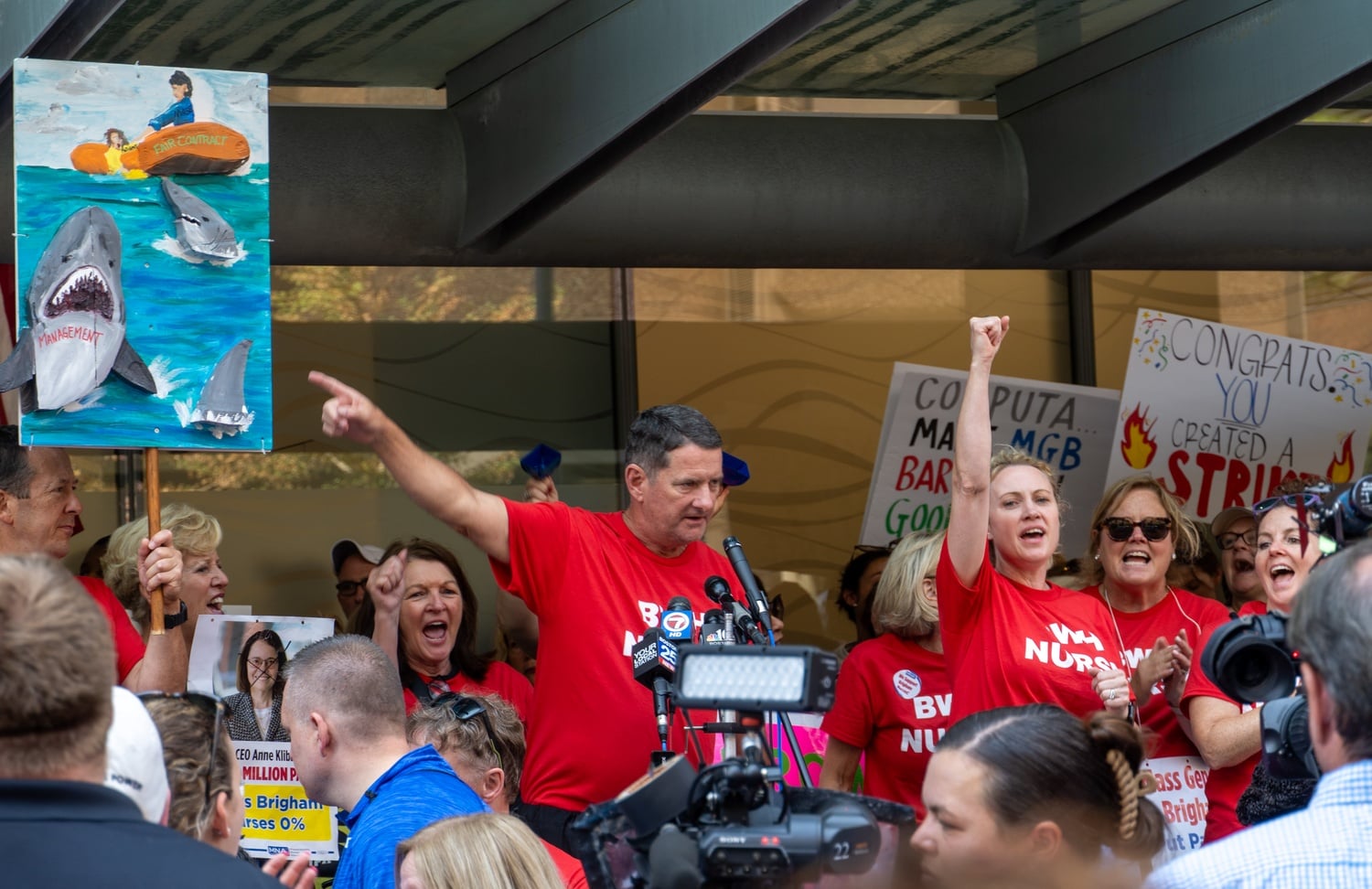
More than 4,000 nurses at Brigham and Women’s Hospital in Boston began a one-day strike Wednesday morning, walking off the job at one of Harvard Medical School’s largest teaching affiliates to demand wage increases, lower healthcare costs, and limits on the hospital’s use of temporary travel nurses.
The strike — which the Massachusetts Nurses Association has called the largest nurses’ strike in the state’s history — follows seven months of negotiations between the union and Mass General Brigham, the hospital’s parent healthcare system.
HMS does not operate its own hospitals, instead relying on formal affiliation agreements with 15 local hospitals. Brigham and Women’s, located less than a mile away from the Medical School’s Longwood campus, is one of HMS’s teaching affiliates and hosts 180 HMS students for rotations each year.
Many physician-scientists at affiliated hospitals also hold HMS faculty appointments. At least 2,670 HMS affiliates — including research fellows, clinical instructors, and professors — hold joint appointments with the hospital, according to an internal Harvard directory.
Several residency programs are jointly branded by Brigham and Women’s and HMS, including programs in psychiatry, urology, and emergency medicine.
Though the strike is scheduled to last one day, nurses are not expected to return to work until July 13 because MGB hired replacement nurses on five-day contracts.
MNA spokesperson David Schildmeier wrote in a statement that hospital workers, including HMS students and affiliated physicians, were being put in a “dangerous situation that could put their patients at risk for serious harm.”
Schildmeier said the replacement nurses “have no connection to the hospital” and “no understanding of the protocols and the patients we care for,” adding that the union has already heard stories about “their inability to safely care for patients.”
“We would hope members of the Medical School would support those expert nurses who are outside fighting for safer patient care, and are letting their administration know how wrong this is,” he added.
Schildmeier confirmed that no HMS-affiliated physicians or investigators are represented by MNA.
Get The Crimson in your inbox.
An HMS spokesperson did not immediately respond to a request for comment. An MGB spokesperson did not immediately respond to a request for comment.
In a statement on its website, Brigham and Women’s wrote that the hospital remained open and was prepared to “deliver safe care to our patients” during the five-day work stoppage.
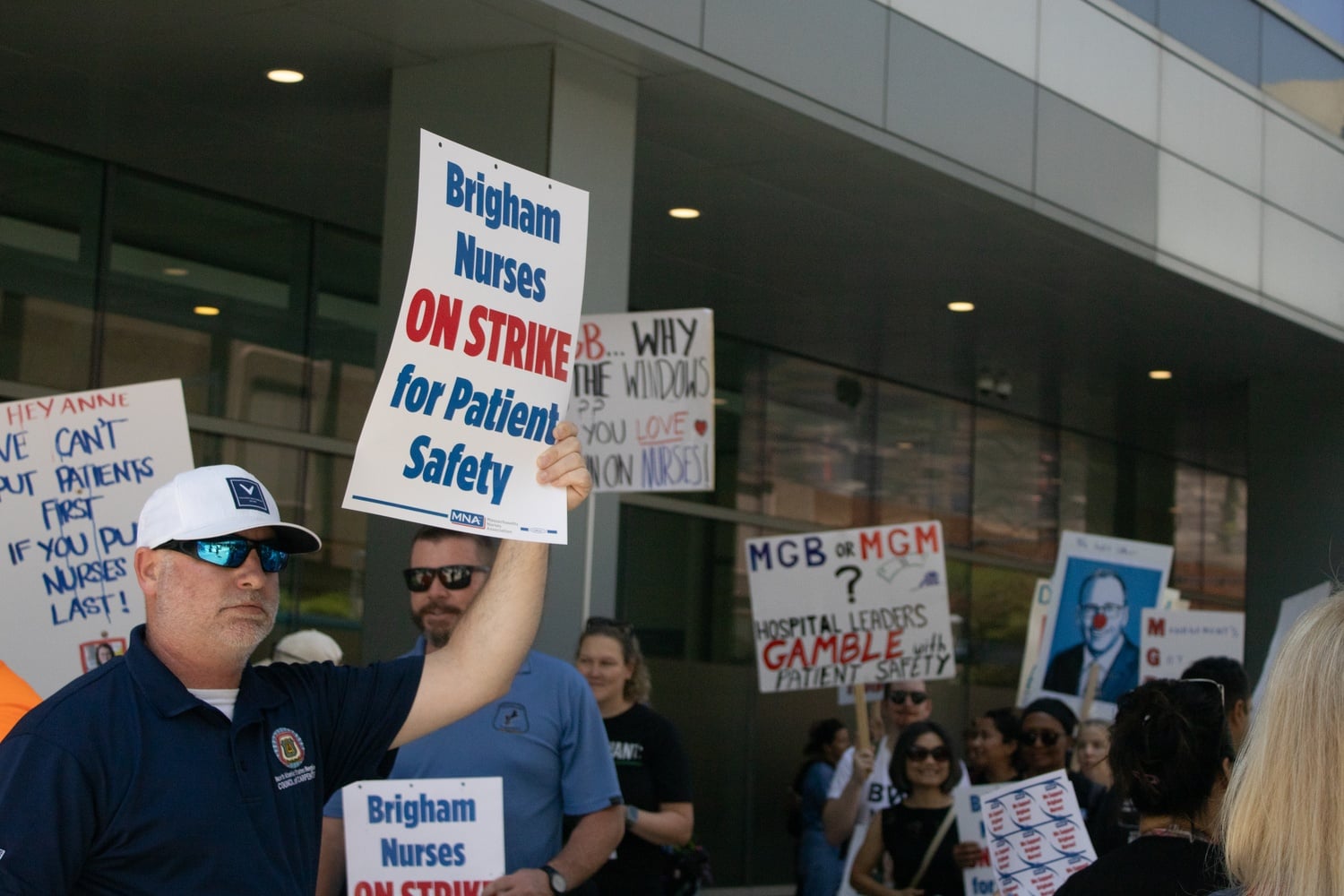
The strike included a rally at noon Wednesday outside the hospital’s cardiology center where several union organizers spoke alongside labor organizers from the Boston Teachers Union and Boston Firefighters Local 718. Hundreds of nurses continued to picket along Francis Street, as passing drivers honked in support, including from a Boston Fire Department truck.
U.S. Senator Elizabeth Warren (D-Mass.), state Rep. Marjorie Decker, and U.S. Representative Seth Moulton ’01 (D-Mass.) were among the local officials who stopped by the picket line Wednesday. Warren handed out donuts to striking nurses.
Massachusetts Governor Maura T. Healey ’92 summoned union representatives and MGB leaders to the State House Wednesday in an effort to broker a new contract, according to the union.
“You mess with one of us, you mess with four thousand of us,” said Kelly Morgan, chair of the Brigham MNA Bargaining Committee. “We are the ones that answer the call.”
“This strike is about patient care, it’s about respect, and it’s about making sure that every nurse has the support needed to provide the care across the continuum that this community deserves,” she added.
MNA has said the hospital is offering a zero-percent wage increase, rather than a cost-of-living wage. The hospital is asking nurses on a Harvard Pilgrim Health Plan — an independent nonprofit health insurer — to pay 2.5 percentage points more of their monthly premium.
Brigham and Women’s has said its nurses are in the top 10 percent of the market for nursing compensation at acute care hospitals and that its proposal would maintain annual 5 percent step increases under a 20-step pay scale.
Separately, more than 450 MGB home care clinicians also went on strike Wednesday after stalled negotiations.
Boston Mayor Michelle Wu ’07 signed a joint statement Tuesday with Warren and U.S. Sen. Ed Markey (D-Mass), as well as U.S. Reps. Stephen Lynch (D-Mass.) and Ayanna Pressley (D-Mass.) in support of the strike, writing that nurses “deserve a fair contract that reflects the essential contributions they make each and every day.”
—Crimson summer interns Lena M. Aloise and Jordan O. Gwon contributed reporting.
—Staff writer Uy B. Pham can be reached at [email protected] or on Signal at ubp.88. Follow him on X @uybpham.
Want to keep up with breaking news? Subscribe to our email newsletter
Have a tip for The Crimson? Share it confidentially