As Students Face Another Year of Bus Delays, Parents Detail a ‘Broken System’
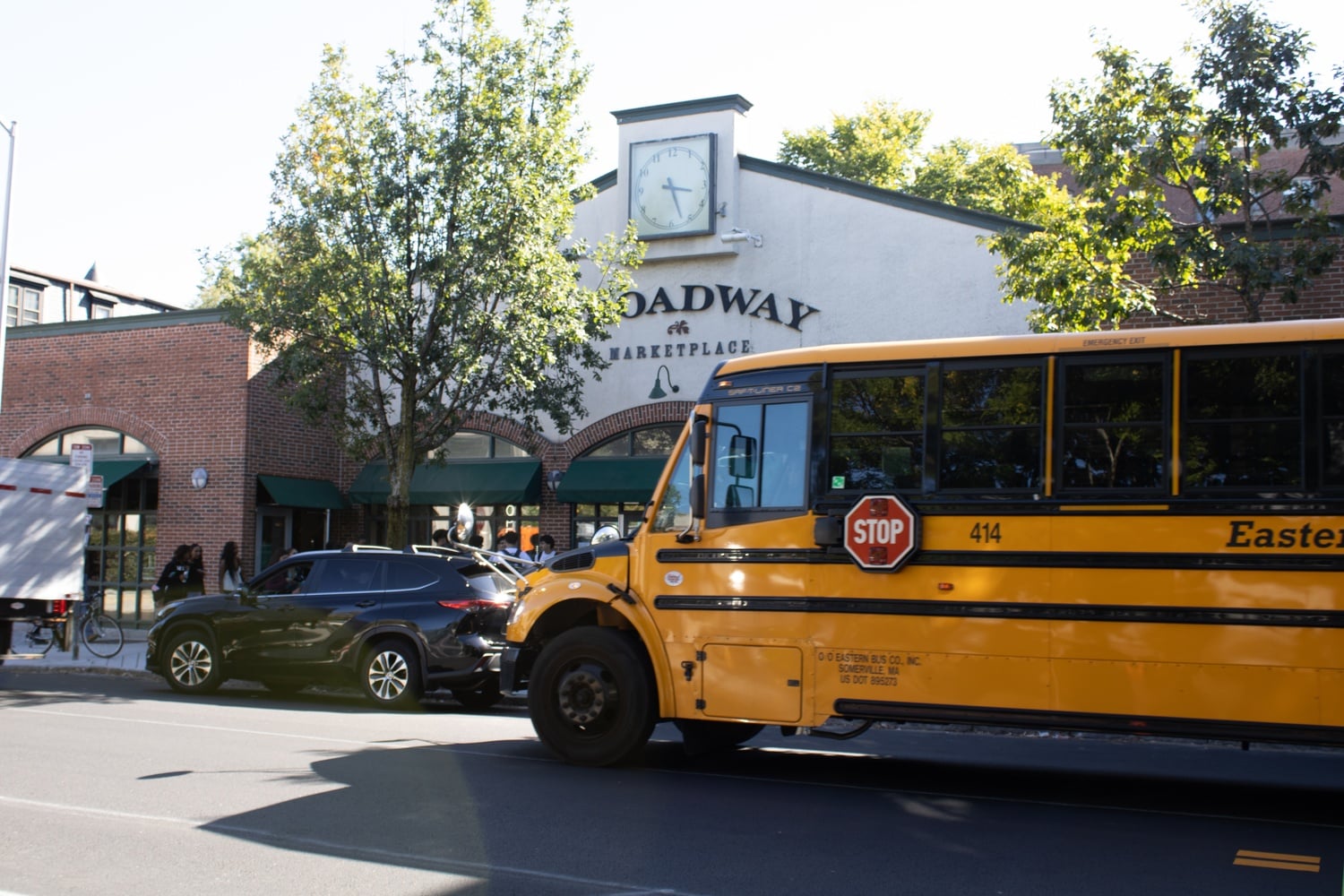
For years, Cambridge Public School parents have described the same issues as students return to school: late buses, unreliable tracking systems, and a lapse in communication from the district.
The district saw significant improvement this year, Superintendent David G. Murphy said during a Tuesday School Committee meeting — with only three percent of buses arriving after the start of the school day last week.
Murphy said the available data showed that the district’s decision to modify bus routes and staggered start times have “significantly improved performance to date.”
But Murphy’s account of broad improvement comes as some families describe problems that they say have persisted across multiple school years, from inconsistent bus schedules to lengthy commutes for students, some of whom spend more than an hour in transit.
Clara Hendricks, who has sent her children to school on the bus for nearly a decade, said her children’s route between North Cambridge and the King Open and Cambridge Street Upper School complex has been unreliable since her oldest child began school in 2017.
The roughly two-mile trip after school has regularly taken between 45 minutes and an hour and 15 minutes, Hendricks said. Morning delays have also caused students to miss breakfast and King Open’s morning meeting, she added.
“In the afternoon, you have kids as young as literally four years old now sitting on these buses for over an hour, not allowed to eat, not allowed to go to the bathroom,” Hendricks said. “It’s really just inhumane.”
Hendricks said her older child now takes an MBTA bus to school because of anxiety about arriving late, requiring the family to pay for transportation CPS would otherwise provide. Her younger child transferred to a neighborhood school last spring, a decision Hendricks said was partly driven by anxiety associated with the school bus.
“If you’re going to offer controlled choice, there has to be a safe way and an efficient way of getting kids to and from school,” Hendricks said.
She also said her family had waited 45 minutes in the rain before learning that a bus skipped their stop.
Get The Crimson in your inbox.
“I implore you to not set up new CPS parents for the same painful 10 years my family has experienced,” Hendricks wrote in a statement to the School Committee shared with The Crimson. “Do the right thing and overhaul this broken system.”
Murphy said that the issue is confined to a few routes — adding that some Eastern Bus Company routes remain slower than intended, but that the district has experienced more significant problems with specialized transportation provided by NRT, which is owned by Beacon Mobility.
“The overall performance over the years has been pathetic,” Murphy said. He added that the district chose NRT and Beacon because they were the only qualified bidders for the contract, and that they have to “prove themselves.”
“If it’s feasible for us to cut the check on a quarterly basis or a monthly basis, then it’s feasible for the vendors to perform under it,” Murphy said.
Murphy attributed some specialized transportation problems to a delay in sending updated student information to NRT and Beacon Mobility in August. According to Murphy, the delay affected the vendors’ ability to establish GPS tracking, though the system is now online. Beacon Mobility did not respond to a request for comment on the delays.
Murphy said CPS was recording every bus arrival time to hold vendors accountable. He added that the contracts define an on-time arrival as at least 15 minutes before school begins, a standard the district planned to begin using in its reporting the following week.
“If your child is late to school because of the bus that your tax dollars pay for, it is completely unacceptable,” Murphy said. “It’s unacceptable every year, every month, every week, every day, including the first day of school.”
Still, communication from the district has been another source of frustration for families, according to six parents who spoke to The Crimson.
School Committee member Richard Harding Jr. said the district’s communication with families was “probably the biggest piece” of the problem. Though he acknowledged the effects of traffic and construction, Harding said families’ concerns were reasonable.
“I still would never understand how a bus misses an entire bus stop and leaves a student or a bunch of students there,” Harding said. “Even if you’re late to a bus stop, to just skip a bus stop, I never thought that would happen.”
Murphy wrote in his memo that CPS sent approximately 30 messages during the first two weeks of school when buses were projected to be more than 15 minutes late through Parent Square, the district’s messaging platform. He asked families to contact their school principals if they did not receive notifications.
“We cannot communicate about problems before they occur or before we know about them, but we will continue to communicate regularly,” Murphy wrote.
Parents said the recurring problems have led them to create their own communication networks. A private Facebook group for CPS bus parents and guardians, founded three years ago, now has more than 140 members sharing real-time updates about late or missing buses.
Arif Hussain, who created the group, said families have used it to alert one another when buses arrive early, stop on the wrong side of a street, or fail to appear at the expected time.
Jodi Ekelchik, whose child used CPS transportation for eight years before entering high school, described the recurring beginning-of-year disruptions as the “September effect.” She said routes generally become more reliable after CPS makes adjustments every year, but questioned why families must endure weeks of disruption before those changes occur.
“They’re going to fix these problems, but why does it have to take a month?” she said. “That’s a month of learning. That’s a month of disruption for some students.”
Murphy said CPS may never achieve an entirely problem-free opening week because of the complexity of its controlled-choice assignment system but said the district should continue working toward that goal.
“The first week of school is always going to be difficult,” Murphy said. “But it can be better.”
—Staff writer Tess E. Sumner can be reached at [email protected].
Want to keep up with breaking news? Subscribe to our email newsletter
Have a tip for The Crimson? Share it confidentially