Nobel Peace Prize Winner Nadia Murad Calls for Listening and Action To Combat Conflict-Related Violence
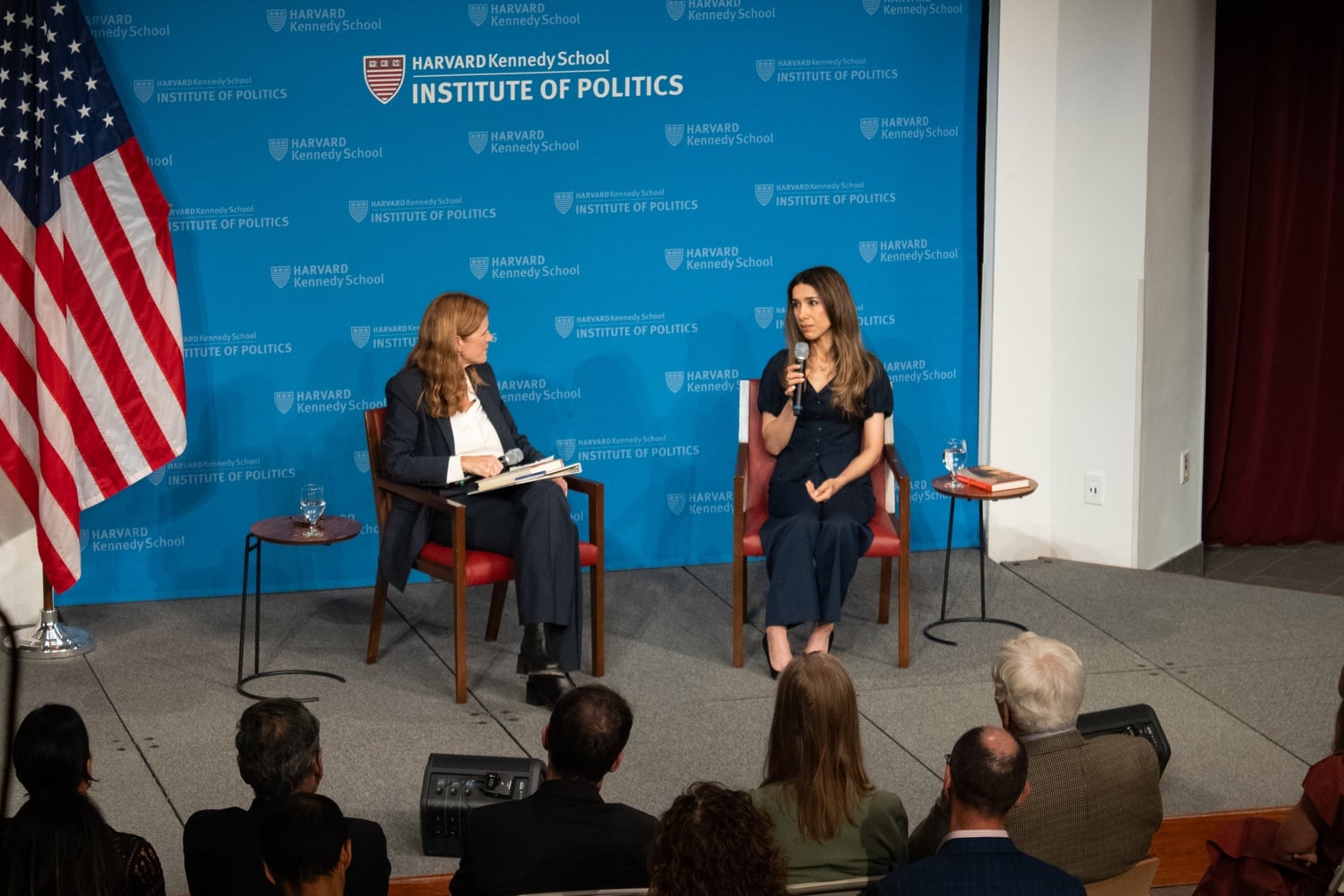
Nobel Peace Prize laureate Nadia Murad called on the Iraqi government Wednesday to take greater responsibility for rebuilding her home region of Sinjar and locating thousands of Yazidis who remain missing following the Islamic State’s genocide against the community.
“For a decade, I’ve been asking the world to do, for example, what is needed in Sinjar for Yazidis and for Iraqis,” Murad said. “But our own government, they’ve done very little.”
Murad, a Yazidi human rights activist who was abducted and subjected to sexual violence by ISIS in August 2014, said the Iraqi government should be responsible for security and rebuilding homes, while the government and international community must work to locate Yazidis who disappeared during the conflict.
“My own niece was only 40 days old when ISIS took her with her mother, and the last time we heard from them, it was eight years ago,” Murad said.
Harvard Kennedy School Dean Jeremy M. Weinstein introduced the event to a packed audience, describing Murad’s journey to leading a global campaign centering the rights of survivors and displaced communities.
Murad has spent the years since her escape advocating for survivors of conflict-related sexual violence and the Yazidi community – culminating in founding Nadia’s Initiative, a survivor-led organization helping women and children victimized by atrocities rebuild their lives. She was awarded the Nobel Peace Prize in 2018 alongside Congolese gynecologist Denis Mukwege for their efforts to end the use of sexual violence as a weapon of war.
Murad said she was at Harvard when she learned she had won the prize, and that she used the award money to begin building a hospital in Sinjar, a project that took seven years.
Murad was joined by Kennedy School professor Samantha J. Power, a former administrator of the U.S. Agency for International Development and U.S. Ambassador to the United Nations, who moderated the event and drew upon passages from Murad’s recent memoir, “I Choose My Beginning: A Story of Courage and Activism.”
While describing her early years in activism, Murad said she initially felt obligated to repeatedly tell her story in hopes of rescuing family members who remained in captivity.
“My hair was falling, and I couldn’t eat anything,” Murad said. “I was not eating, I was not sleeping.”
Get The Crimson in your inbox.
Murad also described the struggle to prevent her experience of abuse from overshadowing her own identity and personal experiences.
“I felt that responsibility to keep sharing and sharing, even though so many times I was treated just as a victim, as a story,” Murad said. “I was told that I had to focus just on the story, and to forget about me as a human being.”
Drawing on support from her husband and sisters, Murad learned how to continue telling her story while practicing self-care.
“As survivors of rape, we were told to be the perfect victims: to not smile, to always cry,” Murad said. “They’re telling us what to do over and over again, and I really became a better activist the moment I took care of myself in small ways.”
During the forum, Murad also implored international organizations and activists to center listening in their approaches to support victims. Murad’s own initiative, she said, plans to collaborate with survivor-led organizations outside Iraq and directly support their ongoing initiatives.
“So many of the UN agencies were coming and asking for the same story,” Murad said. “But most importantly, listen to the people that you are supporting.”
The event also featured questions from Harvard students, survivors and humanitarian workers about how advocates can support survivors without speaking over them.
Murad urges advocates to work alongside survivors rather than positioning themselves as their representatives.
“You just need to center them in the work that you do,” Murad said.
—Staff writer Jen L. Phan can be reached at [email protected] and Signal at jenphan.74. Follow her on X at @jenllphan.
—Staff writer Mirei S. Saneyoshi can be reached at [email protected]. Follow her on X at @mireisaneyoshi.
Want to keep up with breaking news? Subscribe to our email newsletter
Have a tip for The Crimson? Share it confidentially