The Case for a Harvard University Conservatory
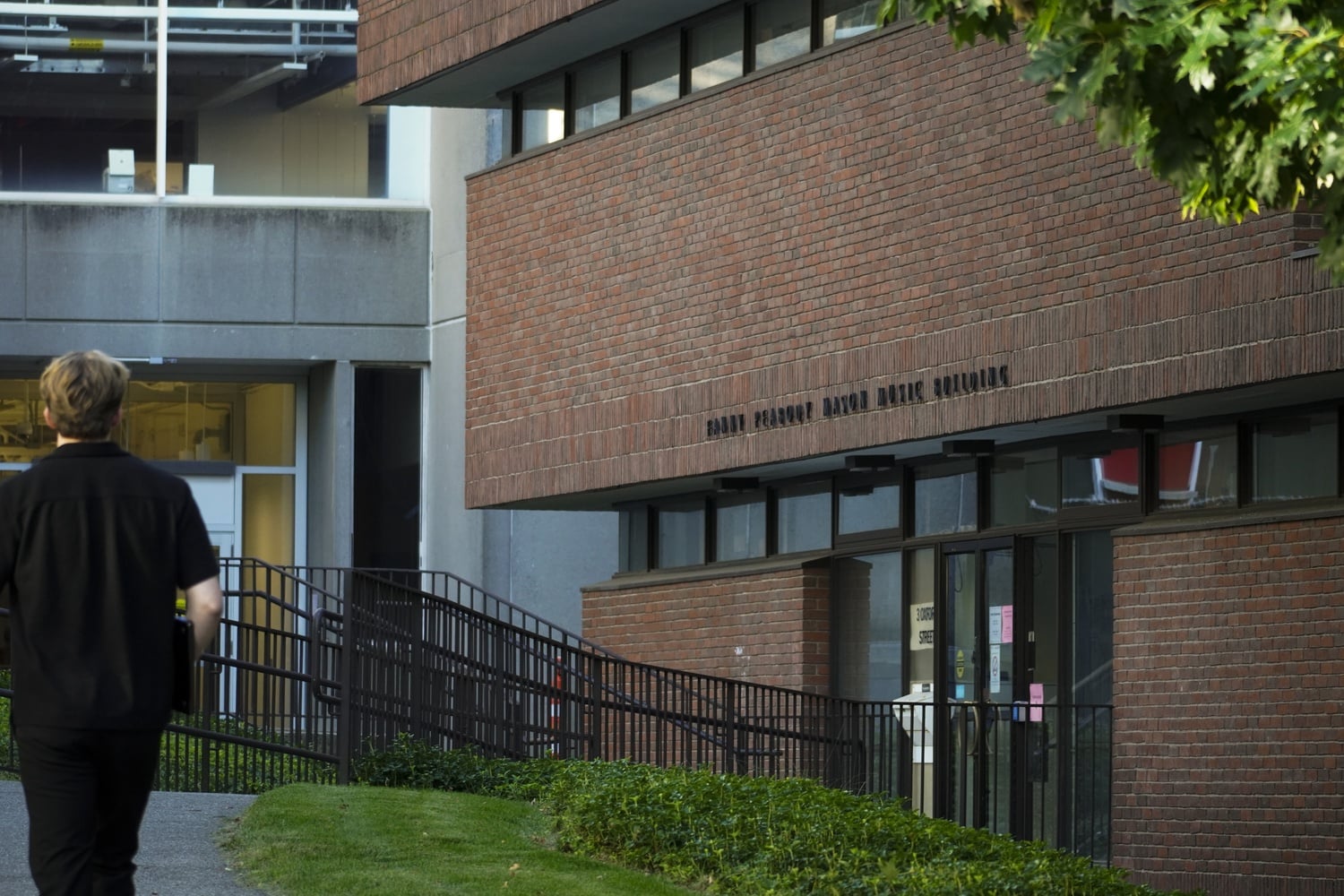
Harvard University has an incredible legacy of alumni in music: Leonard Bernstein ’39, Yo-Yo Ma ’76, John Adams ’69, and Pete Seeger ’40 are just some of the famous names that have graced these hallowed halls.
Considering the artistic success of its graduates, Harvard should do more to foster curricular artistic development. While the College currently has dual-degree programs with the New England Conservatory and Berklee College of Music, students would be better served by the development of a first-rate conservatory housed within the University itself.
Harvard does boast a robust music concentration, but that program has an explicitly academic focus. Those wishing to earn a degree in music performance must trek across the river for classes and lessons, and depending on financial aid status, pay an additional portion of tuition and fees at the partner institution. This results in an excessively demanding lifestyle that could serve to deter prospective students. A Harvard student’s schedule is busy enough without attending a second institution.
Removal of these barriers through the establishment of a conservatory would encourage the development of the arts on campus. Not only would life become easier for the ninety-or-so students who are dually enrolled, but a strong in-house program would likely draw higher participation.
Harvard admits plenty of musicians of the highest caliber, many of whom may wish to pursue music as a career. The University should not be outsourcing any part of their education, but rather should strive to give its students a complete education in all of the facets that interest them.
To see a functioning internal system, one must look no further than our friends down in New Haven. Yale boasts a world-class School of Music which confers a dual Bachelor of Arts/Master of Music with Yale College in which no additional costs are incurred for the students’ time at YSM. This system allows students interested in performance to pursue all of their interests without added financial burden.
Harvard is in a privileged position. Given the prestige of the University, if it were willing to open its coffers, it is entirely possible for a newly conceived conservatory to attract faculty worthy of its lofty goals. One could even argue that in an age where musical education is suffering, it is incumbent upon those with the resources to promote it.
It is not uncommon for top universities to have stellar music performance programs — just look at the music schools of Johns Hopkins University, Rice University, Indiana University, University of California, Los Angeles, and the University of Southern California. If so many of the country’s prestigious institutions have these opportunities, why must Harvard be the exception?
It is true that Harvard College is not a vocational institution — some might worry that a music performance degree is in tension with a liberal arts mission. But any new program can (and should) require students to meet the academic standards of the University in order to enroll at the conservatory. Moreover, it is not without precedent for universities with conservatories to require students to pursue studies outside of music; such is the case with Bard College Conservatory of Music.
But it is just as important to dispel the notion that musical performance is somehow not of the same intellectual caliber as other disciplines. The study of music is one of the oldest pursuits in Western education, making up one fourth of the historical quadrivium and one seventh of the liberal arts. It is essential to building a full education, and performance ought to be a fundamental part of this.
Music is important not just for its cultural and historical relevance, but also for its ability to promote skills like discipline, leadership, problem-solving, and the ability to captivate a room. One cannot argue against the hard work that goes into high level performance.
It is time Harvard devotes the resources to nurture students’ musical creativity within its own classrooms. With enough thought and care, perhaps one day Harvard can hope to have as many alumni in the Boston Symphony Orchestra as the Boston Consulting Group.
Jake D. Truncale ’27, a Crimson Editorial editor, is a Government concentrator in Pforzheimer House.
Want to keep up with breaking news? Subscribe to our email newsletter
Have a tip for The Crimson? Share it confidentially