Everything We Don't Know
any people claim that science and Christianity are easy to reconcile. I don’t believe so.
The classic argument goes that the laws of nature hold so perfectly — they allow life, they are thematically and rationally consistent, they seem to describe an intrinsic property of the universe — because they are the delicate handiwork of the Creator.
As a part of my Christianity, each day I wake up believing in seven (actually many more) impossible things before breakfast. I believe that God came to Earth and was born to a virgin. I believe while on Earth, Jesus Christ raised a man from the grave, gave the blind their sight, fed the 5,000, and healed the ear of His transgressor. I believe Jesus Christ died on the cross and, on the third day, rose from the grave. This, I have found, is incredibly hard to reconcile with my knowledge of biology, chemistry, and physics. And yet, I believe it.
When I was younger, I tried desperately to explain everything so it all clicked together, like a divine but fundamentally solvable puzzle. The healing of the sick must have been psychosomatic, or maybe aided by a divinely guided virus. Lazarus must have only been deeply sick, and Jesus healed him.
However, Jesus Himself always puzzled me. Perhaps his story was a sort of myth, a gospel to reference in times of moral doubt, a quick cheat sheet to the question familiar to everyone who has gone to vacation Bible school — “What would Jesus do?” Maybe Jesus was a prophet who knew of righteousness and God but not one with Him. Or maybe Jesus was just a Jewish man killed by the Romans for causing trouble, something not entirely uncommon in that time.
Despite how easy it was to believe these things, to rationally explain the life of Christ through different narratives, I could not bring myself to dilute my belief through a constant need for explanation.
I’ve always had a proclivity for questions with messy answers. I was the annoying kid questioning why God didn’t stop World War II in Sunday school and why the speed of light was constant in physics class. In response, the Sunday school volunteers would philosophize on the need for evil, while the physics teachers would say something along the lines of: “Because that is how the universe is.” With their answers, they only created an avalanche of new questions. At some point, it became a personal challenge for me to see if an adult in my life would admit to me that they didn’t know.
In this search for an admission of ignorance, I discovered my love for the paranormal. For those of us who believe in the supernatural, every conversation about past experiences comes with the freeing admission of ignorance. I know I feel deeply ignorant about the many unexplainable phenomena I have borne witness to throughout my time outdoors . I have had premonitions of car crashes on new moons that came true the next morning. I have heard people call my name from all sides of my tent at night, the voices changing direction without footsteps. I have seen faceless men in the woods of Appalachia with too-long limbs and heard what sounded like a friend call to me hesitantly in the middle of the night, then scurry away on padded feet like a dog.
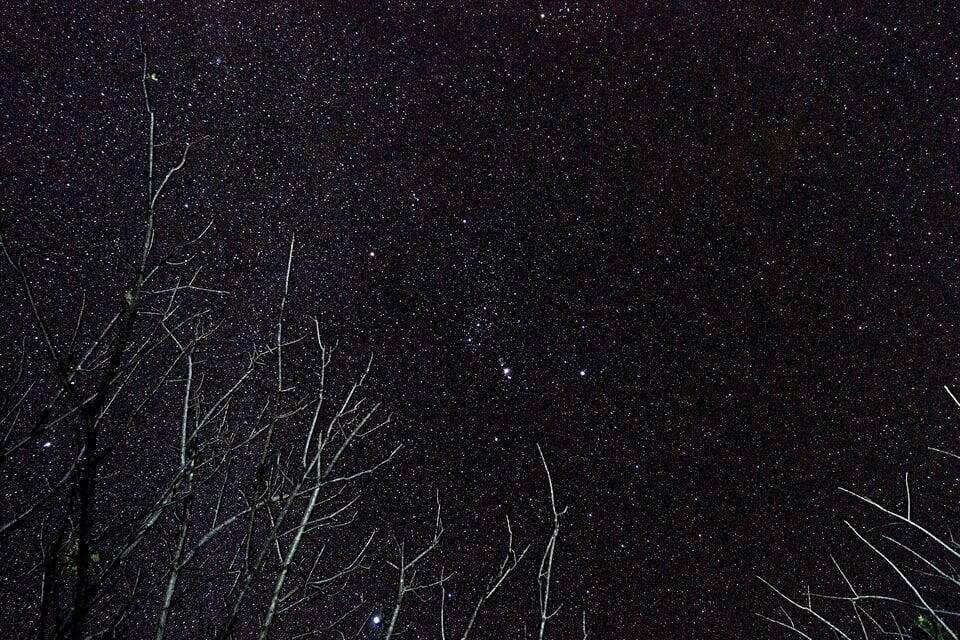
During our hikes in the woods, one of my friends would often tell me, “There is something in those woods.” I would laugh it off, thinking he was trying to scare me, and most of the time, he was. But every so often, his words would take on a new weight. After all, all we knew was the existence of a presence in the dark just beyond the trees. We didn’t know what it wanted, what it could do to us, or what it looked like. Still, we could sense it was there somehow, as true and incomprehensible as dark matter.
I’ve tried to explain these instances away, to rationalize them with a skeptic’s mind, but once again, I can’t. So, I have been left with two options: to ignore the evidence of my own eyes and ears, essentially admitting to having temporary, unexplained hallucinations, or to accept what I can never hope to understand. As with many other people who have had paranormal experiences, I am left only with my belief: raw, unfiltered, and unadulterated by the need for a complete, all encompassing explanation.
Theology and folklore don’t have full dominion over the unknown. They share it like a loving God, endowing every discipline with currently unexplained phenomena to greater and lesser degrees. For example, we do not know why humans have a consciousness, and why we seem to be unique in this regard among other highly -intelligent animals. We do not know what beauty is and what it is not. Most relevant to me, we do not know what happened before the Big Bang, or why distant galaxies are accelerating away from us, or what constitutes the majority of detected matter in the universe.
Physics confronts many unknowns, yet is often treated as a static foundation of truth, a blinding light which can eventually reveal every answer. And, as everyone who has ever struggled on a proof-based problem set will know, all it takes is one contradiction for an entire theory to shatter. Every day, we live in the belief that no such contradiction exists among the facts we consider true. Researchers in quantum gravity and string theory believe that there must be some theory to unite gravity and quantum mechanics, which are currently incompatible on extremely small scales. We live in the belief that, even if God plays dice with the universe, we may someday learn enough rules to sit at the table and play dice with God.
However, physicists are quite good at phrasing their lack of absolute knowledge in smart ways. While a believer in the paranormal expresses his uncertainty about something he has no way of directly observing by saying, “I heard a strange voice from just beyond the treeline,” a physicist can express the same view by asserting, “The abnormal gravitational fields indicate the presence of dark matter.” While a Christian reaffirms her belief by reciting the Nicene Creed, a physicist can share hers by saying, “I subscribe to the Copenhagen interpretation.” The mistake is treating the unknowns of science as unknown variables in a system of equations. Find enough expressions, plug it into a calculator, and solve.
In my short exploration of the philosophy of science, I have found no indication that this belief in the fundamental explainability of the universe is true. Perhaps certain questions of physics aren’t just unknown, but as unknowable as the face of God.
This possibility once scared and discouraged me. Why should I dedicate my life to a search for truth that may not exist? Why should I dedicate my life to a God I can never know is real when I can live a perfectly happy, fulfilling, and moral life without the presence of a deity? Why make any guesses at the riddle that is space and time, that is life after death, that is mythology and cryptids in the woods?
Now, the unexplainable is comforting to me. In my life, I hope to further the field of physics, to contribute to the noble search for truth. However, I don’t think I will live to see all of physics unwound neatly, compacted into a few key equations. I don’t think anyone will, or at least I hope not. I hope with every solution, we find more problems, more misalignments that require more experimentation and consequently more wonder. I hope the universe, in its fundamental unknowability, will hold room for belief in the unexplainable — that a physics that allows light to be both a wave and a particle will allow room for those who believe in a man both human and divine.
Whenever the woods come to life, whenever I hear my name whispered from just beyond the thickest grove of pines, I always wonder what is there. “There is something in those woods,” my friend would always say. Maybe it was a ghost. Maybe it was physics. Maybe it was God. Unexplainable, frightening, defiant, and omnipresent.
I have accepted that I will never know.
— Crimson Editorial Editor Anna J. Guerrini can be reached at [email protected].
Want to keep up with breaking news? Subscribe to our email newsletter
Have a tip for The Crimson? Share it confidentially