Deming Says Harvard Must “Move Faster” on AI, but Forthcoming Guidance Will Stop Short of Mandate
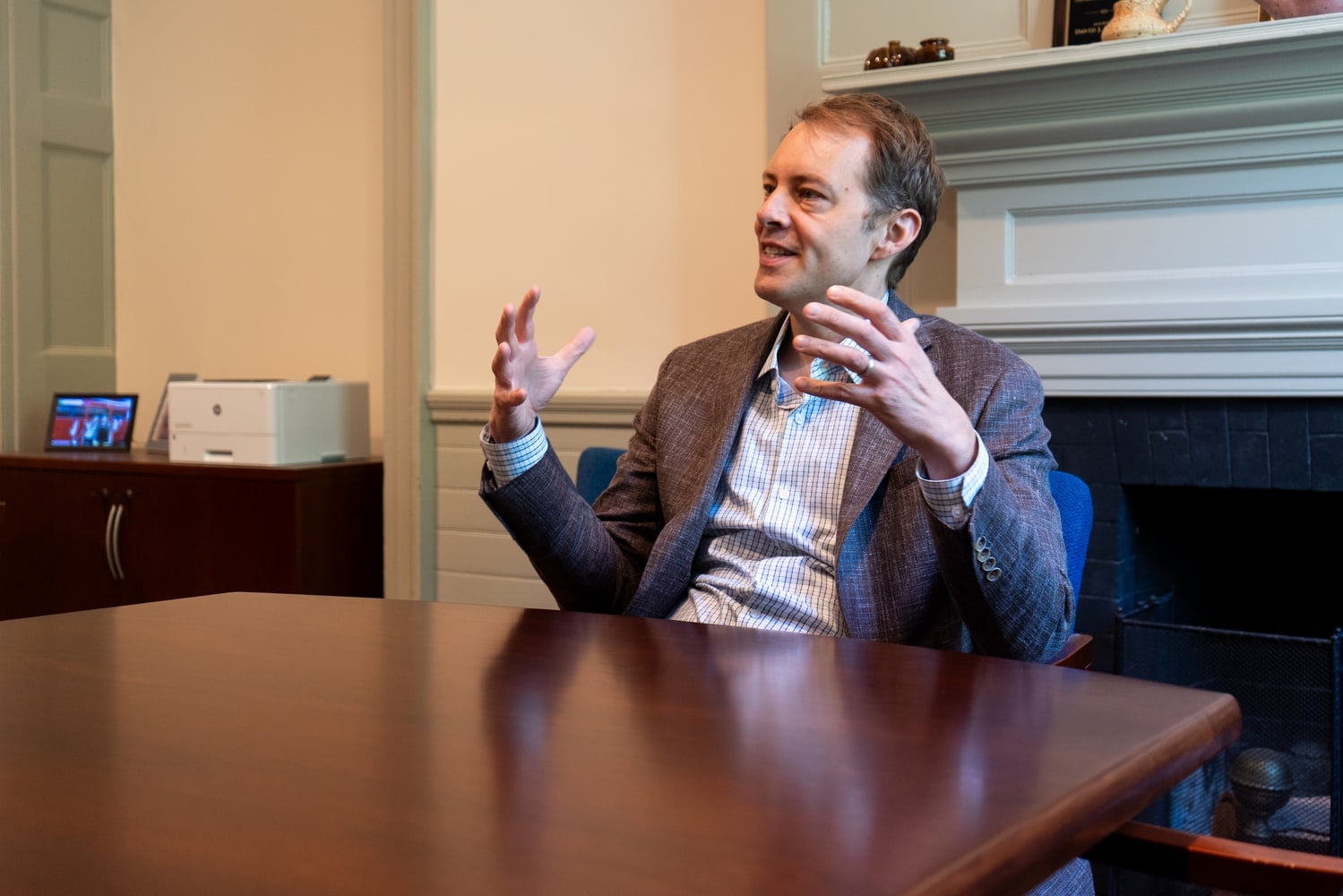
Harvard College Dean David J. Deming said at a Harvard Undergraduate Association meeting on Sunday that forthcoming College-wide guidelines on artificial intelligence will likely be advisory rather than binding on every course, adding that the College needed to “move faster” to address the challenge AI poses.
Deming said that developing guidelines for AI use in the classroom was one of his priorities for the year, as he outlined in an email on the first day of class. He said the process would likely begin in the Faculty of Arts and Sciences’ Education Policy Committee, but that he doesn’t expect it to produce legislation for the full faculty – though he added that the decision is ultimately out of his hands.
He compared his vision for the guidelines to a “set of menus” of possible approaches for faculty. They would range from guidance on enforcing a ban to guidance on incorporating the technology, or could be developed with the Derek Bok Center for Teaching and Learning.
“I think it’ll be more like a set of advisory guidelines,” he said. “I don’t know exactly what it’s going to look like. That’ll be up to the faculty committee.”
But he said he wanted the College to move faster to meet the moment, citing the rapid evolution of AI since the release of ChatGPT nearly four years ago.
“It’s more like we need to do something,” Deming said. “We need to move faster, and the status quo isn’t really acceptable.”
In his first-day-of-classes message, Deming wrote that he “would modestly suggest AI acceptance, or even encouragement” in writing-intensive courses. The message drew backlash from faculty members in the humanities, who said Deming’s suggestion overlooked key concerns about the technology.
During a question-and-answer portion of the Sunday meeting, Deming pushed back against a student’s characterization of his email as a call to embrace AI.
“I’m not encouraging AI use. I’m not discouraging it either,” he said.
Deming distanced his decision-making as dean from his individual views on the technology, saying he could not take a personal stance on it as dean.
Get The Crimson in your inbox.
“When I speak about it, I’m speaking about it from the perspective of somebody who is charged with the education of students at Harvard College, and I can’t really afford to take that position,” he said. “It’s happening whether I’m against it or for it.”
Deming said the College would take a “defensive” approach to protect learning in the liberal arts, including limiting devices in the classroom and “AI-proofing assessments when necessary.”
He also predicted that the College would focus “more on writing at Harvard College rather than less,” and that assignments would require more scaffolding, check-ins, and oral exams to verify the originality of students’ work — an approach he acknowledged was “resource intensive.”
Deming also defended the faculty vote in May to cap A grades at 20 percent, with room for up to four more A’s. He said that before the vote, he and Dean of Undergraduate Education Amanda Claybaugh consulted employers and graduate school admissions officers, whose response was unanimously positive.
“100 percent of them were in favor,” he said, adding that they told him the College was not doing enough to differentiate its students amid current grade inflation.
“I think you think employers want straight As,” he added. “They generally don’t.”
Asked whether the grade cap would stoke competition among students, Deming called the argument a “logical error.”
“When you’re in a larger class, the odds that the person who you are studying with is actually going to be the one who crowds out your A is very small,” he said. “What happens when you study together is you both learn more, and you both do better.”
“It’s just a very zero-sum way of looking at the world, like there’s a fixed-pie of knowledge,” he added.
Asked why many courses are already following the cap a year before it takes effect in fall 2027, Deming pointed to the late timing of the vote and that the College has yet to build software to calculate students’ average percentile rank, a measure used for honors. Faculty also needed time to redesign assessments in courses where, he said, most students had been scoring in the high 90s. Claybaugh urged faculty in June to begin implementing the cap this fall.
“This year is going to be kind of an uneven year for that reason,” he said.
In response to a question about the HUA’s role in achieving his priorities for the upcoming year, Deming said that student voices would be an “extremely potent political force.”
“If there were ever an issue that students almost unanimously felt strongly about, and they worked for the HUA to try to make something happen, I would be listening,” Deming added.
In a spring HUA survey, nearly 85 percent of Harvard undergraduates who responded opposed a proposed cap on A grades.
Deming said revising the policy would not be out of the question if it has a “negative” effect on campus. In March, the Standing Committee on Undergraduate Educational Policy added a provision that the policy would be reviewed by the end of its third year, rather than the typical five-year period.
“If the grade cap ends up affecting campus culture in a negative way and makes people more competitive, that will be bad, and that is something we will have to address,” he said. “But I don’t think it will, and I don’t think it should.”
—Staff writer Theresa F. Bartelme can be reached at [email protected] and on Signal at theresabartelme.15. Follow her on X @theresabartelme.
Want to keep up with breaking news? Subscribe to our email newsletter
Have a tip for The Crimson? Share it confidentially