Spain Prime Minister Speaks on Future of AI, Corruption at IOP Forum
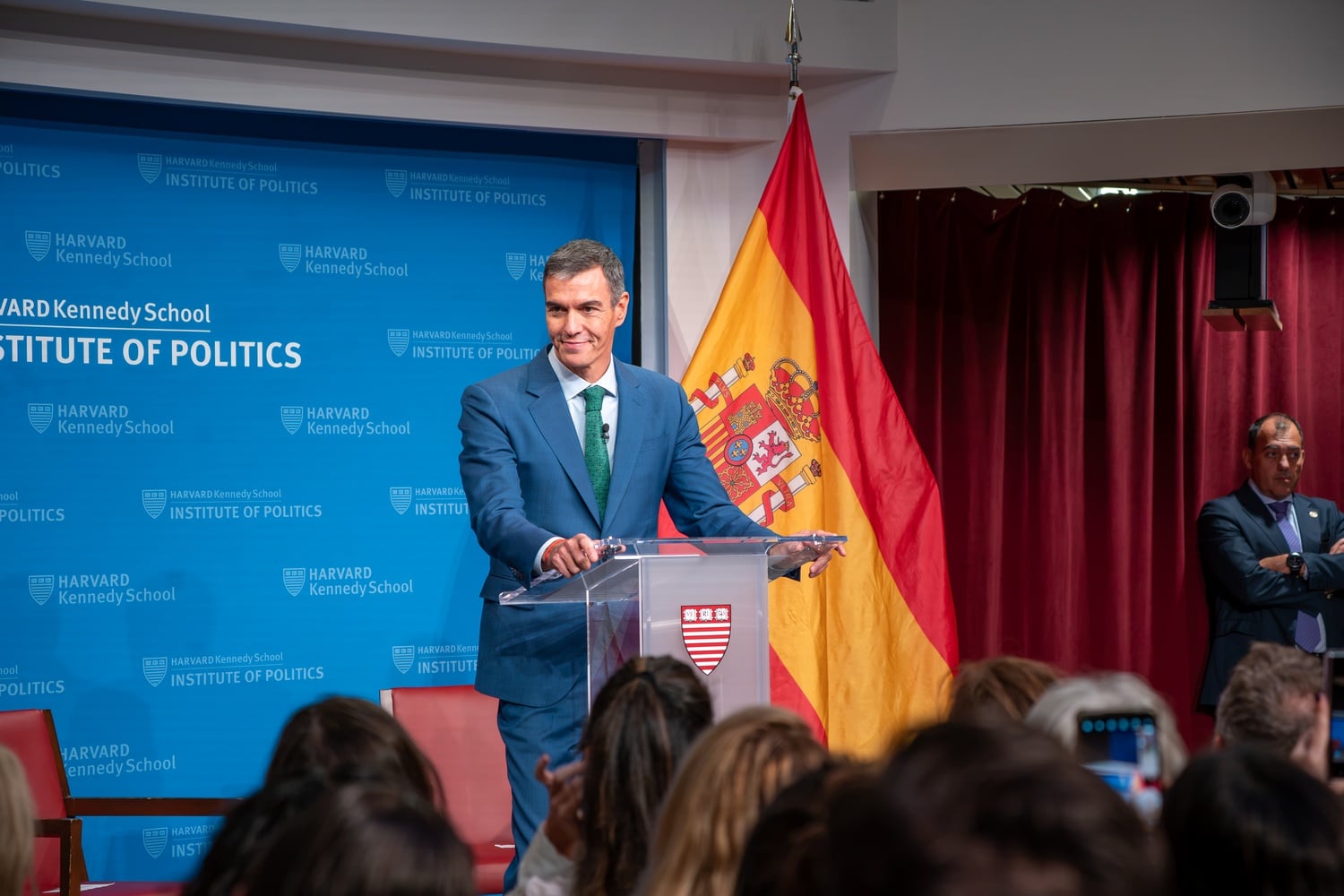
Spanish Prime Minister Pedro Sánchez addressed allegations of corruption and the rising threat of unregulated growth in the artificial intelligence industry at a Thursday night forum at the Institute of Politics.
Sánchez, who has served as Spain’s prime minister since 2018, has been an outspoken critic of President Donald Trump and powerful technology leaders. Sánchez opened the Thursday forum by emphasizing the role of current students and academic institutions in shaping the future of AI development.
“Academia has a major role to play in this. Right here in Cambridge, in the labs and lecture halls around this room, some of the technologies I have been describing are being used and built,” Sánchez said.
“Some of you students at Harvard will refine their algorithms. Many of you will work for tech billionaires who own them or serve in the governments whose job it is to restrain them,” he added.
The forum, moderated by Harvard Kennedy School professor and director of the Carr-Ryan Center for Human Rights Mathias Risse, centered on addressing the growing influence of prominent AI actors on global governance and regulation.
Sánchez highlighted the threat of the rapid growth in the AI industry against a historical backdrop, adding that industry tycoons have long aimed to “circumnavigate established systems.” Sánchez, a member of the Spanish Socialist Workers’ Party, has publicly clashed with tech billionaire Elon Musk and other energy industry leaders since taking office.
“Every generation of tycoons has made the same argument, and every generation was defeated in the end by the same force, the will of the people,” Sánchez said during the Thursday talk.
He urged the audience of more than 200 to not “let these big corporations blind you with their money, their full promise of universal prosperity, and their doom mongering.”
When discussing the actions governments could take in response to the rise of AI, Sánchez said the two options were “fight or flight.” He said he was concerned with the direction the AI industry was moving in, adding that big tech companies are “trying to humanize AI and dehumanize humanity.”
“We are dealing with a group of very wealthy, very powerful people who are perfectly willing to accept the likelihood of a major calamity, if that’s what it takes to move humanity to the next stage,” Sánchez said.
Get The Crimson in your inbox.
Sánchez noted that he was not anti-technology, but against technology benefitting a select few. He pointed to pro-technology pushes he has made while in office, stating that the Spanish government has invested more than $40 billion into the tech sector in the last eight years — commitments made to help overcome “climate change, demographic decline, inequality, low economic growth, unwanted loneliness.”
“I’m not a luddite,” he said.
But he stressed that regulation was needed, especially in a rapidly advancing sector like AI. He backed measures to limit the self-improvement capabilities of AI, establish third-party oversight for companies, and increase reporting requirements for emerging technologies.
Sánchez also spoke to his hopes for the future of AI in a global context, focusing on collaboration with countries to equalize computational capacity — noting that a large amount of the current technological power is concentrated in the U.S.
“There’s about 75 to 80 percent of computational capacities in the United States. About 15 are in China, and all the rest of the world shares the rest, and the EU is somewhere in the single digits in computational capacity,” he said.
A key factor of the collaboration, Sánchez said, was a joint infrastructure for regulation.
“One of the issues will be an agreement,” he said. “How can we work together in order to regulate AI and to frame the responsible development of AI?”
But when the forum opened to audience questions, the conversation pivoted away from AI — instead turning attention to allegations of corruption in the Spanish government, though Sánchez himself has not been personally implicated. Former transportation minister José Luis Ábalos was accused of taking kickbacks from pandemic-era medical supply contracts, and was sentenced to 24 years in prison in June.
The allegations have also hit Sánchez closer to home: his wife, Begoña Gómez, was ordered to stand trial earlier this month over allegations of influence-peddling, which she denies. His brother, David Sánchez, was convicted of administrative misconduct in July and was banned from serving in public office for nine years.
When asked about the corruption in the forum, Sánchez rebuked the allegations against his family in particular.
“I’m sorry to say, those are not corruption cases or scandals,” he said. He characterized the allegations as “nasty politics,” and fueled by the opposition and far-right associations having “crossed some red lines.”
“To suffer this personal attack is is very difficult to assume,” Sánchez said. “And it’s much more difficult because a young student like you, you already condemn them, and you say that my brother and my wife are guilty, and this is not fair, because they are not.”
—Staff writer Katharine E. Chavez can be reached at [email protected]. Follow her on X @KatharineEC7.
—Staff writer Siena G. Devine Guzmán can be reached at [email protected]. Follow her on X @sienadevinee.
Want to keep up with breaking news? Subscribe to our email newsletter
Have a tip for The Crimson? Share it confidentially