Your Concentration Will Change How You Think
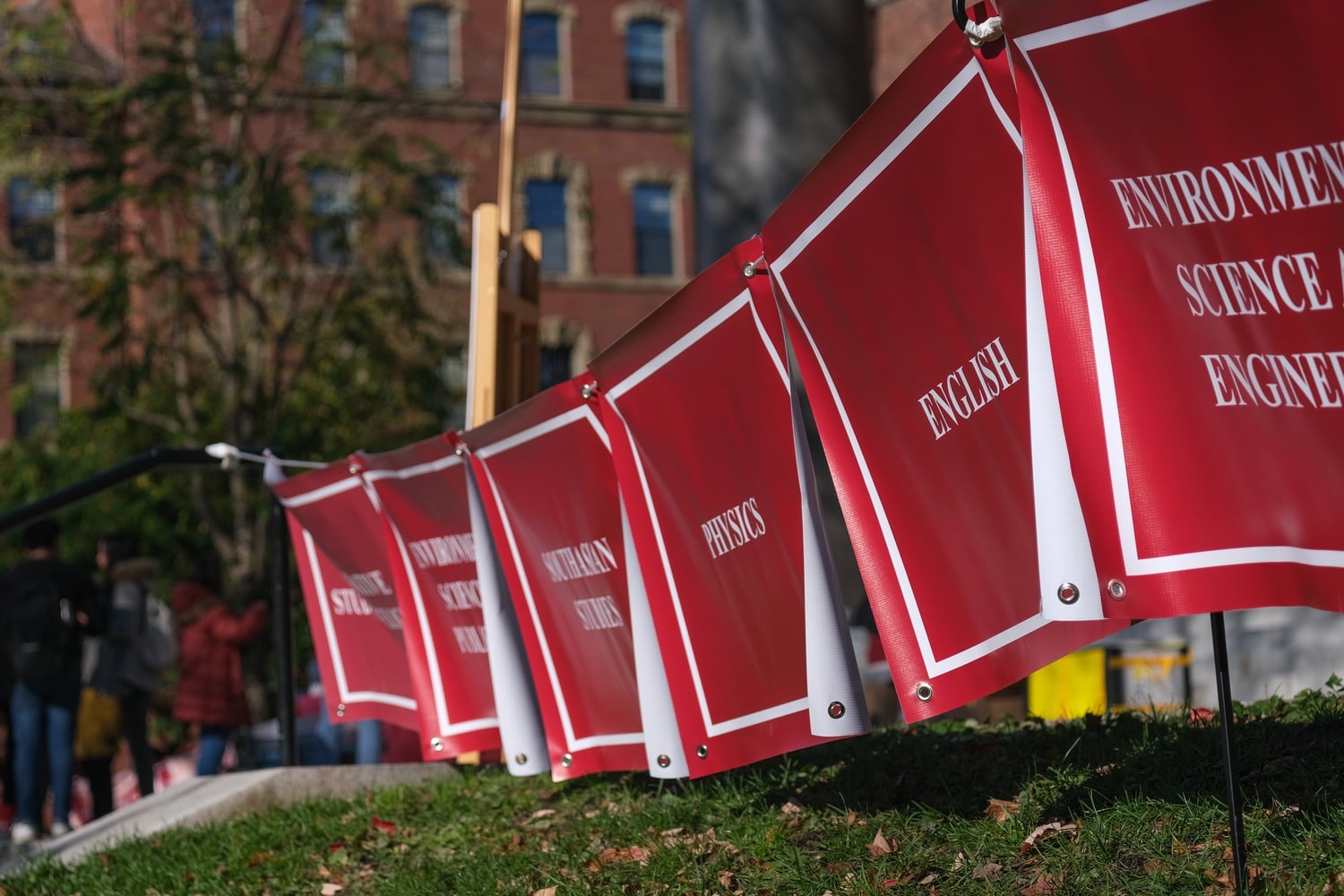
This concentration declaration day, think carefully — your choice may change the way you think.
When picking a concentration, it seems many students, including my sophomore self, make their selection based on the subject they’re interested in. That reasoning may seem obvious, but it’s not always the best one. Instead, we should choose our concentration based on how we want to think about the subjects we’re interested in.
The typical case goes like this: A student is interested in, say, politics. So, they choose to study political science. That sounds straightforward enough.
But an academic discipline is not only a topic of study, it is also an approach to that topic. A politically inclined Harvard student could concentrate in Government, but they could also study politics through the lens of Sociology, Economics, History, or Philosophy.
In my own experience, I ventured outside of the Government Department and took courses in Sociology and the History of Science. I’ve found taking courses in different departments helpful in gaining a meta perspective on a discipline and its assumptions. We shouldn’t assume that any one department has a monopoly on a topic.
I’ve previously written that the Economics concentration teaches many great economic tools, but not necessarily how to think about economics. To varying degrees, this is true of all concentrations. Every field is essentially its own paradigm, and while that superstructure will help you see further and more clearly, it’s difficult to examine the paradigm from within the field.
For an example of how two different disciplines can approach the same task, we can look to the College’s two most recent deans.
Former Harvard College Dean Rakesh Khurana, a sociologist by training, seemed to focus his tenure on the organizations that constitute the College. In 2016, he sought to combat inequality and sexual assault by changing the organizational factors behind these problems — namely, the final clubs. In 2018, he oversaw the consolidation of two offices into the Dean of Students Office and, in 2022, centralized four others into the Office of Student Services.
Khurana was best known, however, for the personal relationships that he built with students, a particularly social approach to the administrative role.
Compare this to current Dean David J. Deming, a professor of economics. In his first year, he spearheaded an initiative to allow alumni to donate directly to their undergraduate houses. The amounts raised by houses were unequal, but everyone was better off — Pareto efficiency if I’ve ever seen it.
Additionally, Deming tackled the longstanding collective action problem of Student Activity Fee opt-outs by making the fee mandatory. He also made laundry free for students. Booyah.
The choices of these two deans suggest that even when viewing similar tasks, like leadership, the academic lens we use to analyze a task can influence the solutions we imagine.
As David Foster Wallace famously said in his 2005 Kenyon College commencement address, we come to college to learn how to think. So, how should we actually choose which way to think?
I think we should avoid choosing just one. The strength of a liberal arts education is that students are exposed to multiple modalities of metacognition. So, the optimal approach seems to be interdisciplinarity — and no, I don’t mean double concentrating.
I won’t beat my hypocritical dead horse too much, but a double concentration is not interdisciplinary so much as it is duo-disciplinary. At best, you’ll learn two ways to think, and in many cases, it may still be one. For example, in my experience as a (partially) recovered Government and Economics double concentrator, those fields are typically just two applications of the same quantitative social science methodology.
So, if the answer isn’t double concentrating, how should we achieve interdisciplinarity?
We can study a variety of fields, not only through our electives, but also within certain concentrations. Some concentrations are purposely designed to be interdisciplinary, allowing students to count multiple fields for credit. I’m especially biased towards the Social Studies concentration, which lets students take courses from throughout the social sciences — but there are plenty of options in the Divisions of Science and Arts & Humanities.
As we enter a new era of artificial intelligence, the rote memorization of facts is becoming less important than the ability to process them. To sophomores choosing their concentrations this fall: Don’t decide only what topics you want to learn but also how you want to engage with them. To make an informed decision, you should test-run a variety of disciplines.
Your concentration can shape how you approach the rest of your life. Choose carefully.
Matthew R. Tobin ’27, a Crimson Editorial editor, is a double concentrator in Social Studies and Economics in Winthrop House.
Want to keep up with breaking news? Subscribe to our email newsletter
Have a tip for The Crimson? Share it confidentially