HKS Used Free Speech as a Cop-Out
Free speech is my favorite value. It lets one student declare the ruins of Gaza an indictment and another reject the framing of the massacre of October 7th as resistance. It allows our intellectual community to weigh evidence and expose claims that lack it.
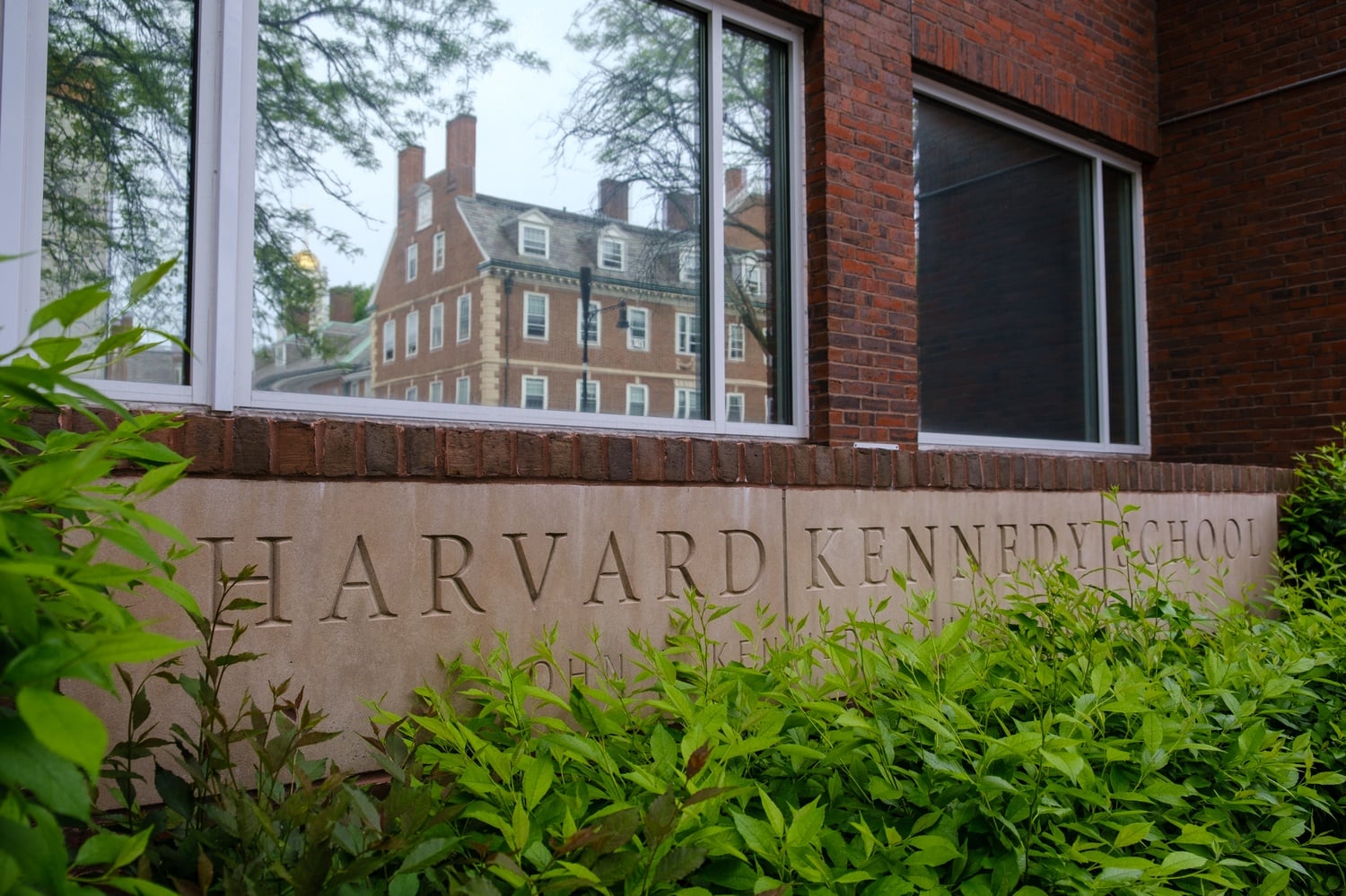
The truest test of an institution’s strength is how it stands by its values when they are challenged. Unfortunately, the Harvard Kennedy School recently cheapened one of its core values by covering up a poor decision under the guise of protecting free speech.
Earlier this month, New York Times columnist Nicholas D. Kristof ’81 delivered the 2026 Malcolm H. Wiener Lecture in International Political Economy at the invitation of the Harvard Kennedy School.
The lecture is an endowed honor and thus a mark of institutional esteem — one that Harvard should have rescinded.
In May, Kristof published a column reporting allegations that Israeli guards trained police dogs to rape prisoners. To merit publication, exceptional allegations should be supported by exceptional sourcing. That standard doesn’t seem to have been met.
By disseminating these allegations anyway, Kristof made them appear as facts, enabling the world to believe a rumor. Israel’s Foreign Ministry called it “one of the worst blood libels ever to appear in the modern press.”
The International Holocaust Remembrance Alliance’s definition of antisemitism includes perpetuating blood libel — accusations that Jews have perpetrated horrific and sadistic crimes, circulated as truth on rumor.
As such, the Kennedy School should not have ignored it. In 2025, Harvard committed to incorporating the IHRA’s definition into its non-discrimination policies, and now considers its examples when evaluating antisemitism complaints.
The standard does not appear to require Harvard to apply IHRA’s definition of antisemitism when evaluating the conferral of honors. But if Harvard will not let the standard inform an honor it is free to withhold, its adoption is performative — a concession made to settle litigation, not a principle meant to guide institutional judgment.
This is where the line on free speech lies. While Kristof has the right to criticize Israel, Harvard need not honor him and his work for what qualifies as antisemitism under its own metrics.
The Harvard Jewish Alumni Alliance recognized this when, in August, they asked HKS to withdraw Kristof’s honor. The group did not ask Harvard to bar Kristof from campus or prevent him from being heard. It asked Harvard not to decorate him.
HKS Dean Jeremy M. Weinstein said no. Withdrawing the invitation, he argued, would call into question the school’s commitment to free speech.
But this is not a question about free speech. It is one of institutional integrity, character, and obligation — values as important as speech, if not more so.
By labeling HKS’ decision to honor an individual as an uplift of free speech, Dean Weinstein makes any challenge sound like an attack on free speech itself. It turns a choice about prestige into a test of principle and shifts attention from what Harvard is really doing: conferring esteem.
An invitation to an endowed lecture reflects institutional judgment. Platforming free speech would be providing access to an audience — but establishing that audience at an endowed lecture signals approval. By overthinking a simple choice, the administration blinded itself with an additional criterion the HJAA never mentioned.
It’s a trap, and Dean Weinstein has fallen in. He recast the Kennedy School’s choice to honor a journalist perpetuating antisemitism as a question of free speech, cheapening the true meaning of the value.
HKS made a mistake honoring Kristof the first time, and doubled down by refusing to rescind that honor. But the school erred most seriously by making a mockery of its own stated values. The real test was whether HKS would act with integrity in the face of antisemitism. The institution failed and brought free speech down with it.
Some might say Harvard’s adoption of IHRA examples of antisemitism is only a guide. Fine. This was a moment to use it. If Harvard will not apply that guide to an honor it could choose to confer elsewhere, then adopting the definition was merely political theater.
That message might be intentional. That troubles me most.
Charleen D. Adams is a computational and statistical geneticist at the Broad Institute of MIT and Harvard, and a former researcher at the Harvard T.H. Chan School of Public Health.
Want to keep up with breaking news? Subscribe to our email newsletter
Have a tip for The Crimson? Share it confidentially