We’re Harvard WGS Alumni. Our Field Has Never Mattered More.
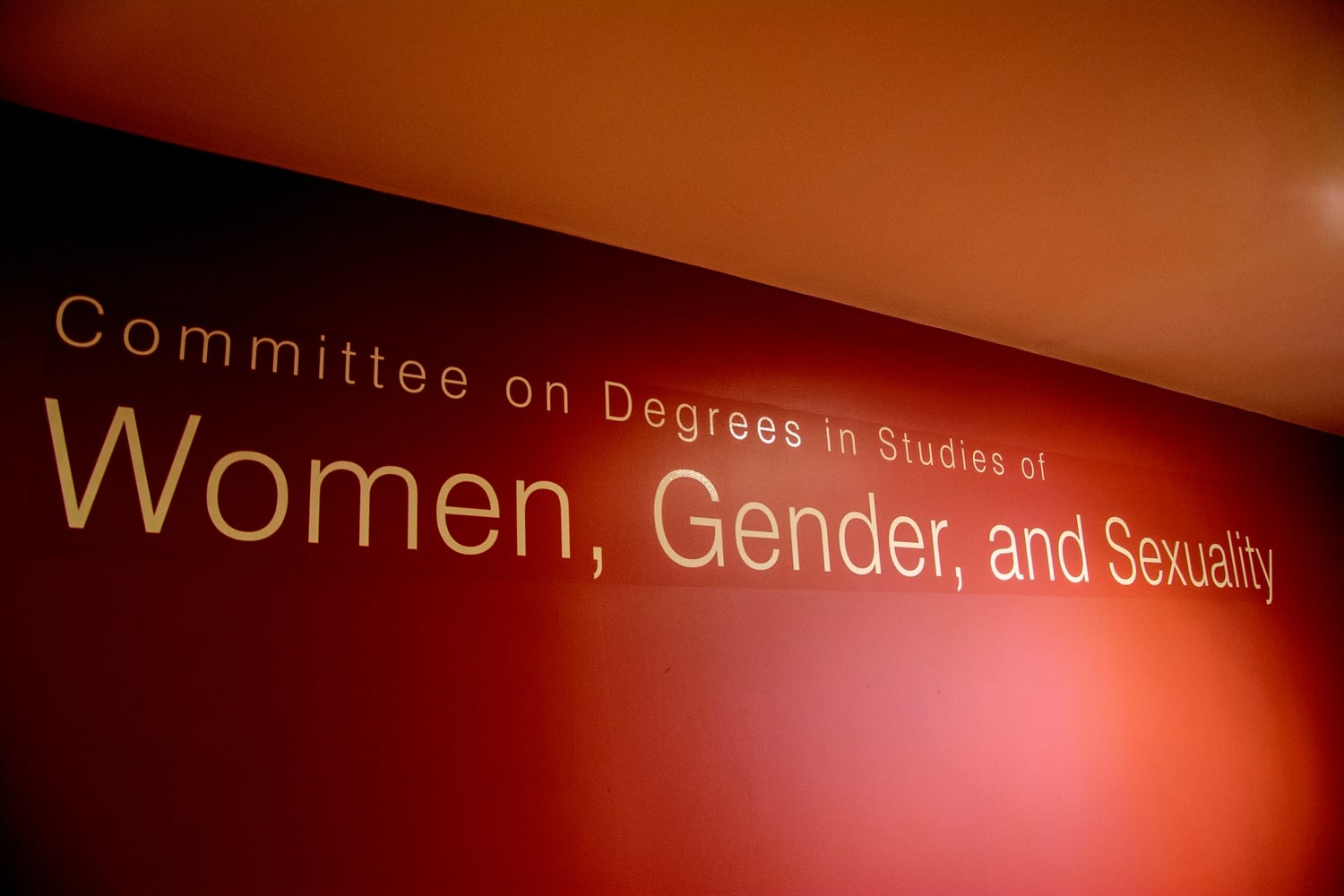
The urgent necessity of thinking about gender and sexuality has never been more apparent. But it is precisely at this moment that Harvard has chosen to avert its eyes.
In April, The Crimson reported that enrollment in Harvard’s Women, Gender and Sexuality Studies program had dropped to an over 15-year low following significant reductions in the department’s teaching staff. Furthermore, the concentration has no tenured faculty of its own following the denial of tenure to Durba Mitra, widely seen as an exceptionally qualified candidate, in June 2025.
As feminist academics trained in Harvard’s WGS program, we know all too well that these challenges are neither Harvard-specific nor WGS-specific. In a national moment marked by the rising cost of college and the gutting of the humanities, small majors committed to critical inquiry whose career “payoffs” are not always immediately visible are shrinking.
But the Harvard story is a distinct one: Harvard has long starved its WGS concentration, denying the program necessary resources for decades. This history makes the program’s vulnerability to contemporary circumstances all the more acute.
As WGS alumni, we collectively raise our voices to affirm the fundamental importance of Harvard’s WGS program to the field of gender and sexuality studies nationally — particularly during our current political crises — and to express deep concern about the program’s future as a result of institutional neglect.
Founded in 1987 as Women’s Studies, WGS has grown to offer a graduate secondary field and to host a regular visiting professor as an endowed chair in LGBT studies. In 2011, The Crimson reported that the number of undergraduates enrolled in WGS courses had grown to 545, up from 388 several years prior. The program’s undergraduate and graduate alums are now some of the leading scholars of gender and sexuality studies across the country, in fields as diverse as law, political science, biological anthropology, history, and Black studies.
The very challenges that made WGS institutionally vulnerable also meant that the program has consistently maintained the highest standards for academic rigor. WGS long existed as an honors only program, and even now students pursuing the degree — who have to be prepared to defend their chosen field from criticism or even ridicule — continue to arm themselves with a rigorous interdisciplinary training in feminist theories and methods. WGS met students’ intellectual hunger with intense and demanding seminars, engaged faculty mentoring, and serious research training, which created a strong pipeline from Harvard WGS to academic research.
Yet despite the program’s extraordinary successes, from its very beginning, Harvard has withheld urgently needed resources from WGS. As a 2019 Crimson retrospective points out, not only was Harvard the last Ivy League university to create a program on women’s studies, the delay was in large part because Harvard believed women’s studies as a discipline had “no way of discovering facts.” Furthermore, a 1990 newsletter on Women’s Studies noted that Harvard would not let the program hire its own faculty members and seemed reluctant to hire women to lifetime positions.
Even when WGS was allowed to grow its faculty, its award-winning faculty members either were not retained (Robert Reid-Pharr, the first tenured WGS professor and a leading scholar in Black studies and gender and sexuality studies, was hired in 2018 and left for New York University in 2023) or denied tenure (see again the Mitra case).
WGS attempted to hire renowned scholar of gender and sexuality studies C. Riley Snorton but, as reported in The Crimson, “the hiring process was shut down by Harvard administrators.” Last fall, five WGS lecturers were laid off, leaving WGS with a skeletal curriculum. Currently, WGS has only one tenure-line faculty member — a pre-tenure scholar.
This hostility to WGS places Harvard a step behind many other peer institutions — Yale and Princeton, for example, have a number of tenured and tenure-track faculty in their equivalent programs. Our field is under threat from state legislatures, university regents, and politicians who have sought to curtail or fully dismantle the academic study of gender and sexuality.
But at Harvard, the single biggest threat to the study of gender and sexuality has long come from the institution itself. Harvard’s WGS program has been denied what is utterly essential for the health of a program: faculty lines. A permanent and tenured faculty will produce reliable course offerings, and a pipeline that ensures that the program will have committed faculty trained in-field to act as leaders.
We live in a moment where gender is at the center of the culture wars, where debates about access to reproductive health care, trans rights, maternal health, trad wives and the “manosphere” abound, and when many of our institutions are revealed to be intimately bound up with sexual predators like Jeffrey E. Epstein.
If WGS is shedding concentrators, Harvard need only look in the mirror: how can a university that has produced many of the country’s leading feminist scholars continue to devalue the very program that trained us? If Harvard positions itself as a global leader in research and scholarship, it must recognize and respond to the fact that its WGS program is starving, not for lack of student interest, but due to the institution’s consistent neglect.
Jennifer C. Nash ’01 is the Jean Fox O’Barr Professor and Chair of Gender, Sexuality, and Feminist Studies at Duke University. Emily A. Owens ’09 is an Associate Professor of History at Brown University. They are alumnae of Harvard’s Women, Gender and Sexuality Studies program.
A full list of the signatories to this op-ed can be found here.
Want to keep up with breaking news? Subscribe to our email newsletter
Have a tip for The Crimson? Share it confidentially