As It Happened: Fed Chair Jerome Powell Says Rates Are in ‘Good Place’ as Iran Oil Shock Clouds Outlook
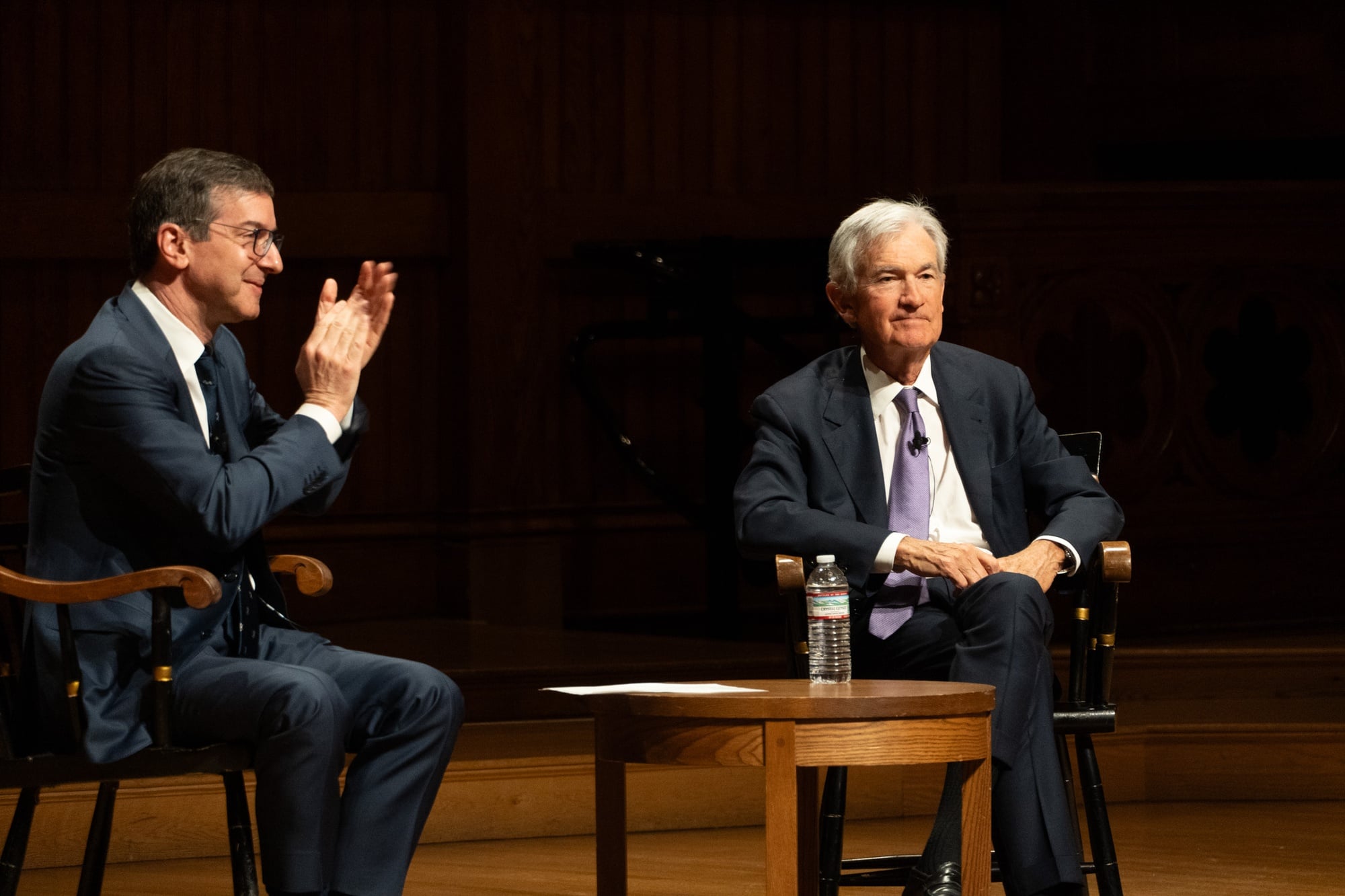
Federal Reserve Chair Jerome H. Powell spoke to Harvard students in a introductory macroeconomics lecture at Sanders Theatre on Monday, discussing the Fed’s decision to hold interest rates steady amid rising oil prices and geopolitical tensions, while also touching on inflation, AI’s impact on jobs, central bank independence, and concerns about the federal debt. Read below for Powell’s specific remarks.
Powell Says Fed Monitoring Inflation Expectations as Oil Prices Climb
Federal Reserve Chair Jerome H. Powell told Harvard undergraduates on Monday that interest rates are in a “good place” to hold steady, even as a widening war in the Middle East sends oil prices higher and muddies the inflation outlook.
“We feel like our policy is in a good place for us to wait and see how that turns out,” Powell said during an hour-long conversation in “Economics 10b: Principles of Economics,” the College’s introductory macroeconomics course.
Powell addressed hundreds of students in the packed lecture, in a conversation moderated by Economics professor David I. Laibson ’88, who co-teaches the course alongside Jason Furman ’92. His appearance was scheduled over a year ago but was not announced until Thursday. Powell last spoke outside of a scheduled press conference at the December 1 annual meeting of the National Association for Business Economics.
Dow Ticks Up After Powell Signals Wait-and-See Approach
The Dow Jones Industrial Average rose more than half a percent after Jerome H. Powell signaled confidence in holding interest rates steady, easing investor concerns that the Fed might move to hike rates amid the war in Iran.
Stocks had fallen in recent weeks as surging oil prices fueled uncertainty about the Fed’s next move. But Powell said Monday during his talk at Harvard that the central bank is taking a wait-and-see approach, describing policy as “in a good place.”
Powell Closes Talk to Applause, Draws Crowds for Group Photo
Powell wrapped up his remarks to sustained applause before students crowded the stage for a group photo.
Harvard Economics professor David I. Laibson '88 told attendees that individual selfies would not be possible due to a “tight schedule.”
Economics 10, Harvard’s flagship introductory course that often enrolls as many as 600 students, is no stranger to high-profile guests. Last spring, Penny S. Pritzker ’81 visited the class, and in past years it has hosted former Fed chair Ben S. Bernanke ’75.
Powell Laughs Off Questions About Fed Press Conference ‘Signals’
Powell joked his way out of a student’s question about whether his usual press conference greeting hints at policy decisions.
The question referenced online speculation that “Good afternoon” signals a tougher, more hawkish stance, while "Hello everyone” suggests a softer tone.
Powell smiled, before declining to engage.
Powell Warns U.S. Debt Path ‘Not Sustainable,’ Says Risks Will ‘Not End Well’
Powell warned that while current U.S. debt levels remain manageable, the trajectory of federal borrowing is cause for concern.
“The level of the debt is not unsustainable, but the path is not sustainable,” Powell said, noting that government debt is growing faster than the broader economy — a dynamic he described as unsustainable in the long run.
Powell stressed that the issue falls outside the Fed’s mandate, but cautioned that inaction could carry consequences.
Powell Rejects Money Supply Theory, Warns Economy Is Harder to Predict Than Models Suggest
Powell fielded questions from students about the origins of pandemic-era inflation, pushing back on the idea that the expansion of the money supply was the primary driver of price increases.
“Monetary quantities are very challenging way to try to think about inflation and the economy,” Powell said, noting that the correlation between money supply and inflation has been “relatively little” in practice.
Instead, Powell attributed the post-pandemic price surge to a collision of “red hot demand” and constrained supply after the global economy reopened. He pointed to the automobile market as an example: consumers fled public transit and needed cars, but semiconductor shortages made them nearly impossible to produce.
Powell Urges Students to Embrace AI, Stay Optimistic Despite Tough Job Market
Asked what advice he would give to undergraduates sitting in the room, Powell acknowledged that it was a “challenging time to enter the labor market,” citing low job creation, disruptions to labor availability caused by immigration policy, and the uncertain effects of artificial intelligence on the market.
But Powell said he was “very optimistic” about the long-term dynamism of the U.S. market, especially in response to the growth of novel technology and artificial intelligence.
He encouraged students to embrace AI and take the time to learn how to use developing technologies, pointing to his own growing productivity.
Powell Sidesteps Question on Warsh's Rate-Cut Plans With Joke
Powell declined to weigh in on remarks by potential successor Kevin Warsh about cutting interest rates, even as Powell himself has resisted doing so amid inflation concerns.
The question, posted by a Harvard student in a Boston Red Sox jersey, drew a lighthearted dodge.
Powell smiled and said the student’s “pitch” was “not something I’m going to swing at.”
Powell Says Fed Closely Monitoring Rise of Private Credit
Powell said the Federal Reserve is keeping a close watch on the growing private credit market, describing it as a “relatively small part of a very large asset pool.”
Still, he emphasized that regulators are paying careful attention to the space as it expands.
“We’re watching it super carefully, as everyone is,” Powell said, saying that the Fed is in regular contact with industry participants and investors.
Powell Warns Against Political Pressure, Emphasizes Fed Independence
Asked what advice he would offer the next Federal Reserve chair, Powell cautioned against allowing the central bank’s “very powerful tools” to be steered by political priorities outside its mandate.
“There's always a time when an administration looks and says, it would be good to use that tool for something else,” Powell said, saying that administrations may be tempted to push the Fed to act beyond its core responsibilities. “We're not trying to work against any politician or any administration, but we have to be careful to stick to what we're doing.”
Asked earlier about maintaining the independence of the Fed, Powell cited his own experience leading the Fed under presidents from both parties. He pointed to his renomination by former U.S. President Joe Biden in 2021 — after first being appointed by U.S. President Donald Trump in 2017 — as evidence of the importance of independence.
Powell Says Fed Debate Strengthens Decisions, Jokes About ‘Acoustic Guitar’ Beginnings
Powell discussed his early interest in politics before finding his footing in public policy.
“When I graduated from college, I really had no plan, but I did have one thought, and that is to have a career in the private sector — but also to do public service intermittently,” he said.
“It’s fair to say that my freshman major was acoustic guitar,” he joked.
Powell Warns Middle East Tensions Could Push Up Gas Prices
Escalating tensions in the Middle East “will certainly affect gas prices,” Powell said, suggesting that a new energy shock could ripple through the economy.
Still, Powell signaled the Federal Reserve is not rushing to respond.
“We feel like our policy is in a good place for us to wait and see how that turns out,” he said, insisting that it was too early to judge the economic effects of the war in Iran.
Powell Set to Speak
Jerome Powell — chair of the Federal Reserve — is set to speak at Harvard’s introductory Economics class this morning.
The Crimson's reporters are on site — follow here for live updates.
Want to keep up with breaking news? Subscribe to our email newsletter
Have a tip for The Crimson? Share it confidentially