Harvard PSC Hosts Vigil to Mourn Two-Year Anniversary of War in Gaza
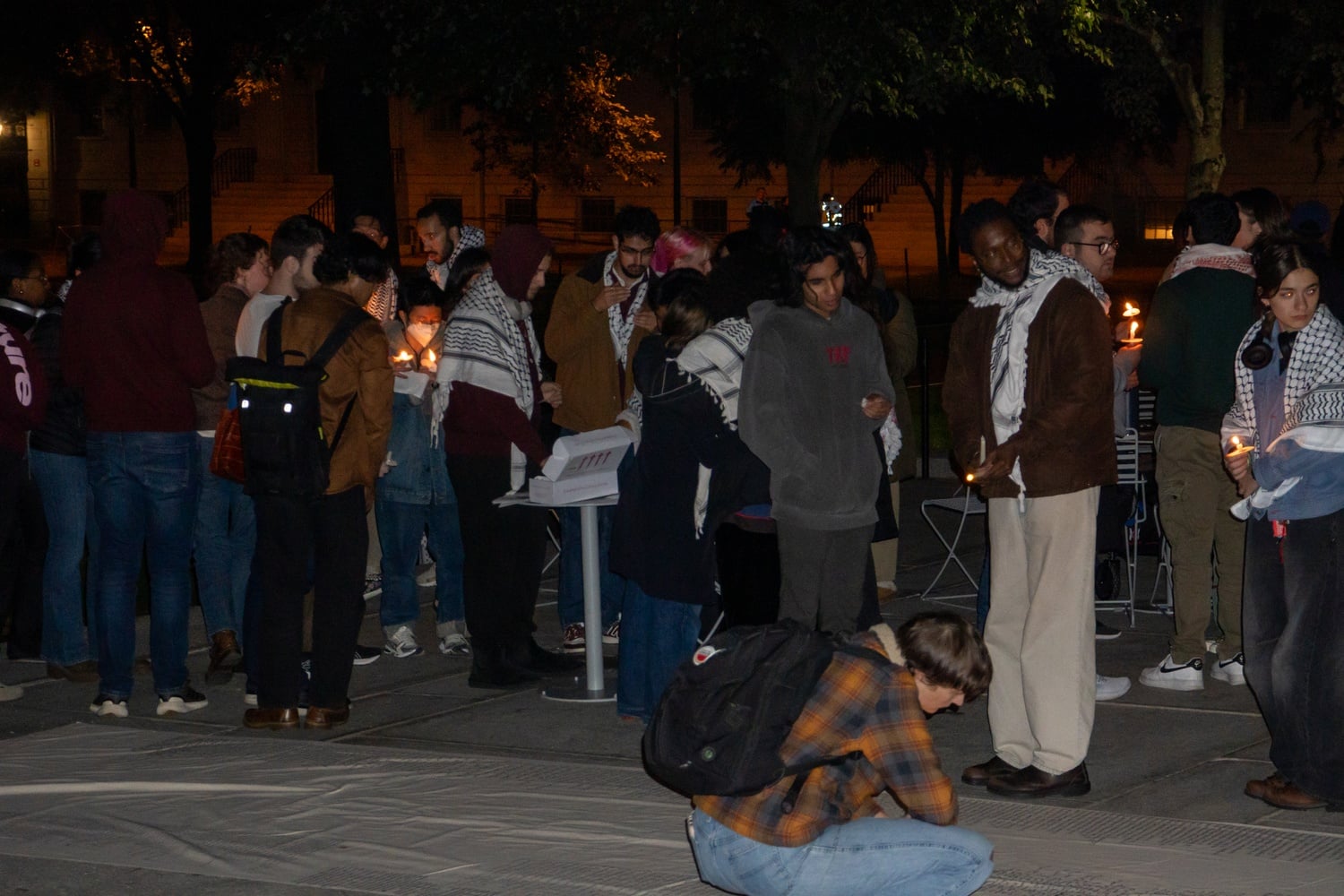
Dozens of Harvard students and affiliates gathered on the steps of Memorial Church Thursday evening for a vigil to mourn tens of thousands of lives lost in the war in Gaza.
The candlelit vigil — the first event hosted by the Harvard Undergraduate Palestine Solidarity Committee this school year — comes two days after the two-year anniversary of Hamas’s Oct. 7 attack on Israel.
Attendees held candles while listening to 12 minutes of a recording naming the Palestinians killed from Oct. 7 to Oct. 26 of 2023. Following the recording, organizers invited attendees to reflect on three point — how they were feeling, their personal responsibilities to Palestine, and courses for action to advocate for Palestine.
“After two years of suppression, doxxing, and targeted discipline of students and faculty in solidarity with Palestine, a sense of defeat and powerlessness is inevitable. We try to ask ourselves and each other the questions each day: What can be done? What are our capabilities?” a pamphlet distributed to attendees read.
University spokespeople did not immediately respond to a request for comment Thursday evening.
Around a dozen attendees spoke to the group in response to the reflection questions, citing feelings of desensitization on campus to the violence alongside hope for the war to end.
The PSC hosted a name-writing session in the Science Center prior to the vigil, where students and affiliates were invited to write the names of Palestinians killed in the war on a banner spanning several yards. At the start of the vigil, organizers unfurled the banner on the steps of Memorial Church.
The vigil marks the first event hosted by the PSC this school year, other than one interest meeting — a marked difference from past two years, which saw a surge in student activism on campus. Since the PSC’s controversial Oct. 7 statement in 2023, which garnered national media attention and prompted White House investigations of University administrators, pro-Palestine groups hosted numerous rallies and demonstrations on campus —including the 20-day encampment in Harvard Yard in the spring of 2024.
The initial wave of heightened student activism immediately following Oct. 7 has been the focal point of President Trump’s attacks on Harvard and its response to pro-Palestine protesters.
Get The Crimson in your inbox.
Olivia G. Pasquerella ’26, an organizer for the PSC and Harvard Out of Occupied Palestine — the group that led the encampment — said in an interview after the vigil that one of the struggles of the pro-Palestine movement has been “keeping that flame lit for as long as possible.”
“A lot of the things are repeating,” Pasquerella, a Crimson Magazine editor, said. “We’ve had vigils for the last two years saying much of the same thing — that the magnitude of death being caused by the Israeli military is incomprehensible.”
PSC organizer Mahmoud M. Al-Thabata ’27 said the vigil was intended to be a “space where people could read names and put a name to the statistics” in an interview after the vigil.
“We wanted people to be able to read off these names and see that they’re humans, that their lives matter, that they should be honored, and that this genocide has done horrific atrocities that should be on people’s minds,” Al-Thabata, a Crimson Editorial editor, said.
Since the start of the war in Gaza in October 2023, an estimated 67,000 Palestinians, including approximately 20,000 children, have been killed as a result of the violence, according to the Gaza Health Ministry. (The ministry is run by Hamas, which has been Gaza’s ruling party since 2007.)
Al-Thabata called for Harvard to disclose its investments and divest money linked to Israeli institutions — though University leadership has repeatedly rebuffed these calls. He also cited the removal of faculty leaders at Harvard’s Center for Middle Eastern Studies and the suspension of Harvard’s partnership with Birzeit University as examples of teaching about Palestine being “completely silenced and diminished.”
“It’s a threat to academic freedom — or intellectual vitality — that this university preaches, and until it grapples with that, it’s going to be stifled,” Al-Thabata said.
Pasquerella noted that though there were “some things that are different” this year, compared to previous years, the movement for Palestine would continue.
“We’re very aware that we have to take care of each other right now, especially being under the Trump administration and seeing the threatened deportation of Palestinians and pro-Palestine organizers,” they said.
“The movement has to push on until Harvard divests,” Pasquerella added.
—Staff writer Alexander W. Anoma can be reached at [email protected]. Follow him on X @AnomaAlexander.
—Staff writer Chantel A. De Jesus can be reached at [email protected]. Follow her on X @c_a_dejesus.
Want to keep up with breaking news? Subscribe to our email newsletter
Have a tip for The Crimson? Share it confidentially