Fallow Kin: A Promise in the Making
Chef Marcos Sanchez — 3 Stars
Situated on the cusp of Central Square and MIT, Fallow Kin arrives with a thesis as clear as its name. “Fallow” references land left to rest so it can return more fertile; here, that idea becomes a kitchen committed to seasonality, locality, and thoughtful, low-waste cooking.
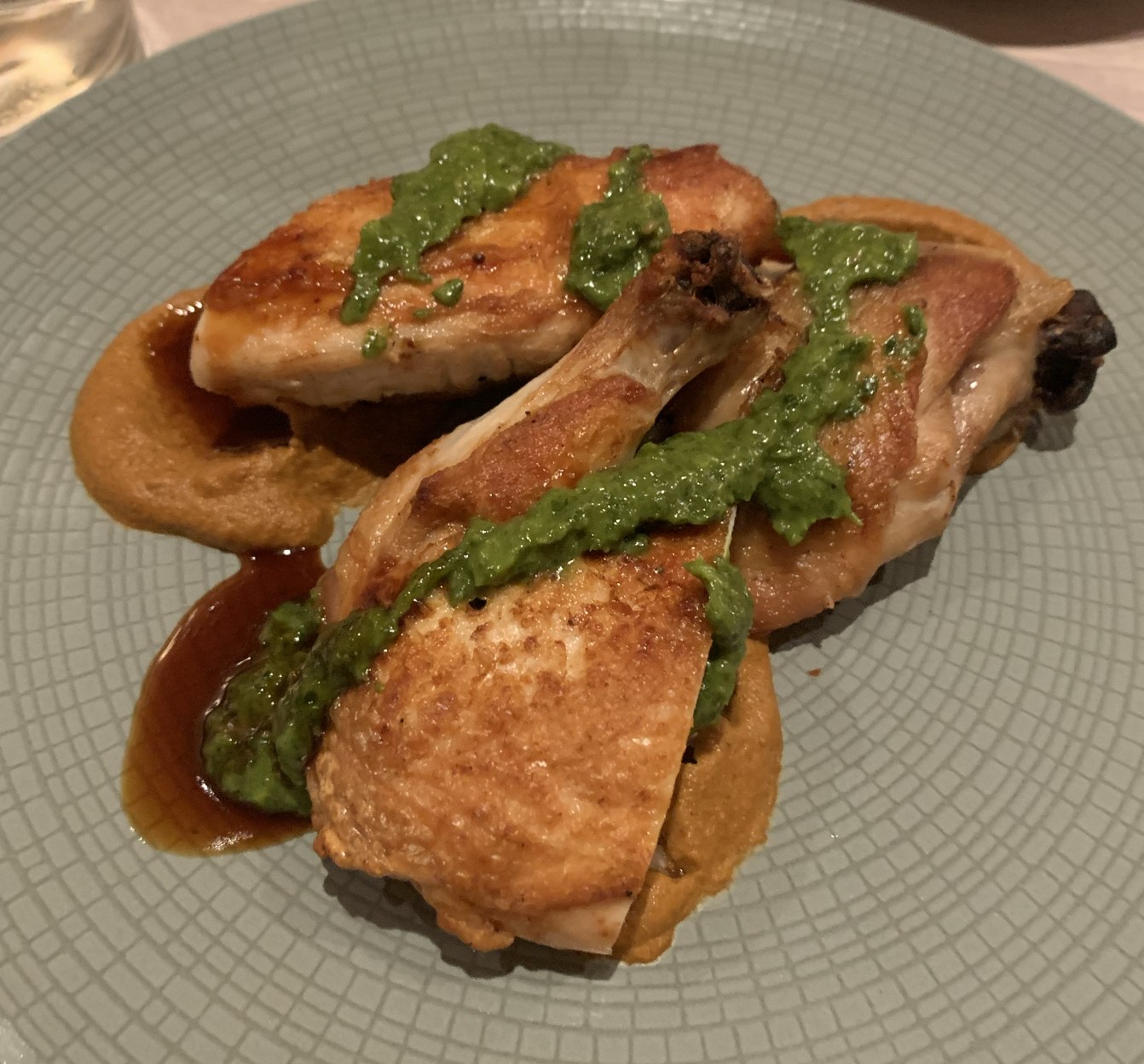
The concept is built into the infrastructure: a chef’s counter with a tasting menu, a regular dining menu, and a late-night zero-waste menu that repurposes leftovers and byproducts with intent. Even on the standard menu, that ethic stays present. For instance, the Feather Brook Farms Chicken appears as a meat course, while the leftover chicken skin resurfaces in a Smoky Cabbage vegetable dish. The result is a house style that values completion as much as invention.
The room creates an excellent first impression by mirroring Fallow Kin’s mission. There’s a modern cabin hush to the space with pervasive evergreen tones, natural light woods, plants climbing the walls, pottery-forward plates, and a soft, warm evening glow. Glass windows allow natural light to stream in during the day, while after dusk, the light narrows to an intimate simmer with candles and lamps. The open kitchen at the chef’s counter is delightfully visible from the dining room, underscoring the collaborative rhythm between the servers and the chefs. It is a setting that promises restraint, focus, and materials treated with care.
Yet, while the ambience and service are impeccable, that promise lands unevenly across the dishes themselves. While often compelling, the food can sometimes be over-salted and occasionally sidetracked by substitutions that muddle the point of the dish. Starting out, the opening bread course is unmistakably a statement piece: Duck Fat Brioche with a side of butter and salted blueberries. The roll itself is superb — a pillowy, buttery, croissant-adjacent crumb that remains soft even at room temperature. The salted berries, however, behave like bright but unruly — and almost unnecessary — punctuation marks. Because they arrive as intact entities with concentrated flavor rather than a permeating spread like the butter, a single bite can swing from balanced to aggressively saline. The concept of revamping a ritual starter bread service into something more vivid certainly intrigues. As executed, though, it requires a more sure hand with distribution and a greater allowance for sweetness.
If the Duck Fat Brioche stirs debate, the Crispy Potato is an undeniable win of the night. Imagine a supersized yet elegant French fry: shatteringly crispy on the outside, piping-hot and translucent within, balanced by a black-garlic aioli that adds depth without an overfried heaviness. A pour of green clam sauce pulls the dish into New England waters with its salty, briny, rich shellfish savor. It evokes a clam chowder, more greatly distilled. Every bite delivers contrast and coherence in equal measure.
On the other hand, the Cavatelli, served in a mixture of duck merguez and sheep’s milk cheese, unfortunately illustrates the risks of Fallow Kin’s zero-waste, experimental ledger. The pasta itself is properly al dente, but the pickled celery — apparently subbed in for the corn used in the original version — wrongly redirects the dish. The celery’s firm crunch and fermented tang call to mind East Asian rice-cake dishes with kimchi, a direction that could be exciting if the base were designed for it. Here, though, the sharper texture and sour note compete with the pasta rather than support it; the sauce is also thin, causing the balance to drift and the pasta to never gain the lead. In a restaurant organized around intention, this plate is a disappointing compromise: an admirable use-what-you-have instinct that blurs the focus. Perhaps it would be better with the sweetness of the original corn kernels, but as served, it’s a letdown.
Fortunately, the Creamy Kale brings the meal back into alignment. Breadcrumbs atop the sizzling skillet of greens add welcome texture. The kale is cooked down to a spoonable softness that lands somewhere between a creamed spinach and a broccoli-cheddar soup. It’s cohesive, comforting, and undeniably rich. Over too many consecutive bites, however, that richness and saltiness might overwhelm, a likely echo of the melty Vermont cheddar woven throughout. The accompanying corn biscuit follows suit: impressively buttery, slightly saline, but missing that sunny corn sweetness that would balance the dish. A salsa verde alongside does useful lifting, brightening the edges and hinting at the higher-contrast finish that this plate could potentially achieve with lighter seasoning. As it stands, the dish is satisfying but heavy. Softer salting and a greater coaxing of corn could transform it into a more complete expression of comfort.
From there, the Feature Brook Farms Chicken doubles down on the restaurant’s whole-animal rigor as aforementioned. The skin is crisp without excess fat, but the meat runs a tad dry and underseasoned on its own, especially if eaten immediately after saltier plates. An autumnal, curry-leaning pumpkin mole and a cilantro-lemon pesto come to the rescue, adding flavor and bounce when pulled generously into each bite. Nonetheless, the fact that the responsibility of building this perfect forkful falls onto the guest implies a crack in care; a chef-directed marinade or a more assertive baste could bring the chicken into harmony from within, not just on top.
Dessert closes the meal on a restrained note: a Japanese Cheesecake that is light, airy, and cleanly made. The dish is perhaps more mousse-like than a traditional New York slice, set with an herb-leaning tinge that may divide opinions. A scoop of lemon sorbet sharpens the palate and underscores the kitchen’s constant wavering between lift and heft. Still, it’s tidy, thoughtful, and, like several courses before it, possibly more admirable than truly craveable.
It would perhaps provide one more degree of clarity around Fallow Kin’s mission and execution if a quick comparison to its sister restaurant is drawn. Talulla, located in the northwestern part of Cambridge, infuses its farm-to-table philosophy into a gentler thesis, promising a warm, living room intimacy where technique serves coziness first. Fallow Kin states its mission more directly and experiments more publicly, aiming for a kind of culinary circularity that diners can see, taste, and consider. That ambition is admirable, but now the question is execution.
As a whole, Fallow Kin reads like an earnest first draft. The restaurant’s identity around zero-waste awareness, ethical sourcing, and season-led thinking truly does feel genuinely pursued rather than simply performative, and the best dishes channel that ethos into flavor, not just rhetoric. There are occasions when the approach wobbles, but there’s a recurring theme in the confusion: salt that crowds out sweetness where sweetness would help, and substitutions that satisfy the sustainability part but shift the dish’s focus to produce something less satisfying. Nevertheless, neither of these flaws stems from an issue with the concept itself. Instead, they require deliberate calibrations and a strong conviction to make the mission legible in flavor, not just innovation.
There certainly is real promise and potential here — in the craft of that brioche, the clarity of that potato, the kitchen’s willingness to iterate in service of a larger idea. If the team leans into the same patience that the name invokes — allowing ideas to rest, refine, and return enhanced — then Fallow Kin can successfully close the gap between mission and meal. It just needs a little time to go fallow and come back stronger.
—Staff writer Audrey Zhang can be reached at [email protected].
Want to keep up with breaking news? Subscribe to our email newsletter
Have a tip for The Crimson? Share it confidentially