‘Massachusetts Avenue: Life Along Cambridge’s Main Artery’ Premieres at the Brattle: A Cinematic Time Capsule of Cambridge
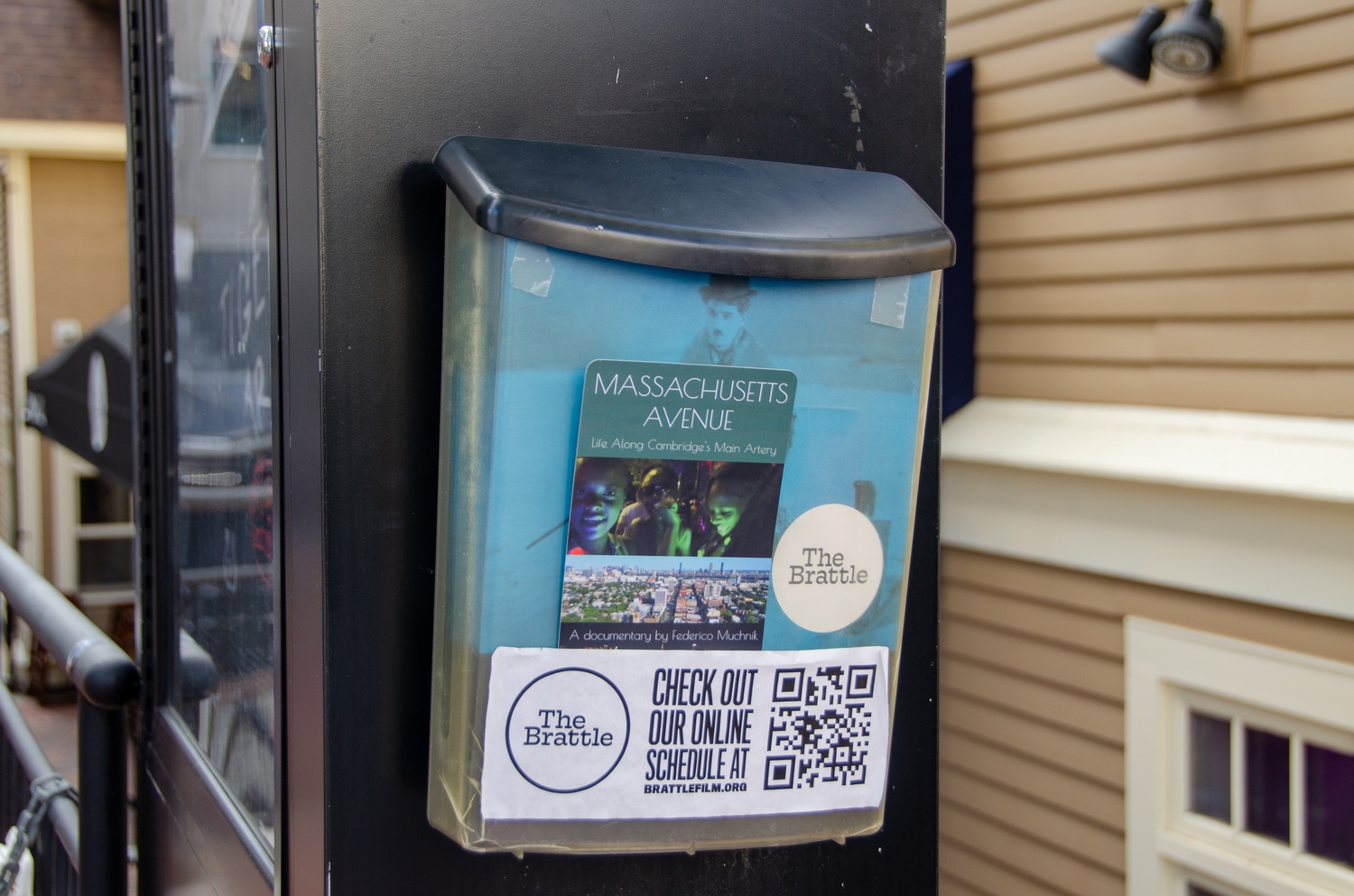
On Oct. 18, dozens gathered at the Brattle Theatre to watch a documentary about the very street many of them took to get there. “Massachusetts Avenue: Life Along Cambridge’s Main Artery” is a project by filmmaker Federico M. Muchnik, who was personally present to welcome the premiere’s attendees.
The documentary surveys a range of people, from business owners to students to residents of Cambridge, each with distinct relationships to Massachusetts Avenue — or, as it is nicknamed, Mass Ave. Between rooftop panoramas and time lapses of the busy streets, the documentary creates space for people to share their own experiences of living in the city as well as their thoughts about its trajectory.
Attendees included regular frequenters of Mass Ave businesses like the Central Barber Shop or The Dance Complex, as well as visitors to the Boston area. Several attendees, as well as a documentary participant and Muchnik himself, shared their thoughts in interviews with The Crimson.
“Even the people that live in Cambridge are going to find out things,” said Luciana Castellan, a Cambridge local and friend of Muchnik’s.
Martina Monteiro is another long-time Cambridge resident. Having just come from Felix Shoe Repair, one of the Mass Ave shops featured in the film, she expressed excitement over the idea of local business owners — including those she is personally acquainted with — getting to share their stories with a wider audience.
“I think it’s going to be wonderful,” she said.
Several attendees were familiar with Muchnik’s past work. Just last April, the Brattle premiered “Open Space,” a documentary centered on Danehy Park in Cambridge. Castellan, who runs and walks her dog in Danehy Park, found that Muchnik truly captured the park’s essence.
“If this is anything like that project, this will be a time capsule of what life is like in Cambridge or along Mass Ave,” she said.
Muchnik wanted to explore his neighborhood after years of living in it — an aspiration that many attendees seemed to share.
“The Avenue, like Danehy Park, is a place that just keeps on giving. It’s always giving. And if you’re like me, who is looking for the meaningful or the exceptional in the everyday, it’s real fertile ground,” Muchnik said.
During the Q&A after the film, several attendees stood up to compliment Muchnik on his drone shots, which conveyed the vastness and magnificence of the city. The audience cheered and applauded in agreement.
Despite these shots, Muchnik used a simple iPhone 15 to film the majority of the documentary. For Monteiro, this filming technique was a major factor in why she was interested in attending the premiere in the first place.
Muchnik explained during the Q&A how shooting on an iPhone, in addition to positioning viewers from the perspective of a customer or passerby, made him less intimidating as a documentarian. Especially when it came to approaching people in the middle of their work and filming their descriptions of their personal experiences, preserving the authenticity was essential.
“The job of the documentarian is to observe — it’s to shut up and observe,” he said.
In preparing for the film, Muchnik knew he wanted to include certain elements like the Harvard Book Store, Andy’s Diner, and The Dance Complex — a place he’s been walking by for years but never knew much about. Much of what ended up in the film, however, was the result of stumbling upon new people while exploring the Avenue.
Bus driver Tony P. Raymond was one of these surprises. As the first to be interviewed by Muchnik in the documentary, he set an upbeat and lighthearted tone, cracking jokes between stops to infuse energy and life in the morning lull. At the end of the premiere, when attendees realized “Lunchbox Tony” was sitting among them, many went up to thank him for sharing his story and express their hopes to see him on the 77 bus in the future.
Raymond embraces the fullness of his life. “Every day is different. Some days I can be miserable — I don’t want to talk. On other days, I’m happy-go-lucky. So I wanna say maybe Federico caught me on a good day,” he said.
While the film created a platform for its interviewees to share the principles they live by, viewers also had the opportunity to observe the atmosphere for themselves and appreciate the motion and sounds that make the city feel alive.
In shots of Harvard Square, the camera caught snippets of different conversations between groups of young adults, two laughing friends, and an argument at a crosswalk. Viewers could see people of different stages of life, all speaking different languages.
According to Castellan, the soul of Cambridge is characterized by this diversity.
“I think Cambridge is very unique because it is very embracing of everyone, wherever they are in their life journey. And people feel safe in that sense, and they feel free to express themselves as they are and what they believe,” she said.
Harolyn Bowden, a student at The Dance Complex, embodies this free self-expression. In the film, she describes how West African dance “awakens something from the ancestors.” Meanwhile, at Rumba y Timbal Dance Company, Director and Founder Roberto Figueroa believes that people can connect through Latin dance, whether or not they speak Spanish. From seeing the genuine smiles on the faces of children and adults of all different races, viewers can’t help but also feel drawn to the joy of the communities built there.
After watching the premiere and seeing how inclusive the dance classes were, Raymond was inspired.
“I was surprised to see some people you never thought would take a dance class. It made me think, ‘Hey, maybe some day I’ll sign up for a dance class,’” he said.
In addition to the beautiful and bustling activity of the city, the documentary also focused on its challenges. Painted white bikes along the sidewalk served as a memorial for two bikers who were killed along Mass Ave. Meanwhile, several seniors at the North Cambridge Senior Center described their frustration with the planned construction of a nine-story (which has since been changed to 12-story) apartment building adjacent to the center, as they expect it will increase traffic at the intersection.
Delving into the hard parts of life along Mass Ave, the camera switched between Al-Jaleel Supreme and Lisa — two people experiencing homelessness with very distinct histories. As a war veteran with PTSD, Al-Jaleel Supreme spoke about the need to respect those putting their lives on the line so that civilians can live comfortably. Lisa, on the other hand, slowly answered questions regarding her winters spent in a group home.
Muchnik included these perspectives with intention.
“My politics are in the movie, and this being an election year for counselors, I wanted to make a few statements about housing, urban planning, and the use of the avenue,” he said.
Another reason many find their way to Mass Ave is for school. As such, Muchnik made sure to focus on students’ political engagement. From Harvard, he featured clips of a pro-Palestine encampment as well as the 2024 People’s Commencement, organized by Harvard Out of Occupied Palestine to honor seniors whose degrees were withheld for participating in a prior encampment.
At MIT, the documentary switched between another pro-Palestine encampment and an organized protest in support of Israel. Even within the same group, students shared different aims for protesting and diverging ideas for resolving the violent conflict.
“You don’t want to preach, you don’t want to foist. You want to observe, and then let people come to the film,” Muchnik said.
And they did. Despite the difficulty of attracting an audience for the premiere, Muchnik gathered people from the area who knew him from his run for Cambridge City Council, had seen his previous documentary, or knew individuals featured in “Massachusetts Avenue.”
Charles Sullivan, Executive Director of the Cambridge Historical Commission and one of the people featured in the film, repeatedly referred to Mass Ave as an artery in his conversations with Muchnik. It was because of him that the final title was born: “Massachusetts Avenue: Life Along Cambridge’s Main Artery.”
As for Muchnik’s next projects, the filmmaker shared during the Q&A that his local documentaries are “starting to look like a trilogy.” People will have to wait to see what part of Cambridge the third installment might examine.
“Massachusetts Avenue” will be shown again on Feb. 1 at the Somerville Theatre and Feb. 7 at the Lexington Venue. Like Castellan predicted, Muchnik believes his creation will serve as a time capsule.
“These films become more valuable as people age and as new people come in,” he said.
To many, the title is fitting. Life pulses through Mass Ave. Raymond described it well: “You meet a lot of characters, but that’s what it is — it’s one big melting pot. Everything and everybody. Federico said he wanted to capture that.”
And capture that he did.
Want to keep up with breaking news? Subscribe to our email newsletter
Have a tip for The Crimson? Share it confidentially