Students ‘Not Surprised’ Garber’s Presidency Will Continue
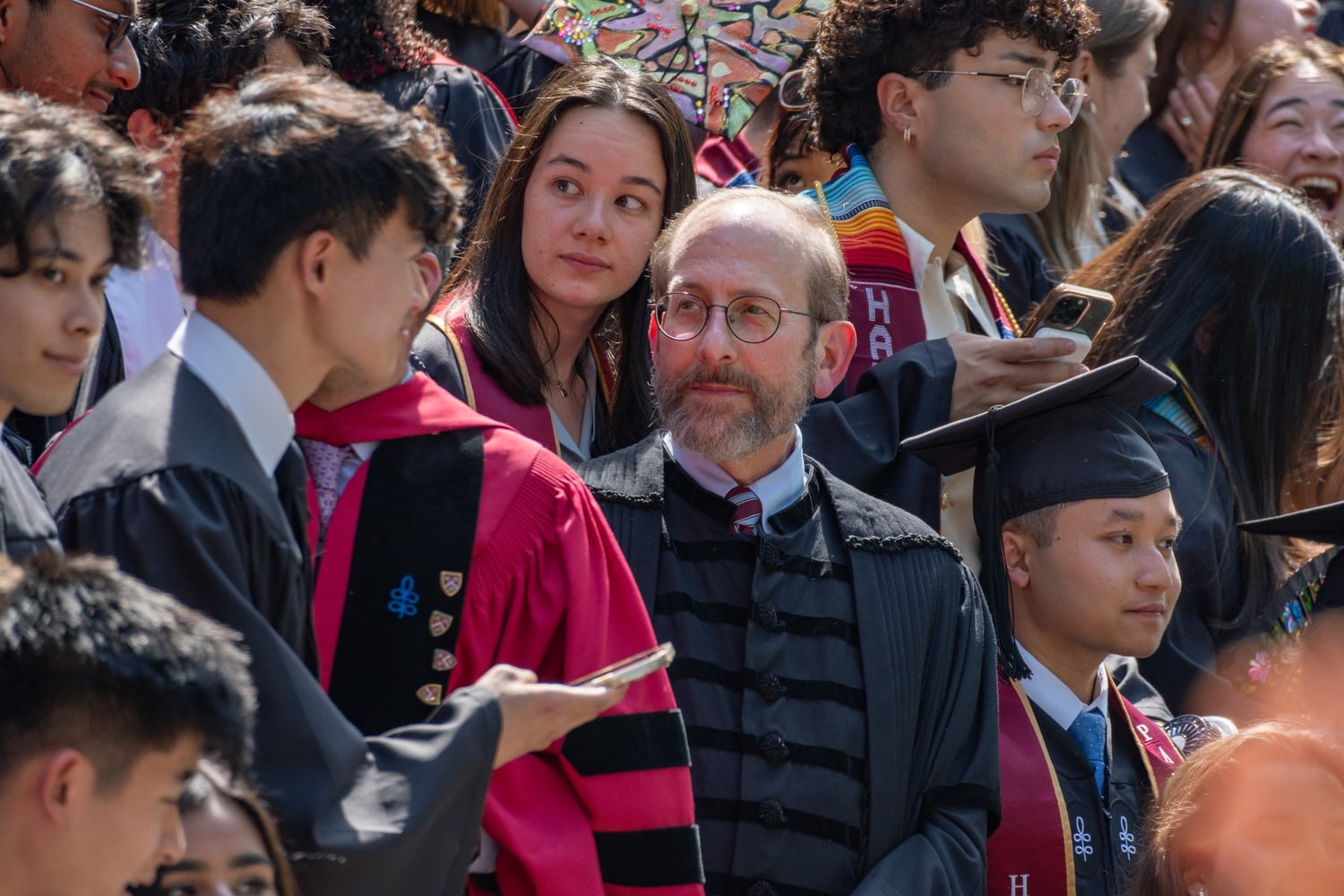
Harvard undergraduates said they were largely unsurprised by the decision to let University President Alan M. Garber ’76 remain in his role indefinitely, citing a desire for continuity as Harvard continues to face pressure from the Trump administration.
But some students said that the stability Garber has provided externally has come alongside internal decisions they viewed as troubling, pointing to what they described as a narrowing of academic freedom — especially for pro-Palestine voices on campus.
Garber had initially been appointed to a three-year term set to expire at the end of the 2026-27 academic year, with a yearlong search for his successor expected to begin this spring. Instead, students opened their inboxes during the final days of exams to a brief email from Harvard Corporation senior fellow Penny S. Pritzker ’81 announcing that Garber would continue his presidency with no defined end date.
Several students said the announcement aligned with expectations.
“I always assumed the plan was for his presidency to become indefinite so long as he did a good job in the eyes of the board,” Aidan F. Mostashari ’28 wrote in a statement. “Given the turbulence Harvard is navigating right now, I understand why continuity may feel appealing to the Corporation.”
Others echoed the sentiment that frequent leadership changes would signal instability at a moment when Harvard is under intense national scrutiny.
“Shifting around too often is a sign of instability, and I think it reflects poorly on the institution,” Brody B. Douglass ’27 said.
Several students said Garber’s response to pressure from the Trump administration — which has attempted to revoke billions of dollars in federal funding and to restrict Harvard’s ability to host international students — defined their views of his presidency more than any other issue.
In April, the Trump administration issued a sweeping set of demands that would have given the government control over Harvard’s hiring, admissions, and teaching practices. Garber rejected the demands, prompting the White House to pull nearly $2.7 billion dollars in federal research funding. With Garber’s approval, Harvard launched two separate lawsuits challenging the administration’s actions.
“He’s been put in an incredibly difficult position, because he has to balance the long-term interests of the University with the short-term interests of the students,” Ella V. Ricketts ’28 said. “I think that he’s balanced that quite well.”
Get The Crimson in your inbox.
International students, in particular, said Garber’s willingness to confront the administration offered reassurance.
“He has shown great courage by defending Harvard and us international students from the Trump administration’s attacks,” Karl N. Molden ’27 wrote in a statement.
Even students who expressed frustration with other aspects of Garber’s leadership said his resistance to the White House mattered.
“Helping lead the fight against the Trump administration’s assault on one of America’s greatest assets, our system of higher education, has been a real win in my book,” Mostashari wrote. “It’s the best thing he’s done as president.”
But other students raised concerns about the direction of Garber’s internal policies, particularly around academic freedom and support for pro-Palestine speech.
Several pointed to what they described as a retreat from support for scholarship and programming on Palestine under Garber’s leadership. In recent months, Harvard removed the faculty leader of the Center for Middle Eastern Studies, suspended the Religion, Conflict, and Peace Initiative at the Harvard Divinity School, and, most recently, dismissed a director at the Harvard School of Public Health whose center focused in part on the region.
Olivia G. Pasquerella ’26, an organizer for the Harvard Undergraduate Palestine Solidarity Committee, said Garber’s administration has taken an increasingly restrictive approach to student activism.
“I think it’s very ironic that in his message, he paid this lip service towards dissent and towards academic freedom and diversity,” they said. “It is very disappointing to see Harvard continue to go in this direction.”
Other students said they were frustrated by broader changes to academic and student-life infrastructure, namely the sweeping restructuring and closure of diversity offices across the University.
Dominick F. Lombard ’27 said he hopes Garber will prioritize “transparency” moving forward.
“We just want to make sure that these changes that we are seeing on our campus — whether it be different student offices or different academic offices — that these are being done for students’ best interests, and not for any political reason,” he said.
A Harvard spokesperson did not respond to a request for comment.
Alexander H. Lee ’27 described Garber’s presidency as a “mixed bag,” crediting his response to federal pressure and the largely “symbolic” recent rollbacks.
“I think it’s important for us to have a very strong voice, especially when we have this place amongst other colleges people look to,” he said.
Conservative students also expressed cautious optimism about Garber’s extended tenure.
Evan J. Doerr ’28, chair of the Conservative Coalition at the Institute of Politics, said Garber’s leadership marked an improvement over that of his predecessor but said momentum toward “meaningful engagement with conservative ideas has stalled and dissipated.”
“Conservatives at Harvard remain willing to work constructively with the administration,” Doerr wrote, “though it is not yet clear that this extension reflects a genuine commitment to making these priorities central rather than peripheral,” he added.
As Harvard continues negotiations with the White House over a potential $500 million settlement to resolve ongoing disputes and investigations from Washington, students said Garber’s next steps will be closely watched.
“I hope that Garber will continue resisting a settlement because of what it would signal to America’s civil society and the growing movement that Harvard fueled when it resisted Trump in the first place,” Molden wrote.
—Staff writer Sebastian B. Connolly can be reached at [email protected]. Follow him on X @SebastianC4784.
—Staff writer Wyeth Renwick can be reached at [email protected]. Follow her on X @wzrenwick.
—Staff writer Summer E. Rose can be reached at [email protected]. Follow her on X @summerellenrose.
Want to keep up with breaking news? Subscribe to our email newsletter
Have a tip for The Crimson? Share it confidentially