Former College Dean Benedict H. Gross Remembered as ‘One of the Kindest People in All of Academia’
Remembered as a transformative College dean and pioneering number theorist, Benedict H. Gross ’71 died in December at 75 after a long illness.
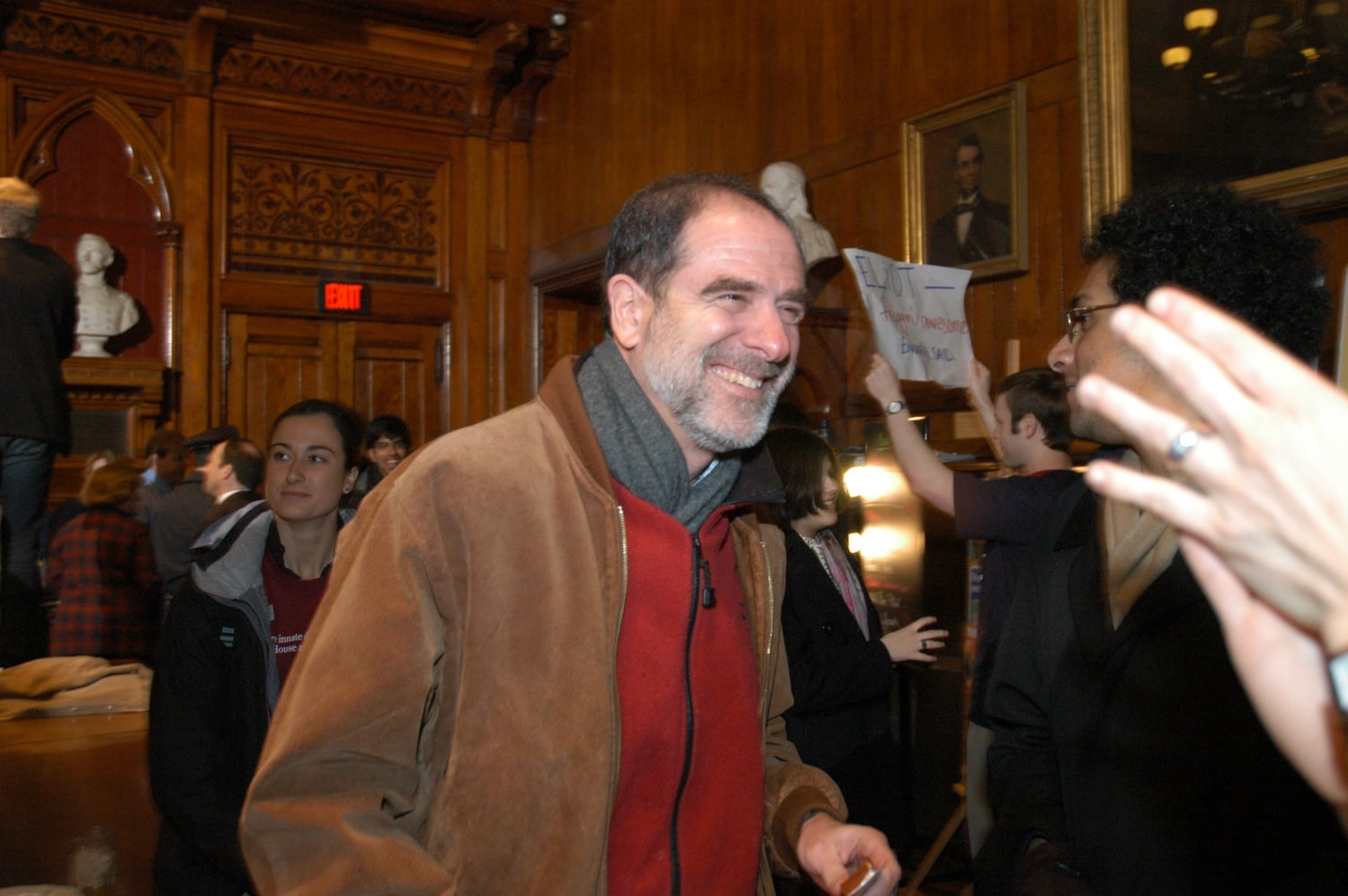
In the spring of 2003, then-Faculty of Arts and Sciences Dean William C. Kirby and Dean of the College Benedict H. Gross ’71 were sitting in the faculty room of University Hall for a regularly scheduled meeting of the Dean’s Council.
But as they went about their business, they stumbled into an unexpected challenge. Then-United States President George W. Bush was on the verge of launching an attack into Iraq, and a group of student protesters had gathered outside the building, getting “noisier and noisier,” until it was “almost impossible to hear,” according to Kirby.
Kirby suggested to Gross that he go outside and tell the students to delay their protest for 15 minutes so the administrators could finish their meeting.
Gross was soon on his way downstairs.
“He went down, and they stopped, to our amazement,” Kirby said.
“I mean, student demonstrators usually don’t stop just because the Dean asks them to,” he added. “But Dick had that rapport with students, and they had a trust in him that helped us at least finish that meeting.”
Gross’s confidence with students and administrators was built over the course of the nearly five decades he spent at Harvard. After earning an undergraduate degree from the College in 1971, he would go on to hold a variety of faculty and administrative posts, including chair of the Math department, Dean of Undergraduate Education, and ultimately, Dean of the College.
As College dean, Gross oversaw significant changes to the undergraduate experience, steering the College through an intensive curricular review process. He also made significant mathematics contributions during his career, including the development, alongside colleague Don B. Zagier, of a seminal formula in the field of number theory.
Gross died in December 2025 at the age of 75, after a long illness.
‘A Real Renaissance Man’
Get The Crimson in your inbox.
Dorian M. Goldfeld was a visiting professor at Harvard in the 1980s when Gross, then an associate professor at Brown University, came excitedly into his office.
In what became a influential moment in modern number theory, Gross had just come up with an idea for a proof to the Gauss conjecture, which had remained unproven for more than a century.
“That one day when he came into my office and said, ‘I have an idea. I think this is going to work’ — he was just so excited. He was beaming,” Goldfeld said.
The results, published in the journal Inventiones Mathematicae in 1986, would go on to earn Gross, Zagier, and Goldfeld the American Mathematical Society’s Cole Prize, awarded for significant contributions to the field of number theory — and the formula would be termed the Gross-Zagier formula in the mathematicians’ honor.
But Gross’s path from Harvard undergraduate to award-winning mathematician was far from straightforward.
After receiving his bachelor’s degree in mathematics, he pivoted to the arts and humanities, traveling to the United Kingdom in 1972 on a Marshall Scholarship to study history and sociology.
Jill P. Mesirov, Gross’s wife and a professor of medicine at the University of California San Diego, wrote in a statement that Gross had always maintained a wide range of interests, which included — outside of math and music — golf, tennis, and skiing.
“As one friend described him - he was a real renaissance man,” she wrote.
But Gross would eventually settle on a career in math, returning to Harvard in the 1970s to pursue a Ph.D.
“He was quite impressive mathematically,” Goldfeld said of Gross as a graduate student. “I mean, he just came up with new mathematical ideas, which is really impressive.”
Douglas L. Ulmer, who earned his own Ph.D. under Gross’s direction at Brown University, wrote in a statement that Gross’s work launched several new areas of research in number theory.
“Dick Gross had a huge influence on modern number theory,” he wrote. “Many of his students have gone on to influential careers of their own.”
The ‘Modern Undergraduate Experience’
Gross’s influence at Harvard extended far beyond the Math department.
After 17 years as a professor at Harvard, Gross assumed the role of Dean of Undergraduate Education in 2002 — and would become Dean of the College one year later after Kirby decided to merge the two deanships into one position following the ouster of former College Dean Harry R. Lewis ’68.
Kirby appointed three new divisional deans at the FAS level shortly after Gross took over the newly-merged position, leaving Gross responsible for overseeing a multi-year curricular review aimed at strengthening the academic experience of undergraduates.
Though Gross drew on-and-off criticism from the student body for the General Education curriculum that ultimately emerged from the review, several students who studied at the College under his deanship said he always maintained a patient and measured approach to the job.
Adam Goldenberg ’08, a former Crimson Editorial editor who frequently challenged Gross in his columns, wrote in an email that Gross was “unfailingly patient and gracious with me, even when he had no good reason to be.”
While a senior, Goldenberg told Gross that he was concerned about not having post-graduate plans lined up. In response, the dean told him to schedule a meeting with him for ten years in the future — and that everything would work out by then.
“Sure enough, ten years later, I found the appointment in my calendar and sent him a note, acknowledging that he’d been right — and suggesting, in jest, that it was time to schedule that coffee,” Goldenberg wrote. “To my surprise, he made sure that we got together.”
Administrators also took note of Gross’s deep attention to detail in undergraduate affairs.
“He knew the curriculum cold,” Kirby said. “He also understood, I think, probably better than anyone else in University Hall, the issues of concern to undergraduates, because his door as Dean of Undergraduate Education or Dean of Harvard College was always open to students.
“Not a difficult man to get an appointment with,” Kirby added.
Gross implemented initiatives to increase first-year seminar offerings and expand study abroad opportunities, while also working with the FAS through an overhaul of academic concentrations and collaborating with department chairs to formally recognize secondaries and delay concentration declarations until students’ sophomore years.
“Much of that work, and the efforts he led as Dean of Undergraduate Education from 2002 – 2003, built the modern undergraduate experience,” College Dean David J. Deming wrote in a Wednesday email to Harvard affiliates announcing Gross’s death.
“He was committed to everything he did, but at the same time, he didn’t take it too seriously,” said Math Department Chair Joseph D. Harris ’72. “He didn’t attach more importance or significance to things than they warranted, and especially when he was in administration, that was a particularly positive quality.”
An ‘Emotional Advisor’
Though Gross was an esteemed mathematician and prominent university administrator, former colleagues and students said he always maintained a down-to-earth attitude.
Martin A. Nowak, Professor of Mathematics and of Biology, wrote in an email that he would remember Gross as “one of the kindest people in all of academia.”
“His enthusiasm for the University and its students was boundless,” he added.
“He would speak to people of all different levels — undergraduates, graduate students, his colleagues — with the same voice,” said Joshua M. Lansky, a former Ph.D. advisee of Gross’s.
Lansky said Gross waited more than 30 minutes after his graduation to meet and take a photo with his mother, staying after most attendees had left.
“He’s a very brilliant, very important man, but his priorities were squarely with kindness and respect for his students and their families,” he said.
“They came to him as an emotional advisor, for moral support, and, you know, sticking to their studies or possibly figuring out if another field would be better for them,” he added. “He was a counselor to a lot of students in a way that transcends just talking about the mathematics.”
Harris, who was classmates with Gross as an undergraduate student at Harvard, said Gross “exemplifies more than anyone else the positive qualities of Harvard and the Math Department.”
“He was committed to everything he did, but at the same time, he didn’t take it too seriously,” Harris said. “I think everybody who dealt with him felt that they had been heard.”
—Staff writer Sebastian B. Connolly can be reached at [email protected]. Follow him on X @SebastianC4784.
—Staff writer Summer E. Rose can be reached at [email protected]. Follow her on X @summerellenrose.
Want to keep up with breaking news? Subscribe to our email newsletter
Have a tip for The Crimson? Share it confidentially