Utah Gov. Cox and Massachusetts Rep. Auchincloss Warn Social Media Fuels Political Polarization at IOP Forum
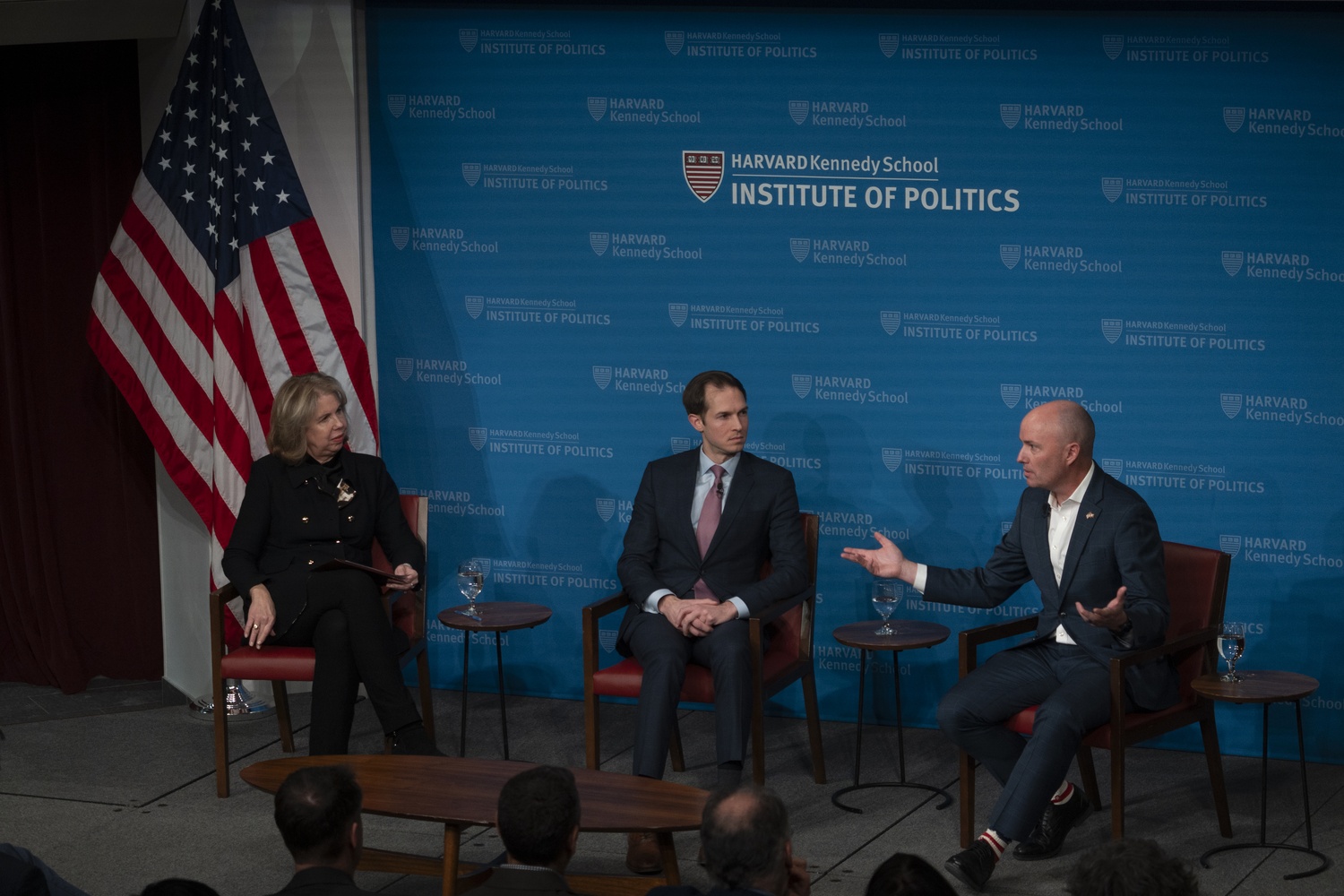
Utah Governor Spencer J. Cox and Representative Jake D. Auchincloss ’10 (D-Mass.) blamed social media for contributing to the normalization of political polarization and violence at a Harvard Institute of Politics forum Wednesday night.
Auchincloss said that a significant problem in society today is the “extremism and the dehumanization” that occurs when U.S. citizens “stop thinking of the American people as a demos where we all have a shared future together.”
“I think the reason that that shared future is deteriorating is, in part, because reality is deteriorating,” he added. “Partly just because of social media — not entirely, but partly.”
The forum — which was moderated by Harvard Kennedy School professor and Director of the Shorenstein Center Nancy R. Gibbs — began with short remarks by Massachusetts Governor Maura T. Healey ’92 and HKS Dean Jeremy M. Weinstein.
Healey said that social media “makes it harder, in many ways, for us to come together and fix the problems, address the problems, have the conversations that really need addressing.”
Cox cautioned attendees about what he called the graphic nature of social media, arguing that real-time circulation of violent content may traumatize users. He pointed to the fatal shooting of right-wing activist Charlie Kirk at a public debate at Utah Valley University last September as one such example.
“I mean the Charlie Kirk shooting — how many of you saw that? Within five minutes of it happening, you saw a gruesome, gruesome death that, again, our brains are not prepared to handle,” Cox said. “We are not capable of processing all of this terrible stuff, and it’s very damaging to our mental health.”
Get The Crimson in your inbox.
Auchincloss said that his priority is legislation that limits social media usage for children. In November, he introduced “the UnAnxious Generation package” — a trio of bills that tax social media companies’ advertising revenues and discourage deepfake images. The bill package would also strengthen age verification to ensure that children under the age of 13 cannot access social media platforms.
“It’s not about wagging your finger and being like, ‘you can never use social media.’ It’s about saying, ‘temperance. Everything in moderation,’” Auchincloss said.
Cox said laws that discourage the use of social media may be warranted, drawing a comparison to legislation he is currently working on to increase the sales tax on tobacco.
But Cox warned that social media companies are “much more powerful” than tobacco companies.
“We’ve never seen anything quite like it,” he said. “And they’re acting incredibly irresponsible.”
Cox stressed the importance of offline interactions to counter the pernicious effects of social media.
“We should be telling people to go and change their neighborhoods, to focus there, and to serve and give back and volunteer at the local food bank,” Cox said. “Go ask your neighbor how they’re doing. That’s the kind of stuff we need, not more people cosplaying national politics.”
—Staff writer Sophia E. Alcacer can be reached at [email protected] and Signal at sophiaalcacer.88. Follow her on X at @sophiaalcacer.
—Staff writer Jen L. Phan can be reached at [email protected]. Follow her on X at @jenllphan.
Want to keep up with breaking news? Subscribe to our email newsletter
Have a tip for The Crimson? Share it confidentially