BSO Presents a Stunning, Sonorous Rachmaninoff Concert
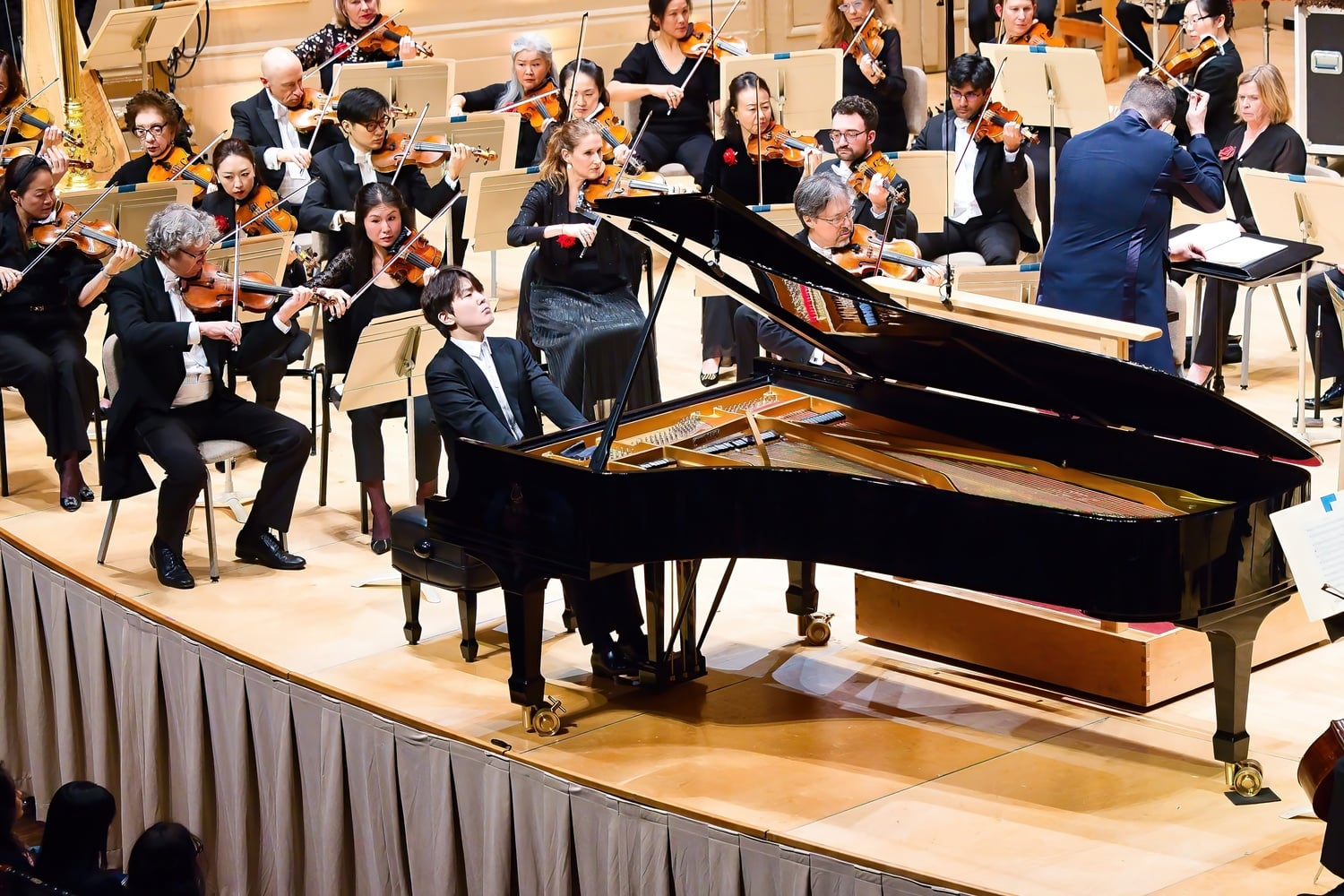
On Oct. 3, pianist Seong-Jin Cho joined the Boston Symphony Orchestra for a night featuring two works of Sergei Rachmaninoff. The concert began with Rachmaninoff’s “Rhapsody on a Theme of Paganini” and ended with Rachmaninoff’s “Symphony No. 2.” Rachmaninoff’s compositions, combined with the emotive playing of Cho and the orchestra, saturated Symphony Hall with emotion.
Sergei Rachmaninoff was a Russian composer and virtuosic pianist, who was celebrated for his expressive, rich compositions. Born in 1873, he was a late Romantic composer and known as one of the last Romantic “heroes.” His extraordinary hands — which supposedly could span 13 keys — helped shape the writing of his piano pieces as well as his performance of them. In his home at Lake Lucerne, Switzerland, he wrote “Rhapsody on a Theme of Paganini,” a brilliant piece which Seong-Jin Cho beautifully performed with the BSO.
“Rhapsody on a Theme of Paganini” is a set of variations on Paganini’s Caprice No. 24, a piece with a distinctive melodic theme. Seong-Jin Cho — the winner of the 2015 Chopin International Competition — lived up to his celebrated reputation with his performance of the piece. He masterfully weaved between the variations, balancing moments of pause with energetic phrasing. His interpretation of the melody was interesting — he emphasized some notes and subdued others, creating a heightened tonal effect. The piece became distinct from other renditions, rejuvenated by Cho’s phrasing.
“Variation No. 18” — the most famous of the variations — was instantly recognizable and well executed. Cho began the variation with a sweet melody, initially gentle and soft. As he crescendoed, the phrase gained strength and ebullience. The orchestra joined, lending strength to the melody as the crescendo climaxed. Cho unleashed a string of powerful chords, exerting visible effort in playing fortissimo. As the arpeggiating chords died down into a piano dynamic, the orchestra softened accordingly. The original phrase repeated at the end, this time dulled and more melancholic. Throughout this variation, the piano seemed to sing. It became personified by Cho’s phrasing: A sweet phrase gained hope, grew in strength, and then softened in old age.
The other variations were equally moving. They melded into each other, sonically diverse yet thematically unified. At times, the piano and the orchestra seemed to be speaking to each other. Their harmonies became conversations, encompassing strong emotions and gorgeously describing human nature. Cho personified the piano with accented, striking notes, bouncing melodies, and angry moments. Each chord was sharply delineated, acting like an individual word. The orchestra’s percussion section also added stylistic shifts and loud, surprising notes. At the end of the piece, a call and response between the strings and piano led to a frenzy of motion. A tremendous crescendo rose to a halt.
Cho then played a piano solo encore, Tchaikovsky’s “The Seasons, Op 37a: X. October. Autumn Song.” His left hand’s bass notes were gloomy, while his right hand seemed to be mollifying the left. Cho had a mournful expression on his face. Though the piece’s tone was pensive, his playing was still powerful. Sometimes, he would slow down, using rubato to its full advantage. The final note seemed to die away: It gradually turned into a hypnotizing, profound silence.
Rachmaninoff’s “Symphony No. 2” was like the sea — its dramatic swells and calm interludes were the waves. In the first movement, the coordinated pizzicato lent an almost eerie vibe. The hushed plucking was well-coordinated and evocative. The violins led the dynamics and tempo at the beginning; later, the second violins and violas led an accelerando. When the pace slowed again, there was a call-and-response section between the strings and woodwinds.
Every instrument seemed to have its moment — at times, the cellos had soaring melodies, and at others, the brass and woodwinds set a more solemn tone. Since every instrument played well, the tonal shifts were enchanting. Near the end of the first movement, flutes brought on a mellow theme, returning to the dulcet mood of the beginning.
In the next three movements, the orchestra continued to play harmoniously and dramatically. Conductor Andris Nelsons waved his arms, swayed, and slashed his baton to encourage various instruments to join the throng, get louder, and hush in turn. He swept the orchestra into its swelling, thunderous moments. The percussion section added brief, thrilling accents. Like in “Rhapsody on a Theme of Paganini,” the orchestra seemed to speak. In their coordinated dynamics and phrasings, the musicians brought Rachmaninoff’s emotional composition to its full effect.
The clarinet solo in the third movement was gorgeously played. The voice of the clarinet wasn’t strained; it sang above the triplets in the violins. Its melody was nostalgic and melancholy. It was fleeting and hard to grasp, but sturdy nonetheless.
When the piece finished, it felt cathartic. Cho and the BSO daringly interpreted Rachmaninoff’s works in a way that magnified their sensational, ambitious melodies.
— Staff writer Canela E. Tustin can be reached at [email protected]
Want to keep up with breaking news? Subscribe to our email newsletter
Have a tip for The Crimson? Share it confidentially