Handel and Haydn Society Presents ‘Art of Living’: A Jubilant Meditation on the Human Experience
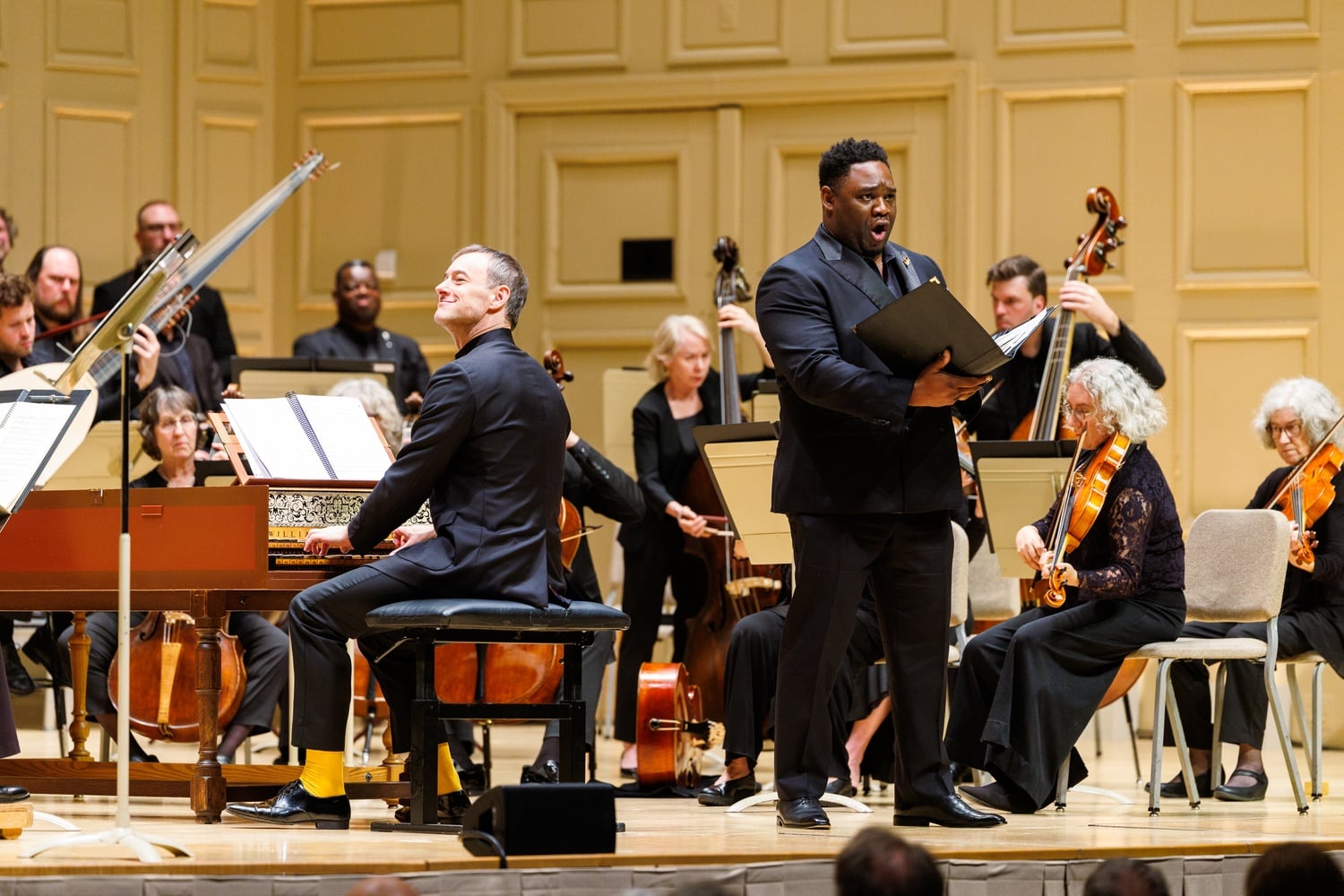
From Oct. 2 to Oct. 4, the Handel and Haydn Society opened its 212th season with “The Art of Living,” featuring one of its eponymous composer’s most enigmatic works: Handel’s “L’allegro, il Penseroso ed il Moderato.” A genre-bending piece that incorporates the poetry of John Milton as adapted by George Frideric Handel’s beloved librettist, Charles Jennens, Handel and Haydn’s presentation of “L’allegro” was a feast of profound questions about life expressed through sublime music.
“L’allegro” is by all accounts an unusual work that demands a certain level of audience imagination. For starters, it barely fits into the conventional definition of an “oratorio” — a lengthy choral work, usually of a religious nature, consisting mainly of recitatives, arias, and choruses without any action or scenery. Unlike Handel’s “Messiah,” which has a clearly defined narrative charting the life and death of Christ, and “Saul” (also recently performed by H+H in Oct. 2025), with its iconic biblical figures, “L’allegro” has no defined characters. Only the titular personas of “L’allegro” — loosely translatable as ‘the cheerful man’ — and il Penseroso — ‘the thoughtful man’ — are invoked through the source material of John Milton’s poems of the same name.
Joy and pensiveness are hence not characters on the stage, and neither is il Moderato — ‘the moderate man’ — the final persona in the trinity added by Charles Jennens to reconcile both emotional extremes at Handel’s request. Instead, the poetry in Handel’s work is broadly meditative, universal, and unfettered, posing open questions to its audience about what kind of person one wants to be.
That was exactly Lecolion Washington Jr.’s perspective as the new president and CEO of H+H. In the programme notes of the evening, as well as his special pre-concert appearance onstage, Washington encouraged audiences to hear more than the resplendent music of the H+H ensemble. Instead, he encouraged listeners to consider how the music connects to one’s life and way of moving through the world.
In H+H’s presentation of “L’allegro,” this approach was abetted by the contribution of Massachusetts Poet Laureate and spoken word artist Regie Gibson, who introduced both halves of the work with his clever wordplay and ekphrastic musings. Especially when dealing with Milton/Jennens’ florid (and yet unquestionably dated) poetry, Gibson’s own words helped to frame Handel’s work in more contemporary, interactive parlance. Speaking to the maddening balance between the extremes in art and life, Gibson’s own poetry was undoubtedly a breath of fresh air into Handel’s literary and musical paradigm.
The vocal soloists of the evening also moved seamlessly between the personas, passing each one off to one another in a virtuosic display of vocal and human emotional range. Tenor Paul Appleby garnered audience chuckles with his whimsical, cavalier attitude as he often embodied the role of “L’allegro,” though this belied his expressive voice and superb diction. He led one of the evening’s most memorable moments, the aria “Haste thee nymph” which word-painted in absolute abandon (on “ha”s of laughter) with an un-Handelian slip of composure. This number also showed the strengths of the chorus, which was throughout the evening in excellent form with its rich, brilliant tone.
Two members of the H+H chorus also had brief solo appearances during the concert. Sopranos Sarah Vitale and Sonja DuToit Tengblad delighted the audience with their colourful voices, holding their own against the other soloists of the evening. Tengblad especially shone in the aria “Or let the merry bells,” accompanied by a rare but well-appreciated carillon. Bass-baritone Michael Sumuel was also a brilliant presence, with his self-possessed, hefty instrument that never wavered in control. This ability was exemplified in another gem of Handel’s word-setting and solo-chorus writing, “Populous Cities,” a paean to what London must have been like to Handel and his inspired contemporaries.
Nevertheless, soprano Joélle Harvey was the vocal highlight of the evening. With a substantial number of solo arias and recitatives, Harvey took each stanza of poetry to expressive heights, showing off her flawless technique with her threading and spinning endless pianissimos both on her own and in counterpoint to her colleagues, especially Appleby in their duet “As steals the morn.” Flutist Joseph Monticello also made a wonderful duet partner in the aria “Sweet bird,” with Harvey’s impeccable trills in perfect mimicry with Monticello’s ornaments and dynamics.
The evening of “The Art of Living” was a highly enjoyable one, suspended in the beauty of the human voice and delicious metaphysical musings about human existence. H+H, with its renewed commitment to making classical music meaningful and aesthetically accessible to diverse audiences, accomplished the performance of Handel’s tricky work with flying colours.
—Staff writer Lara R. Tan can be reached at [email protected].
Want to keep up with breaking news? Subscribe to our email newsletter
Have a tip for The Crimson? Share it confidentially