‘Purpose’ Review: Bursting with Laughter, Drama, and Heart
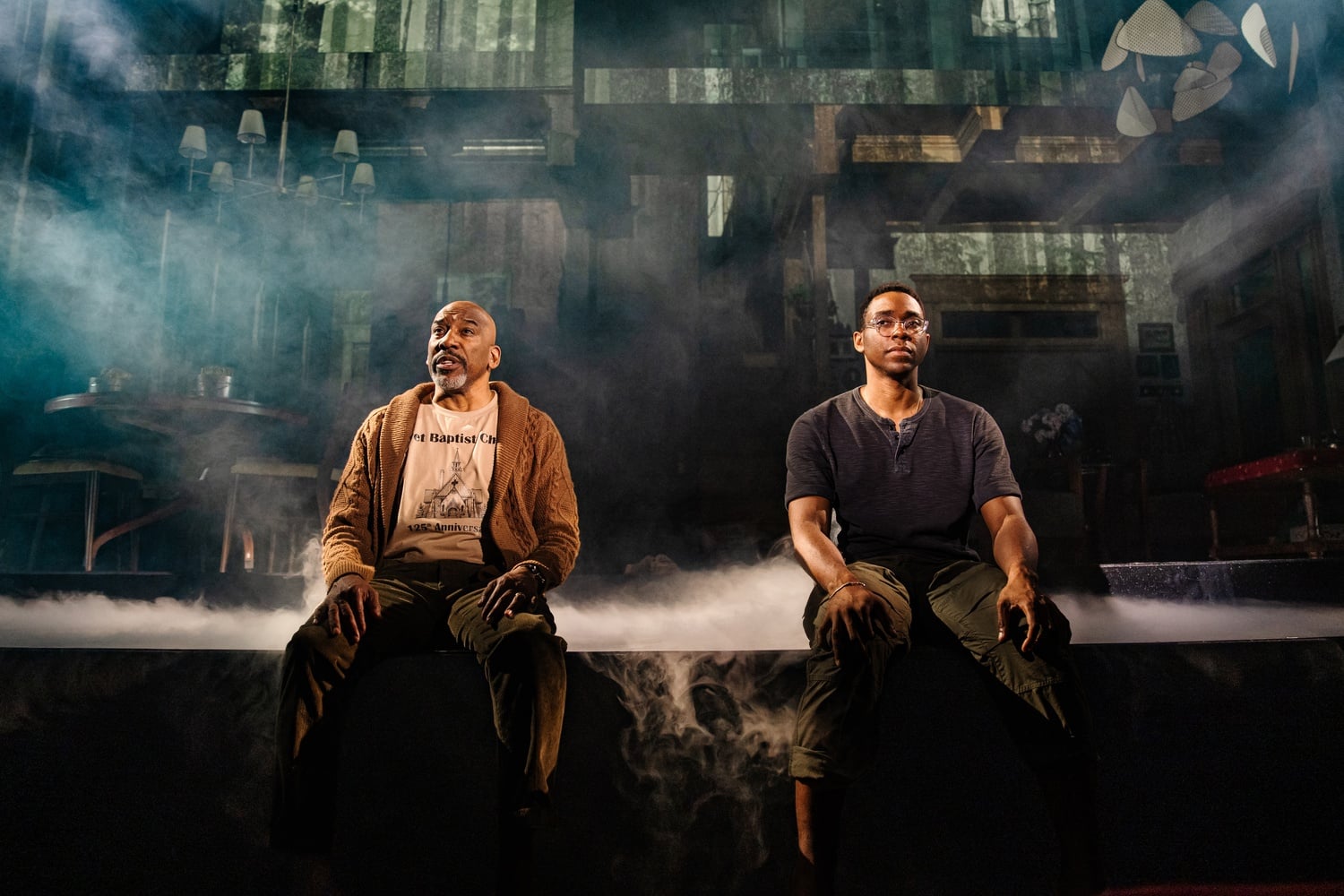
Most families chat about their day-to-day lives while sitting around the dinner table. But for the Jasper family, whose oldest son has returned from a stint in prison, youngest son has dropped out of divinity school to become a photographer, and whose parents frequently dined with the likes of Rosa Parks, there are much more pressing topics to discuss.
“Purpose” is the six-person, nearly three-hour play written by Branden Jacobs-Jenkins and directed by Josiah Davis. Fresh off the heels of the 2025 Pulitzer Prize for Drama and 2025 Tony Award for Best Play, the production is captivating, moving, and at points, hilarious. “Purpose” ran through The Huntington Theatre series at Calderwood Pavilion from Sept. 10 through Oct. 11.
The production is narrated by Nazareth “Naz” Jasper (Omari K. Chancellor) and set during a Chicago snowstorm. Naz’s parents Claudine (Phyllis Yvonne Stickney) and Solomon Jasper (Ezra Knight), older brother Solomon “Junior” Jasper (Ugo Chukwu), sister-in-law Morgan (MarHadoo Effeh), and Naz’s friend Aziza (Kalyne Ashley Coleman) — a surprise guest — have all gathered to celebrate Junior’s homecoming from prison when the blizzard prevents them from leaving the house.
Each of the actors truly embodied their character, creating an atmosphere that allowed one to forget where they were seated and become a fly — or given the play’s recurring motif, a bee — on the wall. In a production that could easily have become a cast of six caricatures, every character — especially Aziza, who also serves as a plot trope — was nuanced and emotionally complex.
The set is a detailed recreation of a cozy two-story Chicago home, and scenic designer Se Hyun Oh used clever tricks to create an illusion of an abode far larger than the Calderwood Pavillion stage. When characters entered the backstage “kitchen” during the performance, sounds of clattering plates echoed through the theater, achieved by sound designer Kathy Ruvuna. Additionally, the door to the “basement” had a hallway adorned with hanging hammers and other tools, a small touch that subliminally informed audiences about the characters’ lives and habits.
Both the set and the performances had no shortage of details. The Jaspers’ upright piano held a shrine to Dr. Martin Luther King Jr., complete with backlighting for the portrait and African-inspired masks. As parents Claudine and Solomon, Stickney’s specific shuffle across the stage and Knight’s humorous squint at a cellphone made the characters feel expressly parental.
Writing the play, Jacobs-Jenkins was inspired by the life of Jesse Jackson, a Civil Rights leader and baptist minister who passed away earlier this year. Though a widely respected and celebrated figure, Jackson’s life was swirled with rumors of infidelity and shady financial decisions involving his son and political protege, Jesse Jackson Jr.
The drama during “Purpose” closely mirrored that of Jackson’s life, offering a glimpse into Black American politics, generational divides, and what it means to keep fighting for social justice in today’s world. In America’s polarized political climate, “Purpose” shed light onto the often overlooked tensions that arise between the old and new guards of liberal Black changemakers.
“Purpose” was punctuated with snapshot-like freeze frames, seamlessly weaving Naz’s photographer instincts into the storytelling. The camera clicks, the houseguests pause midsentence, and Chancellor injects a humorous quip or delightful prose into the scene, a useful and natural device to keep the audience up to speed on the deluge of familial crises that carry the show.
The show was ripe with both passionate monologues and flowing conversations that have a seemingly endless amount of twists, turns, and the occasional major bombshell. In a standout moment, Effeh delivered a heartwrenching tirade about the pitfalls of marrying into the Jasper family that kept the audience’s breath at bay.
Despite the drama, “Purpose” touched on a number of meaningful issues, creating a striking social commentary that didn’t feel tired. Though the family’s dynamics were messy, the characters’ behavior was underscored by the social pressures of intersectional identities which conflict and mesh in intriguing ways. How do you exist as a “famous Black,” for instance, or reconcile being a queer, neurodivergent son of a traditionally-minded pastor?
The show’s staging, conversely, detracted from the storyline at times. Though slightly less realistic, The Huntington’s “Purpose” may have benefitted from a table arrangement reminiscent of Leonardo da Vinci’s “The Last Supper”, as Chancellor’s back was facing the audience for significant portions of the show. To combat this, Chancellor glided across the stage on a rolling swivel stool, a simple directorial choice that helped animate the relatively static set.
The other actors’ facial expressions also more than made up for this lack of visibility. Although she had few lines during the dinner scene, Coleman was magnetic as her expectations of dining with her heroes of American history shattered before her.
Though the snowstorm let up and the curtains drew to a close, The Huntington’s “Purpose” is sure to stick with audiences. With its elaborate set design, effective situational comedy, and intense acting, “Purpose” was a resonant reminder to love one another in the face of fallibility.
“Purpose” ran at the Calderwood Pavilion from Sept. 10 to Oct. 11.
—Staff writer Avani I. Shah-Lipman can be reached at [email protected].
Want to keep up with breaking news? Subscribe to our email newsletter
Have a tip for The Crimson? Share it confidentially