From NYFW: PUBLIC SERV-CE Explores Overlap Between Music and Fashion
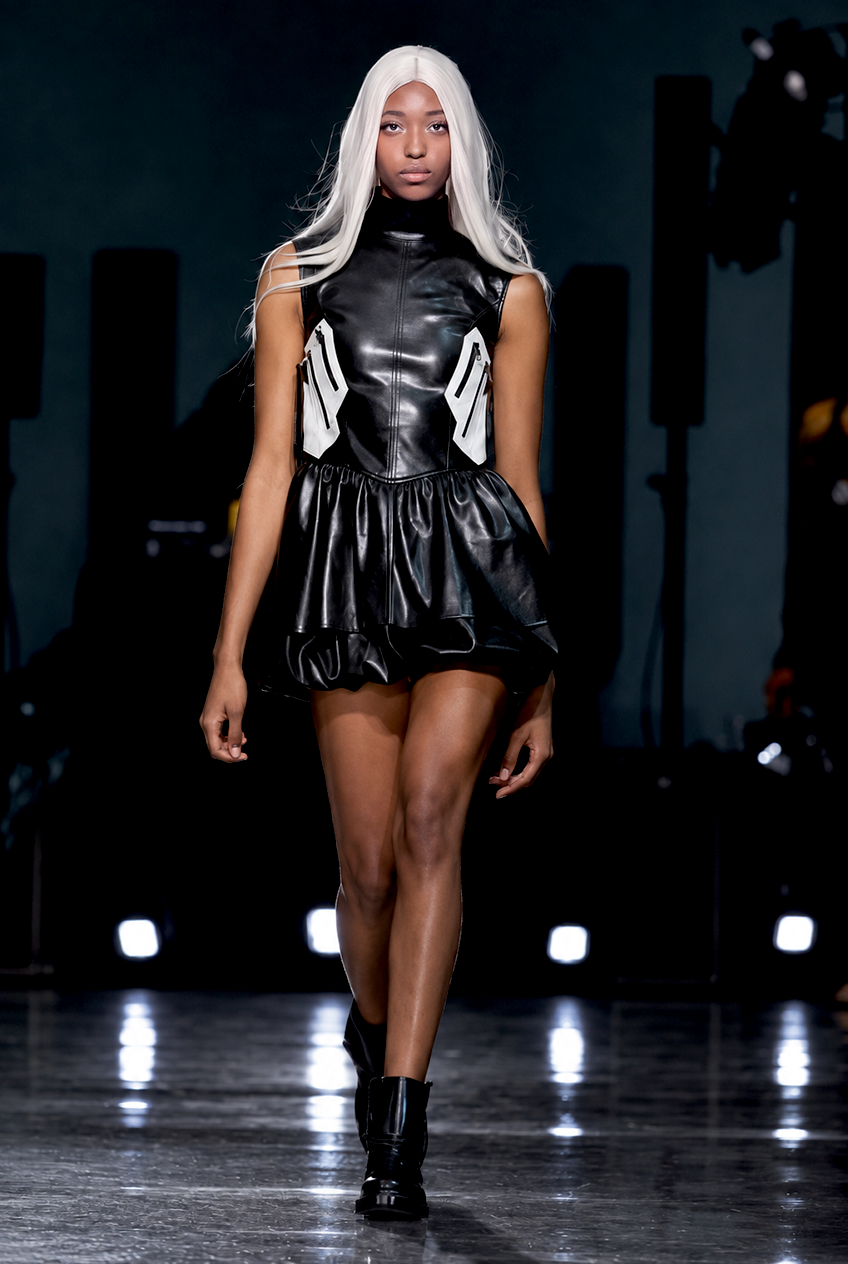
On Sept. 13, emerging fashion house PUBLIC SERV-CE held their Spring/Summer 2027 New York Fashion Week runway at the Arte Museum in Chelsea, New York City. Titled “THE REST IS NOISE,” the show featured futuristic streetwear designed by Raphael Young as well as the brand’s own EDM soundtracks. Before the show began, attendees were allowed to freely explore the museum’s immersive digital art exhibition. The kaleidoscopic projections alongside live DJ Jnr Choi’s mesmerizing beats heightened the mood, creating an atmosphere that was both visually and sonically stimulating. This multisensory experience set high expectations for the collection, which — while ambitious in its theme of industrial design — did not always match the energy of its surroundings.
Born in South Korea, PUBLIC SERV-CE creative director Raphael Young started out as a footwear designer. He has previously collaborated with labels such as Louise Goldin and Raoul, in addition to taking up leadership roles at Off-White and Jil Sander. In this particular collection, Young and his team focused on cohesive yet surreal silhouettes that could have come straight from the worlds of Roblox or Star Trek. For instance, model Femka Abinet wore an oversized bomber jacket with even more colossal sleeves. The ruched detail ran from her shoulders all the way to her waist, aligning perfectly with shiny leather panels on the sides of her bodysuit. Similarly, multiple variations of a sweater were sent down the runway, each evoking a sense of borrowedness through elongated sleeves that completely covered the models’ hands.
Additionally, PUBLIC SERV-CE incorporated grungy patterns into their clothing, resulting in a roughness around the fabrics’ edges that matched with the brand’s overall rebellious aesthetic. One of the sweaters mentioned above served as a designer’s canvas — smudged black streaks of dye interrupted a solid watermelon-pink background, a visualization of radio static. Another example is The League co-founder Ron Abaekobe’s outfit: He wore a beige set consisting of a sleeveless utility vest and wide cargo trousers. Large pockets covered both pieces, while the irregular dye pattern resembled oil stains. This gave the outfit a rugged quality reminiscent of both traipsing through sand dunes and working as a mechanic.
Two top looks in the collection were worn by musical artists, emphasizing PUBLIC SERV-CE’s interest in how the fashion and music industries overlap. DJ Jnr Choi stepped out in a voluminous black trench with a flipped-up collar that resembled a vampire’s cloak. The sleeve-ruching motif reappeared on the coat, which was left unzipped to reveal zigzag quilting running down the center. Meanwhile, American rapper Fivio Foreign donned a floor-length jacket in a shocking shade of red, with large flaps extending across his shoulders. Made from what appeared to be windbreaker material, the jacket had an unusual inflatable quality. Both musicians’ outfits conveyed a sense of visual loudness, tying the collection back to the theme, “THE REST IS NOISE.”
Although PUBLIC SERV-CE embraced a bold and distinctive aesthetic, the collection occasionally felt repetitive. The leather jackets and sweaters, in particular, became monotonous as they all shared the same lengthened sleeves and slouchy shape. The only variation between some pieces was perhaps the color — even graphic design was kept constant. For example, multiple designs included an image of a pair of red headphones, alluding to noise and the human sense of hearing. Unfortunately, what started as a signature gradually became a less intriguing default. Furthermore, due to the long walkway, models were spaced far apart and the audience had more time to notice the repeated elements.
Furthermore, the collection seemed to be overly focused on promoting brand identity, distracting the audience from design details. The words “HOUSE OF PUBLIC SERV-CE” were printed on almost all of the outerwear. This declaration reinforced the brand’s individualism, yet overshadowed unique elements such as the cracked paint texture on a sweatshirt that Foreign wore. Rather than being able to zoom in on the surface treatment of fabric, the audience’s attention is immediately drawn to the bolded text. Singer-songwriter Bryant Barnes wore a grey and white zip-up lined with angular ridges that evoked the suit of a cyborg. However, with “HOUSE OF PUBLIC SERV-CE” written across his chest and split awkwardly down the middle by the zipper, the placement of the lettering was consequently disrupted by the inventive aspects of the piece, reducing it to a vehicle for brand recognition.
PUBLIC SERV-CE successfully translated the theme of “THE REST IS NOISE” into striking textures and structural motifs, creating a multisensory runway experience. However, the collection’s repeated silhouettes and persistent branding sometimes overshadowed the creativity within individual garments. Despite these shortcomings, the collection demonstrated PUBLIC SERV-CE’s ability to establish a distinctive visual identity and merge fashion with music and contemporary culture.
—Staff Writer Sophie Tung can be reached at [email protected].
Want to keep up with breaking news? Subscribe to our email newsletter
Have a tip for The Crimson? Share it confidentially