Wellesley College President Paula Johnson Pushes Universities to Foreground Civic Duty in Fifth Annual MLK Lecture
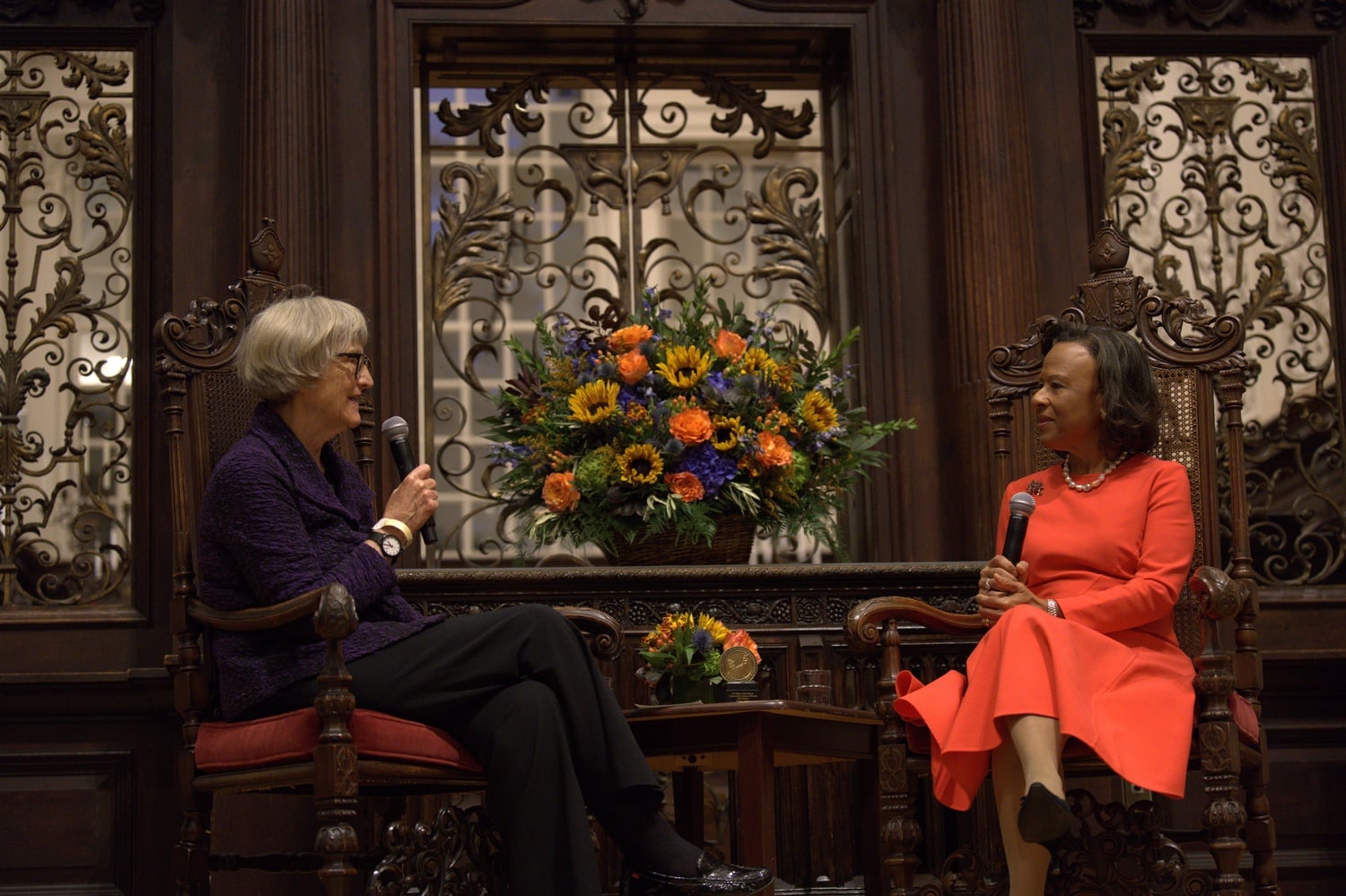
Wellesley College President Paula A. Johnson ’80 said Thursday that universities were “falling short” of their obligation to cultivate civic responsibility in students during this year’s annual Dr. Martin Luther King Jr. Commemorative Lecture.
Johnson made the case to hundreds of Harvard affiliates at Memorial Church that universities could not rely on their diversity alone to facilitate civic engagement and needed to actively push students to engage thoughtfully with one another.
“Bringing people together in the same college or university is not the same thing as creating understanding and connection,” Johnson said. “The fact of diversity does not alone create democratic capacity.”
The event, now in its fifth year, honored Johnson for her commitment to upholding King’s values and ideals. Prior honorees include Ford Foundation president Darren Walker and civil rights scholar Sherrilyn Ifill. Johnson’s address was followed by a moderated discussion with former Harvard President Drew G. Faust.
Appealing to King’s idea of democratic capacity, Johnson argued that there was an “urgent need” for universities to prioritize civic values and civil discourse in what she called “an age of rapid technological advances and political fragmentation.”
“I’ve witnessed the growing discomfort of students and faculty sharing their views,” said Johnson, who has served as Wellesley’s president since 2016. “I’ve observed the consequences of a focus on service without corresponding emphasis on citizenship or civic purpose.”
Harvard President Alan M. Garber ’76 has championed open inquiry at the University since he took office in 2024, responding to widespread criticism that Harvard struggled to facilitate disagreement across ideological lines.
Get The Crimson in your inbox.
Garber introduced Johnson on Thursday, and Johnson in turn praised Garber for his leadership in the face of “challenging forces,” though she did not explicitly mention the University’s ongoing stand-off with the federal government.
“During the past two years, Harvard has faced challenging forces with bravery, fortitude, and resilience,” Johnson said to wide applause. “President Garber, you have helped to preserve our freedom throughout the academy. Thank you for your courage and for your strong leadership.”
But Johnson suggested that universities more broadly had lost sight of their democratic obligations and instead become a transactional “economic endeavor” for students. She proposed three ways for universities to rebuild democratic capacity: prioritizing character, pushing students to think about their place in history, and forcing students to engage across differences.
“I believe deeply in the power of democracy, and I believe that we must make its centrality explicit in the education we provide,” Johnson said.
“Doing so requires us to look beyond the concerns of the day, to take risks in an unfavoring and unforgiving environment, and to give our students the best tools to seize the promise of democracy and to fulfill their unlimited potential to preserve its future,” she added.
Johnson said such work was underway at Wellesley, citing the Clinton Fellows Program, a civic training initiative that is open to all Wellesley sophomores. She also pointed to a recent effort to reframe Wellesley’s honor code through faculty-led discussions with freshmen about honor, integrity, and respect on campus.
“It makes me very hopeful because I think there is a hunger for our students today to actually learn more and to contribute,” Johnson said.
Though Johnson acknowledged that universities “have not fulfilled” King’s vision for higher education, she said she was eager to continue the work.
“I know many of us here today know doubts about whether or how our colleges and universities might meet the test,” Johnson said. “But never have I believed more than now that it is the most important work that we have to do.”
Want to keep up with breaking news? Subscribe to our email newsletter
Have a tip for The Crimson? Share it confidentially