Poise and Power: Boston Philharmonic Opens Its Final Season With Beethoven and Brahms
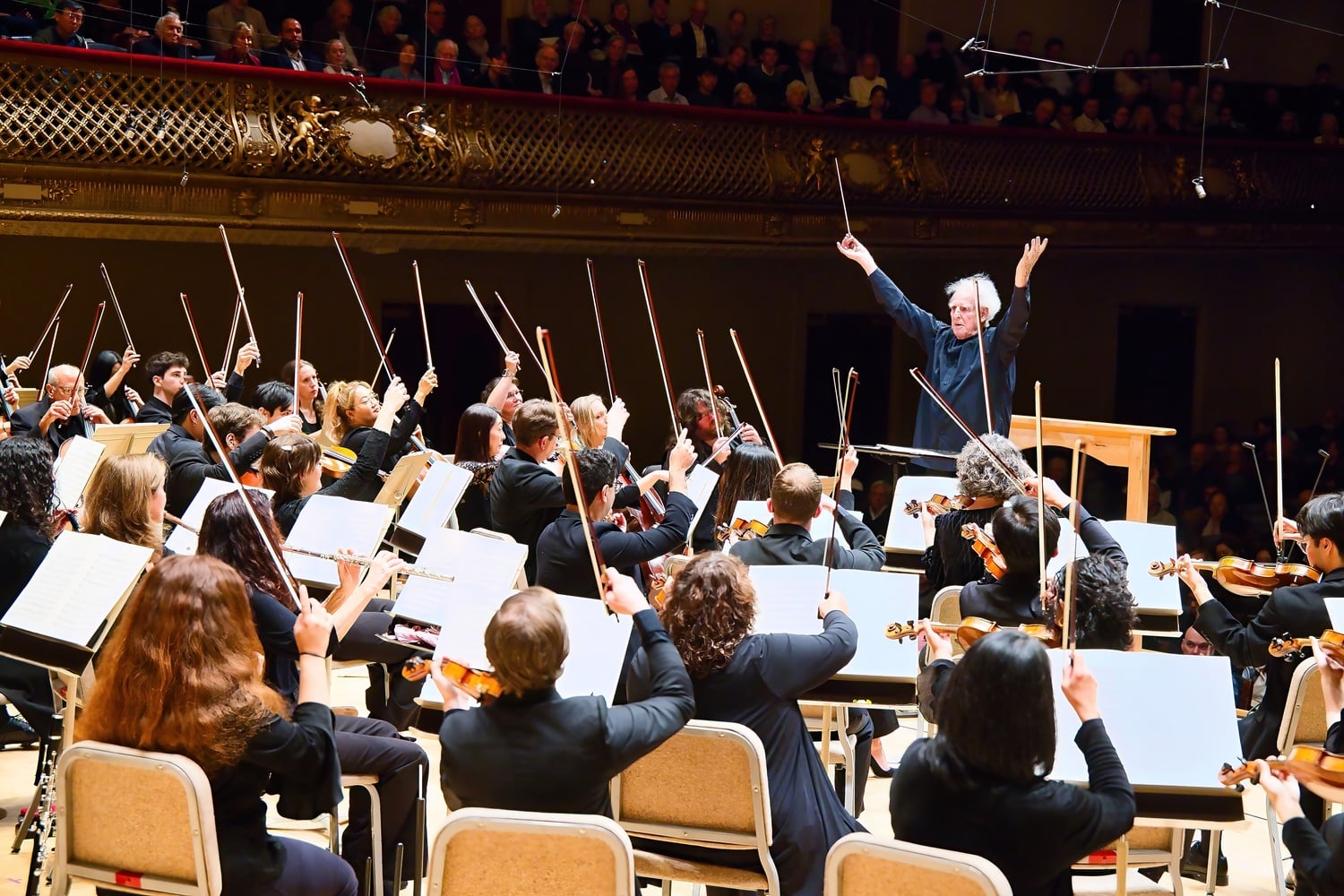
On Oct. 11, the Boston Philharmonic Orchestra opened its 48th and final season at Symphony Hall, performing Weber’s overture to “Der Freischütz,” Beethoven’s Violin Concerto in D, and Brahms’s Symphony No. 4 under the direction of conductor Benjamin Zander.
Zander founded the BPO in 1979 and its youth orchestra in 2012. The 2026–27 season will be the last for both ensembles due to Zander’s impending retirement. In the program note, he described the season’s repertoire as “desert island pieces,” and the ones he likes coming back to “for joy and sustenance.” Indeed, the program reflected that idea as each piece harked back to the German Romantic canon that has been central to the identity of the BPO since its founding.
Weber’s “Der Freischütz” overture — which draws its themes from the opera of the same name — was a fitting opener. It began with a slow introduction in which paired horns called back and forth, and the timpani entered with a suspenseful roll at a marked pianissimo. Zander’s conducting treated the piece as a study in contrast — the shift from the hushed introduction to the clamor of the trumpets in the main section established the dynamic range the orchestra would draw on for the rest of the concert.
Violinist Guy Braunstein then took the stage for Beethoven’s Violin Concerto in D. The concerto opened with five timpani strokes, a rhythmic motif that returned throughout the first movement. Braunstein became the youngest concertmaster in the history of the Berlin Philharmonic in 2000, and his orchestral background was evident in how he handled the work’s many passages where the solo line accompanies the ensemble rather than leading it. His cadenza ended with the soloist stating the second theme outright, a detail Beethoven built into the movement.
During his encore, Braunstein gave a heartfelt speech thanking Zander, then said, “I know you are waiting for Brahms after the break. How about Brahms before the break?”
He launched into the Hungarian Dance No. 6, which Brahms originally wrote for piano four hands and which Braunstein performed in a version for solo violin. Arranging is central to Braunstein’s work as a musician, and the piece, with its abrupt shifts of tempo and character, suited the format well.
After the intermission came Brahms’ Symphony No. 4, and the orchestra played it with the assurance of an ensemble that knows the piece well. The BPO’s program notes that this was its seventh performance of the symphony in Boston over the past 50 years. That experience was audible. The work opens in medias res, poised between C major and E minor. Zander took the first movement at a driving pace, and the sonata-form structure remained easy to follow. The Andante moderato with its Phrygian inflections, and the Allegro giocoso, a scherzo-like movement in 2/4, gave the horns and woodwinds their most prominent solos.
Zander’s pacing must be commended. Brahms’ symphony moved through sharp changes in mood, yet he kept the orchestra together through each movement without letting the energy drop once. The final movement, consisting of 30 continuous variations and a coda, registered as a single continuous arc, while the ending in E minor was delivered without any softening of the symphony’s tragic conclusion.
Together, the three works traced a clear line from Weber’s early Romanticism, through Beethoven’s expansion of the concerto form, to Brahms’s late synthesis of Classical structure and Baroque technique.
The Boston Philharmonic Orchestra still has several large works still ahead. The season will continue with Schubert’s “Unfinished” Symphony and Bruckner’s Fifth on Nov. 22, Beethoven’s Symphony No. 9 on Feb. 14, and Mahler’s Symphony No. 9 on April 11. If the opening concert is any indication, the final season will offer Boston audiences an emotional and fitting farewell.
—Staff writer Maya Y. Koreth can be reached at [email protected].
Want to keep up with breaking news? Subscribe to our email newsletter
Have a tip for The Crimson? Share it confidentially