Hundreds Weigh In on Cambridge Proposals to Boycott, Divest From Companies Tied to Israel
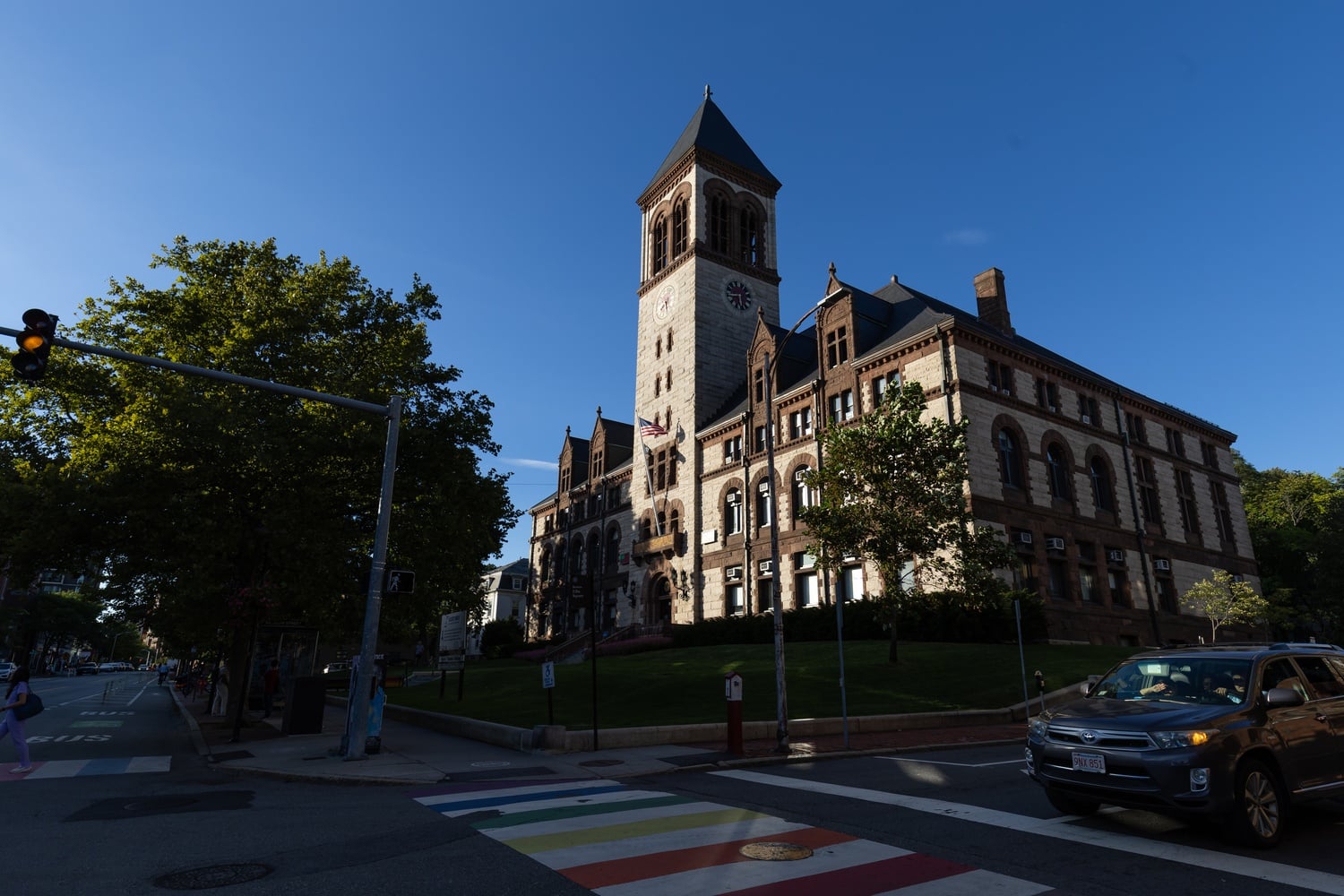
The Cambridge City Council is weighing two orders to boycott and divest from companies tied to Israel — sparking a contentious six-hour marathon of public comment Monday night as nearly 300 residents lined up to speak on the proposals.
The orders, introduced by Councilors Ayah A. Al-Zubi ’23 and Jivan G. Sobrinho-Wheeler, specifically call for the City Council to pull investments from companies “complicit in the genocide, apartheid, and occupation of Palestinians” and asked the city solicitor to determine whether the city could legally boycott the companies on the same grounds.
The meeting is the first to stretch longer than five hours since the Council implemented a 10 p.m. cutoff in June. But with 352 people registered to speak, the Council voted 7-2 to allow the meeting to run long in order to hear every resident in one session.
Of those registered, more than 260 spoke to the two orders. And the crowd was divided, with roughly 165 in support and more than 100 opposed.
Monday’s meeting only included public comment, and the Council recessed just before midnight without weighing any of the agenda items. The meeting resumed at 9 a.m. Tuesday — and both orders were tabled in less than half an hour.
Vice Mayor Burhan Azeem and Councilor Patricia M. “Patty” Nolan exercised their charter right to punt discussion on both orders to a future meeting. While a regular meeting is not scheduled for the Council again until Nov. 2, Mayor Sumbul Siddiqui suggested the city may call a special meeting to address the orders sooner.
Nolan expressed concern with passing city policies that “single out one country” and should be reworked to “be just and fair and include all problematic companies.” She instead advocated for a policy order that asks for a review of all funds linked to “countries or organizations tied to terror or war crimes.”
The divestment order cites a report from Cambridge for Palestine, which identified nearly $24 million in the city’s pension fund and Other Post-Employment Benefits Trust Fund tied to companies named on the American Friends Service Committee Divestment Shortlist for “having severe and consistent involvement directly contributing to genocide, apartheid, and occupation of Palestinians.”
The report lists $2.6 million invested in Palantir and $18.2 million invested in weapons manufacturers — including Elbit Systems and defense contractor Lockheed Martin — from the pension fund. It also named another $3 million from the OPEB Trust Fund invested in GE Aerospace, which provides engines used in Israeli military aircraft, including for Boeing and Lockheed Martin.
In the policy order, Al-Zubi and Sobrinho-Wheeler argued that divesting from these companies would have little impact on the city’s overall pension fund — noting that the investments in companies identified by AFSC make up for only about one percent of the fund.
Get The Crimson in your inbox.
The policy order, if approved, would require both the pension fund and OPEB Trust Fund to divest from companies identified by AFSC and refrain from investing in the companies in the future. It would also add language to the city’s investment policy to “ensure that no investment of City funds shall be made in investment portfolios that have any exposure to companies with severe and consistent involvement directly contributing to genocide, apartheid, and occupation of Palestinians, where a permitted alternative is available.”
The councilors also noted in their orders that Cambridge residents had brought forward concerns over additional city ties to companies linked to Israel’s ongoing military campaign in Gaza and the West Bank, asking the city manager and city solicitor to evaluate the legality of instituting an ordinance to boycott these companies under federal law.
The boycott order specifically lists the city’s contracts with Motorola Solutions, which they wrote has provided “essential infrastructure used in illegal Israeli settlements and prisons.” If approved, the councilors’ order would refer the proposed ordinance to the Ordinance Committee for further discussion.
Many of the residents who opposed the boycott and divestment orders argued the city should not get involved in an international conflict, and several argued that divesting from Israel could be seen as antisemitic. Multiple residents who spoke against the proposals also pointed to a petition circulating among residents to urge the Council to vote against the orders, which they said has already gained more than 650 signatures.
Other residents encouraged the city to invest locally rather than in large corporations tied to weapons manufacturing, with many arguing that the city’s monetary investments are reflective of its values.
State Rep. Mike L. Connolly, speaking in public comment, expressed support for the proposals and urged Cambridge to follow Somerville’s lead in supporting divestment.
“I encourage you to prohibit city investments and contracts with companies that sustain Israel’s genocide, apartheid, and illegal occupation of Palestine,” Connolly said. “Last year, Somerville voters expressed strong support for this policy, and I hope we can work together here in Cambridge to take this meaningful stand as well.”
Somerville residents backed a nonbinding ballot question in 2025 to divest from companies linked to Israel, and Somerville City Councilors introduced a draft ordinance to divest in June. A Council committee is set to discuss the ordinance again on Oct. 27 before it moves to a vote.
In Tuesday’s meeting, Azeem said that he found residents’ comments “deeply moving,” and said the divestment order as written “leaves place for better language” — arguing the city should avoid international affairs.
“I’ve said before that I don’t think we should get involved in foreign policy, and I do still think that. I just do not believe that we should have engaged in foreign policy for this whole time, and then draw the line right now at this moment on the topic of Israel and Palestine,” Azeem said. “That doesn’t sit right by me, and so perhaps something we can revisit in the future.”
This is not the first time Cambridge has grappled with whether to leverage its financial investments to take a stand on international conflicts. In 1980, the Council voted to divest from companies doing business in Apartheid-era South Africa. In 2021, the Council also voted to end contracts with companies that “perpetuate violations of International Human Rights Laws,” but amended the order to omit mentions of alleged Israeli apartheid before passing it.
—Staff writer Samuel Ruiz-Macias can be reached at [email protected].
—Staff writer Maya Fu can be reached at [email protected].
Want to keep up with breaking news? Subscribe to our email newsletter
Have a tip for The Crimson? Share it confidentially